
Every freeze-thaw cycle across the Midwest pulls more soil out from under driveways, warehouse floors, and sidewalks.
Tearing out and repouring that concrete costs weeks of downtime and thousands of dollars.
Polyjacking corrects the same settlement in hours, and our analysis suggests it should be the first option you price for sunken slabs.
Key Takeaways
- Cost-effective repair: Lifting the existing slab avoids full demolition and replacement, which is the most expensive path in concrete repair.
- Fast return to service: The foam cures quickly, so surfaces are usable within a few hours.
- Greener material: Polyurethane foam contains 39–49% renewable and recycled materials.
Construction Project Risk Assessment Impact Probability Levels for Precast Crews
What Is Polyjacking, Exactly?
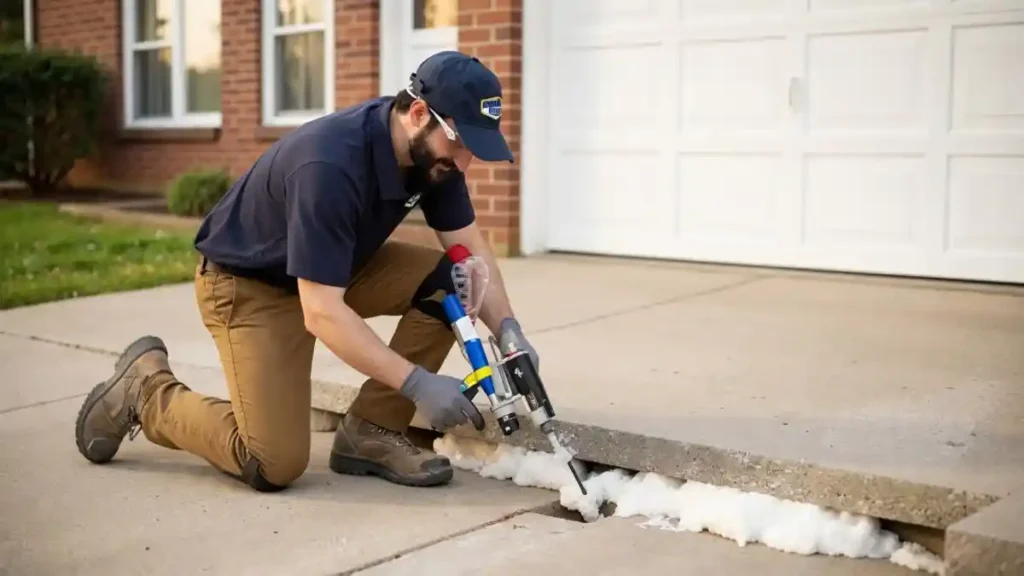
It is a slab-lifting method that injects high-density geo-technical foam beneath settled concrete.
According to The Constructor, crews drill ⅝” holes through the slab and pump polyurethane foam into the voids below.
The foam expands up to 7 feet under each hole, filling gaps and raising the slab back to grade.
You will also hear it called polyurethane concrete lifting or polylift. Our contractors note the same core benefit under every name.
The slab stays in place and keeps its compressive strength and structural integrity.
If you’ve been following construction technology trends across the Midwest, this won’t come as a surprise.
Our region’s expansive clay soils and deep frost lines create exactly the kind of voids this foam is built to fill.
Check your site’s soil profile in the USDA Web Soil Survey before you quote any lift.
What Makes Polyjacking Different From Mudjacking?
The difference comes down to the fill material. Mudjacking pumps a heavy mud or cement slurry under the slab.
Foam replaces that slurry with a lightweight, permanent fill.
| Factor | Polyjacking | Mudjacking |
|---|---|---|
| Material | High-density geo-technical polyurethane foam | Mud or cement-based slurry |
| Hole Size | Small ⅝” holes, fewer required | Larger holes, more required |
| Longevity | Does not break down over time | Slurry can erode and wash out |
| Cure Time | Usable within a few hours | Longer cure before traffic |
| Soil Impact | Lightweight, adds no pressure to soil | Heavy fill adds load to soil |
| Eco-Friendliness | 39–49% renewable and recycled content | No recycled-content advantage |
Construction industry insiders are noting the longevity gap most of all. Slurry erodes over time, which sends crews back to the same slab within a few seasons.
Foam stays put.
Where Does It Fit on Your Next Job?
The method works on nearly any flatwork that has settled but has not crumbled.
We found it performs well on these surfaces:
- Sidewalks and walkways
- Residential driveways
- Garage and basement floors
- Office floors
- Warehouses and sports arenas
For public pavement work, the Federal Highway Administration publishes pavement repair and preservation guidance worth reviewing before you bid municipal jobs.
For slab design and repair standards, the American Concrete Institute remains the reference most engineers will ask you about.
Big Stone County Megaproject Data Center Solar Wind Annexation Ortonville Tests Midwest Builders
Polyjacking Cuts Slab Repair Time for Midwest Contractors Polyjacking corrects the same settlement in hours, and our analysis suggests it should be the first option you price for sunken slabs. @CNplus @companyconcrete @poltracking https://t.co/VvjTaVkhjC
— US News (@Us_news_ways) October 28, 2026
How Does the Polyjacking Process Work Step by Step?
A standard lift follows seven steps. Each one depends on the step before it, so do not skip ahead.
- Inspect the slab to measure settlement, map voids, and confirm the concrete is sound enough to lift.
- Drill injection holes at planned intervals using ⅝” bits, which means far fewer and smaller holes than slurry methods require.
- Seat the injection ports tightly in each hole to prevent foam blowback.
- Inject the foam in controlled bursts while you track the lift with a laser level.
- Stop at target grade and let the expanding foam fill the remaining voids.
- Patch and seal the holes, joints, and cracks to block the water that causes future heaves.
- Return the surface to service once the foam cures, typically within a few hours.
Drilling concrete releases respirable dust. Follow OSHA’s crystalline silica standard for dust control on every lift.
B2B Suppliers of Precast Concrete Moulds Manufacturing Rise
What Does This Mean for Midwest Contractors?
Polyjacking turns slab repair from a demolition job into a precision job. Our analysis suggests three practical advantages for your crews:
- Cleaner sites: No concrete or grout splatter during injection.
- Lighter fill: The foam adds no extra load to already weak soil.
- Fewer callbacks: The material does not break down the way slurry does.
The material story matters for clients chasing sustainability goals.
The American Chemistry Council offers technical resources on polyurethane chemistry and safe handling that help you answer owner questions with confidence.
Pair that with the recycled-content figure, and you have a stronger case for foam over slurry.
Property owners benefit too. A lifted driveway or garage floor is back in use the same day, with no weeks of curing and no torn-up landscaping.
Which is often the deciding factor when a homeowner compares quotes.
Start by auditing your current repair backlog. Flag every settled slab that is still structurally intact, then price polyjacking against full replacement before your next bid goes out.