Concrete that sets before it reaches the form is wasted concrete. On tight sites, high-rise decks, and large slabs, placement speed decides whether a pour succeeds or fails.
A concrete pump solves that problem by moving liquid concrete to an exact location before it hardens. That is why placement equipment now shapes project schedules across the Midwest.
Construction Company Proposal and Estimate Closing Rate Problems
Key Takeaways
- Line pumps handle low-volume work like pools, sidewalks, and single-family slabs, while boom pumps manage high-volume pours on high-rise and large-slab projects.
- Following ACI 304.2R and OSHA 29 CFR 1926.700(a) helps reduce blowouts, hose whipping, and placement rework.
- Matching pump type to pour volume and reach can lower labor costs and cut concrete waste on site.
What Does a Concrete Pump Actually Do?
A concrete pump is a mechanical device that transfers liquid concrete by pumping it through a pipe or hose.
It carries the mix from a mixer or batching plant to the placement point.
The goal is simple: get concrete where it needs to go before weather and time turn it into a hard, immovable compound.
Our team observed that most placement failures trace back to reach and volume, not the mix itself.
When a mixer truck cannot get close enough, the wrong equipment forces manual moving, which slows the pour and adds risk.
The right pump removes that bottleneck.
Elon Musk Terafab Construction Plan What It Signals
Which Concrete Pump Types Should You Compare?
The industry works with two main categories. The first is the trailer-mounted pump, also called a line pump.
The second is the boom pump.
A line pump sits on a trailer or truck chassis and requires hoses attached manually to the outlet.
These hoses are made of steel or rubber and link together to lead concrete to the placement point.
Line pumps handle lower volumes, which makes them a practical choice for swimming pools, sidewalks, and single-family home slabs.
A line pump is also the more versatile of the two.
Beyond structural concrete, it can move grout, wet screeds, mortar, shotcrete, foamed concrete, and sludge.
That flexibility helps on jobs where you place several material types across one project.
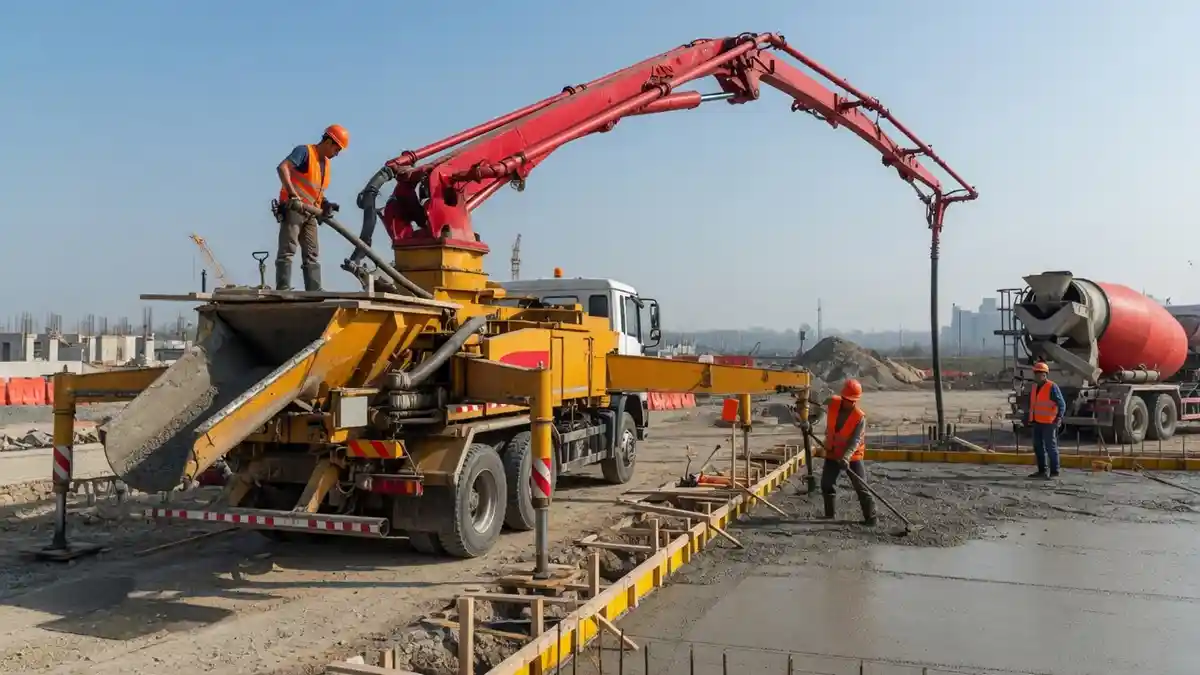
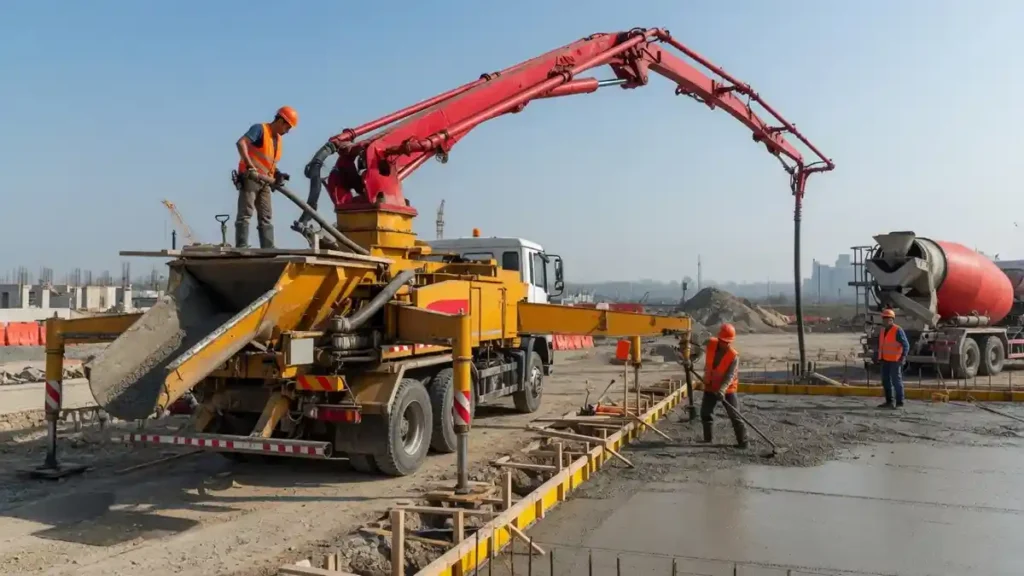
A boom pump attaches to a truck and uses a remote-controlled articulating robotic arm to place concrete with pinpoint accuracy.
It pumps at high volumes, which suits high-rise buildings and large slabs where trucks cannot reach the pour point.
Our contractors note that a boom pump often pays for itself on large jobs through speed alone.
Underpinning Foundation Methods That Work
Concrete Pump Guide the Machine to Your Pour
— US News (@Us_news_ways) August 13, 2026
A concrete pump solves that problem by moving liquid concrete to an exact location before it hardens. That is why placement equipment@Liebherr @SchwingAmerica @Putzmeister https://t.co/gyH0uZnun6
Concrete Pump Comparison Table
| Factor | Line / Trailer Pump | Boom Pump |
|---|---|---|
| Mounting | Trailer or truck chassis | Truck with robotic arm |
| Placement method | Manual steel or rubber hoses | Remote-controlled articulating arm |
| Volume capacity | Lower | High |
| Best-fit projects | Pools, sidewalks, single-family slabs | High-rise, large slabs |
| Material range | Concrete, grout, mortar, shotcrete, screed | Primarily structural concrete |
| Reach | Limited by hose runs | Extended vertical and horizontal reach |
What Makes a Gate Valve Pump Worth Considering?
Some manufacturers offer gate valve operated concrete pumps in low and high pressure options.
These units are built from single-piece casting of high wear-resistance, work-hardening material.
That construction can extend service life on abrasive mixes.
The internal parts matter more than the sales sheet.
A quality unit includes a control housing, Siamese pipe, connection pipe, tapper pipes, and maintenance-free hydraulic cylinders.
We found that the hydraulic cylinder design and heat loss rating tell you more about long-run performance than headline pressure numbers.
Foundation Underpinning Methods That Hold
How Do You Plan a Pump Pour Safely?
Placement by pumping carries real hazards.
The two most common are blowouts, when a pressurized hopper or line ruptures, and hose whipping, when a line thrashes under pressure.
Both are avoidable with proper setup.
Anyone placing concrete by pumping should review ACI 304.2R, the Guide to Placing Concrete by Pumping Methods.
For worker safety, OSHA 29 CFR 1926.700(a) sets the baseline standard for concrete and boom pump truck operations.
Here is a practical sequence our team uses on site:
- Confirm volume and reach. Measure the pour size and the distance to the placement point, then match a line or boom pump to those figures.
- Check the mix design. Verify slump and aggregate size suit the pump and line diameter, since a poor mix can jam the line.
- Prime the system. Run a grout or slurry batch to lubricate the line before concrete moves through.
- Set exclusion zones. Keep crew clear of hose ends and hopper areas to reduce blowout and whipping exposure.
- Monitor pressure during the pour. Watch for pressure spikes that signal a blockage, and stop before a line ruptures.
- Clean immediately after. Flush the line and hopper before residual concrete hardens inside the equipment.
Buildwell Construction Drives Smarter Structural Framing
What Does This Mean for Midwest Contractors?
Pump selection is a scheduling decision, not just an equipment decision. Choose a line pump when volume is modest and the site allows short hose runs.
Choose a boom pump when reach or high volume drives the timeline.
The trade-offs are worth stating plainly:
- Line pump pros: lower cost, material flexibility, easier setup on small sites.
- Line pump cons: limited reach, more manual hose handling, slower on large pours.
- Boom pump pros: high volume, extended reach, faster placement on tall or wide structures.
- Boom pump cons: higher rental cost, larger footprint, more setup space required.
For precast work, placement planning ties directly into connection design.
The PCI Connections Manual helps coordinate cast-in-place pours with precast components, which reduces field surprises.
If you are scoping a pour and are unsure which concrete pump fits, tell us your volume, reach, and site constraints.
We can walk through the trade-offs with you and help you match the machine to the job.