

Freeze-thaw season is weeks away across the Midwest, and that’s when a small crack in basement wall concrete can turn into a leak, a bowed wall, or a costly rebuild.
The type of crack you’re looking at decides whether you spend $75 on a DIY kit or call a structural pro. Here’s how we sort them out on job sites.
Key Takeaways
- Horizontal cracks and any crack wider than ¼ inch (about 6 mm) point to structural trouble and need professional attention fast.
- Hairline, vertical, and diagonal cracks are usually cosmetic, with fixes ranging from $75 DIY kits to $400–$600 for professional injection.
- Wet cracks need fast action, since the CDC advises drying water-damaged areas within 24–48 hours to limit mold growth.
New Bills Compliance Deadlines US States Construction Materials
Why Does Timing Matter So Much Right Now?
Our contractors note that crack calls spike after the first hard freeze. Water in the soil freezes, expands, and presses against below-grade walls near the frost line.
That uneven hydrostatic pressure drives most horizontal cracking in both block and poured foundations. If you’ve been following precast concrete trends across the Midwest, this won’t come as a surprise.
Clay-heavy soils and wide temperature swings keep cast-in-place walls under constant stress. A crack in basement wall sections that looked harmless in August can widen noticeably by March.
Which Crack Types Should Worry You Most?
Our analysis builds on the field-tested breakdown in Renco’s guide to foundation crack types, cross-checked against our own site experience.
Use the table below to match any crack in basement wall concrete or slab to its likely cause and fix.
| Crack Type | Severity | Common Cause | Repair Method | Estimated Cost |
|---|---|---|---|---|
| Horizontal | High | Unbalanced soil, hydrostatic pressure, freeze-thaw | Professional structural repair with reinforcement | Professional quote |
| Stair-Step | High if wider than a quarter | Settlement or outside moisture along mortar joints in block walls | Professional inspection and repair | Professional quote |
| Hairline | Low | Settling and drying in year one | Sealant or crack injection | ~$200 DIY / $400–$600 pro |
| Vertical | Low | Settlement or natural curing | Epoxy or polyurethane injection | $75+ DIY / $400+ pro |
| Diagonal | Low | Curing or settlement, within 30° of vertical | Epoxy injection | $75 DIY / $400+ pro |
| Shrinkage | Low, but radon risk | Moisture loss in the first year | Builder warranty claim or epoxy injection | Often covered by warranty |
| Slab | Low to high | Curing, poor soil compaction, frost heave | Monitor, or professional inspection if wider than hairline | Varies by cause |
| Non-Structural | Low to moderate | Curing, typically 1–2 mm vertical or diagonal | Injection to stop seasonal leaks | $75 DIY / $400+ pro |
| Wet Non-Structural | Moderate | Shrinkage in the first month, overly wet mix | Urethane injection, which expands on contact with water | Professional quote |
| Structural | Severe | Soil pressure, soil shrinkage, temperature movement | Epoxy plus carbon fiber staples or straps | Professional quote |
The quarter test is our quickest field check. If a coin slides into the gap, the crack needs a professional inspection.
The American Concrete Institute’s ACI 224R report lists a tolerable crack width of roughly 0.012 inch (0.30 mm) for concrete exposed to moist soil, which is far tighter than most owners expect.
California Highway 166 Cuyama River Construction Lessons
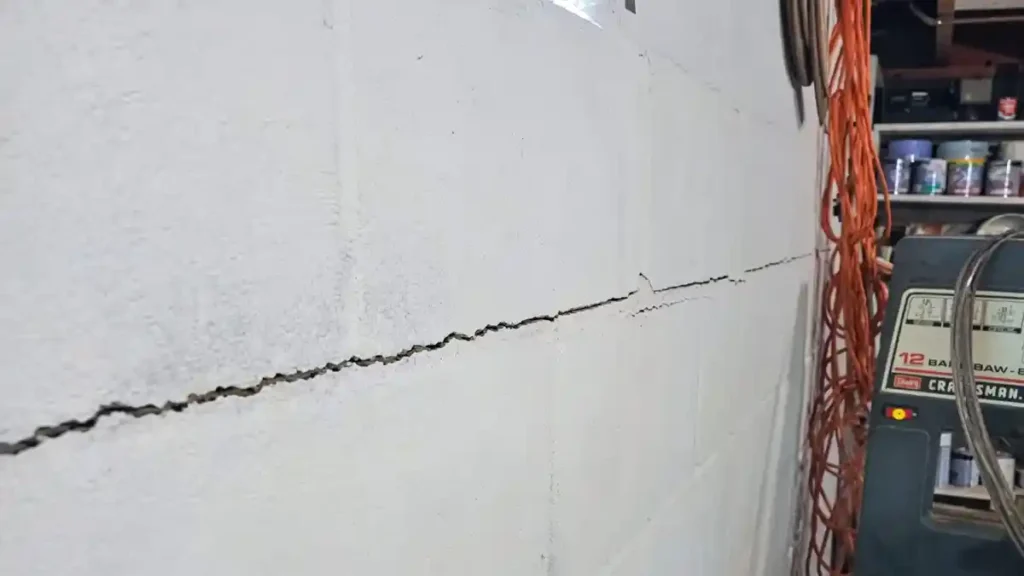
How Should You Assess a Crack in Basement Wall Step by Step?
- Document it: Photograph the crack with a ruler or coin beside it and write down the date.
- Measure the width: Treat anything wider than ¼ inch, or wide enough to fit a quarter, as potentially structural.
- Note the direction: Flag horizontal and stair-step patterns right away, since vertical and diagonal cracks are usually cosmetic.
- Check for moisture: Look for dampness, white mineral deposits, or seepage after rain and snowmelt.
- Check for bowing: Hold a long straightedge or 4-foot level against the wall to spot inward movement.
- Re-inspect in six months: Compare new photos against the originals to see whether the crack has grown.
- Match the repair: Use epoxy or polyurethane for dry cracks, urethane for wet cracks, and carbon fiber reinforcement for structural cracks.
- Call your builder first on new homes: Hairline and shrinkage cracks in year one may be covered under warranty.
What Hidden Risks Come With Moisture and Gas?
Even a non-structural crack in basement wall concrete can let water in during storms and spring melt.
The CDC’s mold guidance recommends keeping indoor humidity below 50% and drying wet areas within 24–48 hours.
Shrinkage cracks raise a second concern.
The EPA notes that radon can enter homes through foundation cracks, so we recommend a low-cost radon test in any basement with open gaps.
Crack in Basement Wall? Decode the 10 Types Fast Freeze-thaw season is weeks away across the Midwest, and that’s when a small crack in basement wall concrete can turn into a leak, a bowed wall… @BobVila @ThisOldHouse @lowesscwv https://t.co/K8O44AG2Hj
— US News (@Us_news_ways) October 28, 2026
What Does This Mean for Midwest Contractors?
Construction industry insiders are noting a steady move toward precast concrete foundation walls on residential and light-commercial builds.
According to the Precast/Prestressed Concrete Institute (PCI), precast panels are cast under plant-controlled conditions with consistent mix design and curing.
Those are the same variables behind most shrinkage and curing cracks in poured walls.
In our experience, a crack in basement wall panels made off-site is far less common for several reasons:
- Controlled water-cement ratios limit the shrinkage that overly wet field mixes cause.
- High-strength mixes, often above 5,000 psi, resist soil and frost pressure.
- Factory curing removes weather swings from the equation.
- Faster installation shortens open-excavation time when rain can saturate backfill.
Scott County Iowa Approved Construction Bond Projects Shift
How Will This Impact Your Next Build?
Every crack in basement wall concrete tells a story about soil, water, and curing. Read that story early, document it carefully, and match the fix to the actual cause.
If you’re planning new construction, talk with your team about precast walls before the first excavator arrives.


