

Your mould sets your tolerances, cycle times, and margins before a single panel leaves the yard.
With the new ACI/PCI 319-25 code raising expectations for structural precast, choosing between b2b suppliers of precast concrete moulds manufacturing is now a schedule decision, not just a purchasing line item.
Key Takeaways
- The Kompass India directory lists 15 suppliers of moulds and shuttering for reinforced and prestressed concrete elements across nine Indian states.
- ACI 117 tolerances and the ACI/PCI 319-25 code make mould accuracy a compliance issue, not a cosmetic one.
- Steel, GRP, and polyurethane (PU) moulds differ sharply in finish, reuse, and lead time, so match the material to your production volume.
North Augusta SC Million Construction Approved Contract Annexation Projects
Who Are the B2B Suppliers of Precast Concrete Moulds Manufacturing?
The supplier pool is wider than most Midwest buyers assume.
The Kompass India B2B directory counts 15 companies under moulds and shuttering for reinforced and prestressed concrete elements.
Those firms operate as manufacturers, distributors, importers, exporters, and service providers, and many hold several roles at once.
Our analysis suggests the most useful filter is the subcategory, not the company count.
The directory groups b2b suppliers of precast concrete moulds manufacturing into these segments:
- Metal moulds for concrete products: 16 listings, the largest segment
- Moulding machines for structural building elements: 8 listings
- Metal moulds for concrete blocks: 5 listings
- Concrete moulding presses: 5 listings
- Metal moulds for prefabricated building units: 4 listings
- Hollow core extruders: 2 listings
Four names stand out for structural work.
New Age Engineering Solutions LLP, which trades as Murta Precast Machines & Moulds, builds vertically cast wall units that integrate structural columns and walls.
Vardhman Infrafab fabricates steel and composite formwork for RCC girders, piers, and pier caps.
SPAN Engineers manufactures and exports steel shuttering, staging, and formwork systems.
Paschal Form Work India pairs GRP formwork with formwork planning software.
Which Mould Type Fits Your Production Line?
Mould material controls finish quality and reuse. Our contractors note that the cheapest mould on the quote is often the most expensive one per cast.
| Mould Type | Best Application | Material | Reuse Potential | Supplier Role (Kompass Examples) |
|---|---|---|---|---|
| Steel moulds | Girders, piers, wall panels | Fabricated steel | High | Manufacturer/exporter (SPAN Engineers, Vardhman Infrafab) |
| Vertical wall moulds | Integrated column-wall units | Steel systems | High | Manufacturer/licensor (New Age Engineering) |
| GRP formwork | Architectural and repetitive shapes | Glass fibre reinforced plastic | Medium | Manufacturer (Paschal Form Work India) |
| PU wetcast moulds | Pavers, blocks, textured units | Polyurethane | Medium | Specialty producers |
| Hollow core extruders | Floor and roof planks | Machine-formed | Continuous | Equipment manufacturers |
Coverage in BFT International of German producer Intexmo shows PU wetcast moulds gaining ground in the concrete block industry.
The appeal is detailed surface texture without heavy steel tooling. Make sure any wetcast option is part of your b2b suppliers of precast concrete moulds manufacturing shortlist if you produce architectural units.
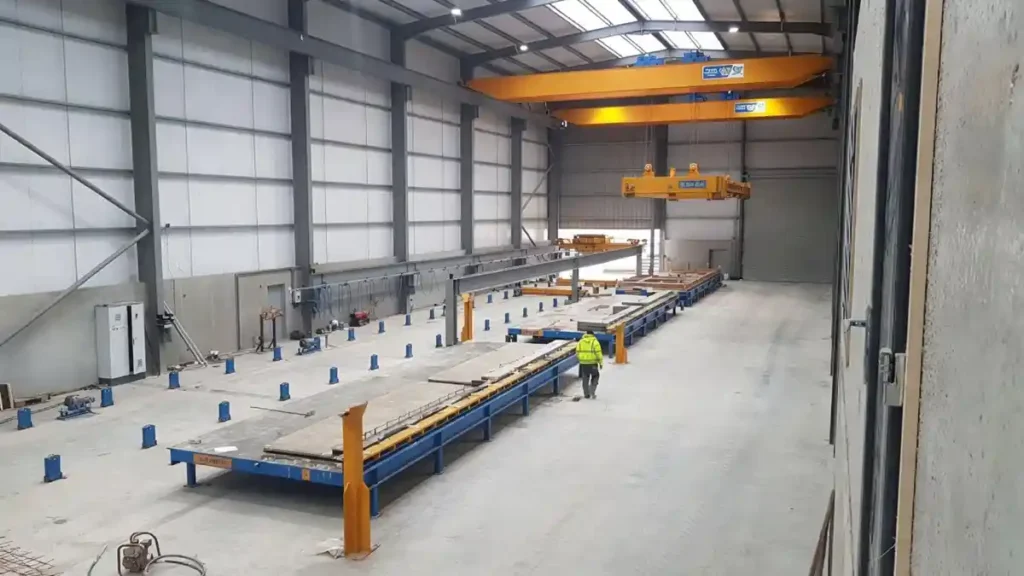
What Standards Should Your Moulds Meet?
Your mould must hold the tolerances your engineer specifies.
The PCI tolerance manual builds on ACI 117 (the standard for concrete construction tolerances), and those limits begin at the form face.
The newer ACI/PCI 319-25, the dedicated building code for structural precast concrete, separates precast requirements from general cast-in-place rules.
Construction industry insiders are noting that this shift puts more scrutiny on fabrication accuracy, including how well a mould holds its shape across repeated pours.
When you request quotes from b2b suppliers of precast concrete moulds manufacturing, ask for dimensional tolerances in writing.
Post and Beam Construction Cloth Hall Lancashire Religious House: Read the Frame
How Do You Vet and Onboard a Mould Supplier?
Vetting comes down to verified capability, not catalog photos.
Follow this sequence:
- Define the element. List dimensions, finish class, concrete grade, and target cycle count.
- Filter by subcategory. Search directories such as Kompass by mould type, not company name.
- Confirm the supplier role. Separate true manufacturers from distributors and resellers.
- Request tolerance data. Ask how the mould meets ACI 117 limits after repeated use.
- Review shop drawings. Check stripping draft, joint locations, and embed and insert placements.
- Order a trial casting. Measure the first piece against PCI tolerances before full production.
- Lock in support terms. Agree on spare parts, repair turnaround, and freight responsibility.
Vetting b2b suppliers of precast concrete moulds manufacturing this way protects both your schedule and your inspection results.
Page County Iowa Megaprojects Construction Expansion Since 2024-02-27: Bid Smarter
B2B Suppliers of Precast Concrete Moulds Manufacturing Rise With the new ACI/PCI 319-25, choosing between b2b suppliers of precast concrete moulds manufacturing… @moldtech @ProgressGrp_Ltd @KVMIntl https://t.co/cqfyi28tkJ
— US News (@Us_news_ways) October 27, 2026
What Does This Mean for Midwest Contractors?
If you’ve been following precast concrete trends across the Midwest, this won’t come as a surprise.
Plants that control mould quality control their delivery dates.
ENR’s ongoing coverage of materials and supply chains reinforces a simple point: lead time is a cost line.
Global sourcing opens the door to specialized tooling, but freight, customs, and repair access belong in your total cost.
Overseas b2b suppliers of precast concrete moulds manufacturing can beat domestic pricing on steel systems, while nearby fabricators win on quick fixes.
Concrete Construction’s field reporting repeatedly ties consistent forms to fewer patch-and-repair hours.
Pull your top three mould types from the table above and run Step 1 of the vetting checklist this week.