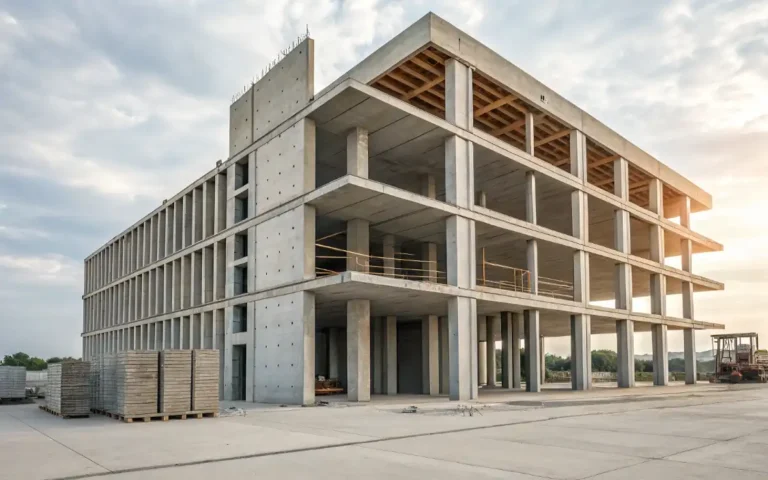

Unprecedented e-commerce acceleration and logistics demands mean commercial developers no longer have the luxury of extended timelines, pushing speed and structural resilience to the absolute forefront of industrial development.
Modern warehouse construction requires an immediate pivot toward building materials that minimize on-site labor variables while maximizing long-term thermal and structural performance.
If you have been following precast concrete trends across the Midwest, this shift toward off-site fabrication won’t come as a surprise.
Asphalt Calculator for Your Paving Project
Modern logistics infrastructure demands build times that traditional on-site masonry simply cannot deliver.
Key Industrial Benchmarks
- Accelerated Speed to Market: Utilizing off-site precast assembly reduces total project shell schedules by up to 40% compared to traditional stick-built or tilt-up alternatives.
- Reduced On-Site Labor Demands: According to data published by the Precast/Prestressed Concrete Institute (PCI), structural precast components shift up to 75% of component labor to controlled factory environments, mitigating localized craft labor shortages.
- Enhanced Thermal Performance: Integrated insulated sandwich wall panels eliminate thermal bridging, drastically lowering lifetime HVAC expenditures for temperature-controlled logistics centers.
How Will Precast Integration Impact Your Next Build?
We found warehouse construction the traditional approach of casting structural walls directly on-site introduces severe scheduling vulnerabilities, especially during erratic Midwest winter cycles.
By executing the core elements of warehouse construction within climate-controlled manufacturing facilities, the structural erection process transforms from an unpredictable variable into an exact science.
Our analysis suggests that specifying a high-performance concrete mix, such as Grade 50 or Grade 60 self-consolidating concrete, yields uniform structural strength across every single wall panel.
warehouse construction industrialized approach eliminates common on-site defects like honeycombing or structural cold joints, guaranteeing uniform load-bearing tolerances across the entire building envelope.
| Attribute | Structural Precast Panels | Traditional Tilt-Up Concrete |
| Curing Environment | Factory Controlled (Chamber Cured) | Ambient Field Conditions |
| Erection Speed | Immediate Upon Site Delivery | Dependent on Slab Curing & Crane Windows |
| Minimum Concrete Strength | 5,000 PSI to 8,000 PSI | 3,000 PSI to 4,000 PSI |
| Weather Dependency | Completely Independent | High Risk of Frost or Rain Delays |
| Labor Allocation | Specialized Minimal Rigging Crew | Large Formwork and Pouring Crews |
Renovo Home Partners Collapse Structural Framing Decisions
What Does This Mean for Midwest Contractors?
Our contractors note that optimizing spatial configurations is the single most critical factor in achieving true financial returns during a major warehouse construction initiative.
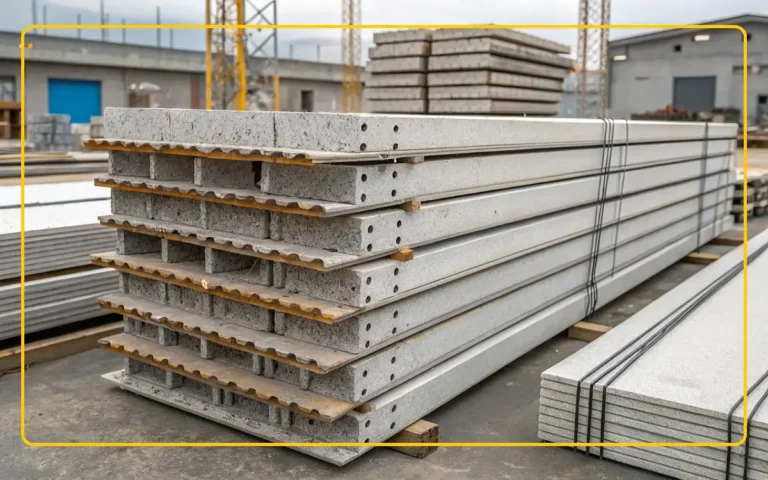
warehouse construction structural framing allows for expansive, long-span double-tee roof systems that minimize the need for interior load-bearing columns.
Fewer columns translate directly to uninhibited floor plans, allowing logistics operators to maximize their high-density racking configurations and automated guided vehicle paths.
Furthermore, according to a recent global economic overview by Research and Markets, North American logistics infrastructure demand continues to dominate capital expenditures, with institutional developers consistently favoring Grade-A specifications that offer superior space utilization and high environmental compliance.
How to Execute Precast Wall Installation on Site
Achieving maximum structural alignment and maintaining rigorous safety tolerances during warehouse construction requires a highly systematized site installation protocol.
The following sequence details the exact structural workflow mandated across our industrial job sites to ensure structural integrity and precise component connection.
1.Substructure Verification and Shimming:Prerequisite Phase.
Verify warehouse construction elevation tolerances of the cast-in-place concrete footings using digital surveying equipment.
Lay down high-density plastic engineered shims to create an absolute level baseline plane before any structural panels are unchained from the transport rigging.

Custom Home Renovation Using Precast Concrete Walls
2.Rigging and Crane Pick Optimization:Execution Phase.
Secure the specialized lifting hardware to the pre-engineered, cast-in lifting inserts embedded directly into the precast panel.
Utilize a dual-point crane pick configuration to lift the panel smoothly from the flatbed transport truck, ensuring zero torsional stress is placed on the concrete matrix.
3.Setting, Plumbing, and Temporary Bracing:Alignment Phase.
Guide the panel slowly over warehouse construction protruding foundation dowels until it rests firmly upon the verified shim packs.
Check vertical alignment using precise laser levels, and immediately secure the panel with heavy-duty adjustable pipe braces anchored directly to the building floor slab.
4.Welding and Structural Tie-In:Finalization Phase.
Execute structural welds on the matching embedded steel plates located at the panel junctions and roof line connections.
Pour a non-shrink, high-strength structural grout beneath the panel base plate to seal the foundation connection, establishing permanent load transfer pathways before releasing temporary braces.
Asphalt Paving Lafayette Grading Foundations
Why Thermal Efficiency and Long-Term Durability Win
The financial evaluation of modern warehouse construction must extend far beyond initial capital expenditure to account for long-term operational viability.
Insulated precast concrete wall assemblies incorporate an internal continuous layer of extruded polystyrene insulation sandwiched between an exterior architectural wythe and an interior structural wythe.
This composition provides an unbroken thermal barrier that significantly reduces heating and cooling load demands.
Research compiled in architectural whitepapers by BuildingScience.com demonstrates that perfect barrier systems, such as non-composite precast panels, provide far superior long-term defense against rainwater penetration and moisture tracking compared to multi-wythe field-applied masonry.
This protection completely eliminates the risk of hidden structural rot and moisture degrade over the lifespan of the asset.
For modern logistics facilities, choosing advanced precast panels for your warehouse construction framework translates directly into a durable, rapidly deployed, and energy-efficient building asset.
By removing the unpredictability of field casting and shifting construction to a controlled setting, industrial builders achieve absolute certainty in scheduling, structural execution, and financial performance.