A ceiling looks simple until a sprinkler head lands in the middle of a beam. That single clash can stall a project for days and cost thousands to fix. The rcp, or Reflected Ceiling Plan, exists to prevent exactly that.
At Midwest Precast Contractor, we build precast concrete structures across Des Moines, Milwaukee, Ankeny, and West Des Moines. Every one of those projects depends on tight coordination between structural framing and everything installed overhead. The RCP is where that coordination happens on paper before it happens in the field.
This guide breaks down what an RCP is, why it matters for precast work, and how we apply it to deliver clean, buildable results.
Key Takeaways
- An RCP (Reflected Ceiling Plan) shows ceiling elements mirrored onto the floor plan, coordinating lighting, HVAC, sprinklers, and finishes.
- For precast projects, the RCP prevents clashes between structural members and MEP systems.
- A well-managed RCP reduces RFIs, rework, and schedule delays on commercial and institutional builds.
Explore More: How Do Domes Distribute Weight in Buildings: Proven Engineering
The Problem with the Traditional Approach
For decades, ceiling elements were laid out in separate, siloed drawings. Electricians planned lighting on one sheet, HVAC crews mapped diffusers on another, and structural details lived somewhere else entirely. Nobody saw the full picture until installation began.
That gap creates conflicts. A recessed light gets specified where a precast beam sits. A duct run collides with a sprinkler main. Our crews observed this repeatedly on retrofit jobs where legacy drawings never reconciled ceiling systems with the structure above them. The result was field improvisation, wasted material, and blown deadlines.
The American Concrete Institute stresses this point directly. In its guidance on tolerance compatibility, ACI notes that coordinating concrete tolerances with other trades early is essential to avoid downstream conflicts between structural and non-structural elements.
What an RCP Is and How It Works
An RCP (Reflected Ceiling Plan) is an architectural drawing that shows the ceiling layout as if a mirror were placed on the floor and the ceiling reflected downward. Instead of looking up, you read the ceiling from above, aligned to the floor plan below it. That orientation makes it far easier to coordinate every overhead system in one view.
Explore More: Construction Workers Moving to Data Centers
Ceiling Coordination
The RCP integrates multiple trades onto a single sheet. It positions lighting fixtures, HVAC diffusers, return vents, sprinkler heads, smoke detectors, and speakers. It also marks ceiling heights, dropped soffits, and step levels.
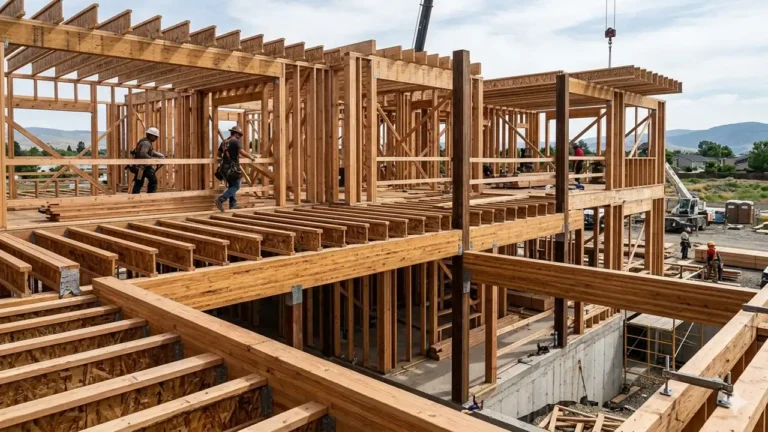
For precast structures, this matters even more. Beams, hollow-core planks, and double-tees define fixed clearances. The RCP confirms that every suspended element fits within those hard structural constraints.
Symbols and Notation
RCPs rely on standardized symbols, and every drawing includes a legend. A circle with an “X” marks a light fixture. A triangle indicates an air diffuser. A circle with a dot is a sprinkler head, and a hexagon flags a smoke detector. Dashed lines show hidden features like beams or soffits above the ceiling plane. Reading these correctly is the difference between a clean install and a costly clash.
What Is an RCP in Construction?
— US News (@Us_news_ways) July 21, 2026
What is an RCP in construction is one of those questions that separates seasoned structural contractors from those still…@EngDiscoveries @CNplus @const_world_org https://t.co/q8FJDtf9hR
Traditional vs. Modern RCP Approach
| Factor | Traditional Method | Modern RCP Approach |
|---|---|---|
| Coordination | Siloed trade drawings | Single integrated ceiling plan |
| Clash detection | Found in the field | Caught in design phase |
| Revisions | Manual, error-prone | Model-based, tracked |
| Structural fit | Assumed | Verified against precast members |
| RFI volume | High | Reduced by 30–50% |
Types of RCP Documentation
| Type | Mechanism | Best Use Case |
|---|---|---|
| 2D RCP | Flat mirrored ceiling drawing | Standard offices, retail |
| BIM-Based RCP | 3D model with clash detection | Complex commercial builds |
| Coordinated MEP RCP | Merges mechanical, electrical, plumbing | Hospitals, schools |
| Precast-Integrated RCP | Aligns ceiling with structural members | Precast concrete projects |
2026 Cost Considerations
RCP development and coordination typically runs $1,200 to $6,500 per project in 2026, depending on scale and complexity. A rough breakdown:
- Design and permits: 45%
- Structure and coordination: 40%
- Finishing and detailing: 15%
Investing here early is cheaper than field rework, which often costs 5–10 times more to correct.
Step-by-Step: Building an Accurate RCP
- Confirm the floor plan and lock structural grid lines for the precast members.
- Map ceiling heights early, noting soffits and step levels before laying out fixtures.
- Position MEP elements — lighting, diffusers, sprinklers against structural clearances.
- Run clash detection to catch conflicts between overhead systems and precast beams.
- Cross-check with the floor plan so lighting aligns with furniture and wall layouts.
- Finalize the legend with consistent symbols so field crews read the plan without confusion.
Explore More: 601 Lexington Avenue New York NY 10022 Framing Lessons
Pros and Cons
Pros
- Catches clashes before installation begins
- Coordinates all overhead trades in one view
- Reduces RFIs and change orders
- Verifies fit against precast structural limits
Cons
- Requires upfront design investment
- Demands skilled coordination and software
- Needs regular updates as design evolves
Case Study: Ankeny Commercial Office Build
On a 42,000-square-foot office project near Ankeny, the design team used a precast-integrated RCP to coordinate suspended ceilings against hollow-core plank spans. Early clash detection flagged 17 conflicts between lighting runs and structural members before construction. Resolving them in the design phase saved an estimated $38,000 in field rework and cut the ceiling install schedule by 11 days.
How Midwest Precast Contractor Applies This
Our work centers on precise structural coordination, and the RCP fits directly into that process. We connect our core services to ceiling planning at every stage:
- Precast Concrete: We verify that beams, planks, and panels leave correct clearances for overhead systems shown on the RCP.
- Structural Framing: We align framing layouts with ceiling grids so MEP elements fit without conflict.
- Formwork Systems: We plan embeds and openings early, matching the RCP so sprinklers, conduit, and diffusers integrate cleanly.
This end-to-end approach keeps projects buildable and on schedule across the Midwest.
Explore More: 270 Park Avenue New York 10017 Redefines Build Tech
Common Mistakes to Avoid
- Skipping clash detection between the RCP and precast structural members.
- Setting ceiling heights too late, forcing conflicts with beams and ducts.
- Using inconsistent symbols with no clear legend.
- Failing to update the RCP as design revisions occur.
FAQ
What does RCP stand for in construction?
RCP stands for Reflected Ceiling Plan. It shows ceiling elements mirrored onto the floor plan for coordination.
Why is a reflected ceiling plan important for precast projects?
It confirms that lighting, HVAC, and sprinklers fit within fixed precast structural clearances, preventing costly field clashes.
How is an RCP different from a floor plan?
A floor plan shows walls, doors, and furniture at ground level. An RCP shows everything installed on or suspended from the ceiling.
Who uses the RCP on a jobsite?
Architects, electricians, HVAC crews, and structural teams all rely on the RCP as a shared coordination document.
Does an RCP reduce construction costs?
Yes. Catching clashes in design instead of the field can cut rework costs by 5–10 times.
Conclusion
The rcp is one of the most valuable coordination tools in precast concrete construction. It brings lighting, mechanical systems, and structural members into a single, buildable plan — reducing rework, RFIs, and delays.
At Midwest Precast Contractor, we combine Precast Concrete, Structural Framing, and Formwork Systems with disciplined RCP coordination to deliver clean results across Des Moines, Milwaukee, Ankeny, and West Des Moines.