

One stranded admin password can lock your whole team out of the BIM model the week before a precast pour.
If one person holds the master key to your bid files, drawings, or access-control system, shamir secret sharing reconstruction from shares python code lets you split that risk across your crew.
No single person holds the whole key, and no single absence stops the job.
Key Takeaways
- Adi Shamir’s 1979 (k,n) threshold scheme splits one secret into n shares. Any k shares rebuild it, and k−1 shares reveal nothing.
- Reconstruction relies on Lagrange interpolation over a finite field. The public-domain Python reference uses the 12th Mersenne Prime, 2^127 − 1.
- The scheme has two known gaps: shares can’t be verified, and the full secret exists in one place during splitting and rebuilding.
Seattle Convention Center Summit Loading Dock Sets the Bar
What is Shamir’s secret sharing, and why should contractors care?
Shamir’s secret sharing is a way to split one secret so that only a group can rebuild it.
According to Wikipedia’s entry on Shamir’s secret sharing, the method traces back to Adi Shamir’s 1979 paper, “How to Share a Secret,” published in Communications of the ACM.
It offers information-theoretic security, which means a thief who steals fewer shares than the threshold learns nothing about the secret.
If you’ve been following construction technology trends across the Midwest, this won’t come as a surprise.
Firms now store project data in cloud platforms, run drone fleets, and manage digital jobsite access.
Each of those systems has a master credential that someone has to protect.
Our team has seen the same pattern on many projects: one IT lead or one superintendent holds the only admin key.
Shamir secret sharing reconstruction from shares python code replaces that single point of trust with a quorum (a minimum group that must agree).
Start by listing every credential your firm could not afford to lose.
How does reconstruction from shares actually work?
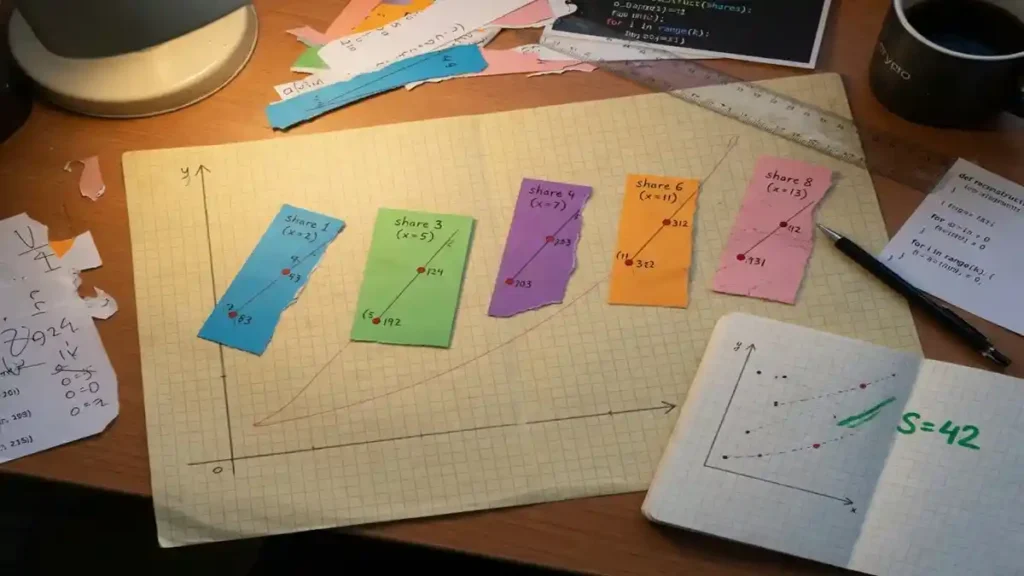
Reconstruction works because a set number of points defines a unique curve.
Two points fix a line, three fix a parabola, and four fix a cubic curve. The secret sits at the point where the curve crosses x = 0, written as f(0).
The math runs inside a finite field, which is a closed number system that wraps around a prime number.
The Wikipedia example shows why: with plain integers, one stolen share revealed that the secret was even.
Switching to mod p arithmetic closes that leak.
What does a worked example look like?
Our analysis of the source example uses these values:
- Secret: 1234
- Shares (n): 6
- Threshold (k): 3
- Prime field: p = 1613
- Shares issued: (1, 1494), (2, 329), (3, 965), (4, 176), (5, 1188), (6, 775)
Any three of those six points return 1234. Two points return nothing useful at all. This is the core behavior that shamir secret sharing reconstruction from shares python code reproduces at production scale.
Subsurface Construction Leadership Team Names and Titles
How do you run the Python code step by step?
The reference script uses two public functions: make_random_shares and recover_secret.
It draws random coefficients from random.SystemRandom, a cryptographically secure source.
For new builds, Python’s secrets module documentation recommends the same class of generator.
Follow these steps to test shamir secret sharing reconstruction from shares python code on a single workstation:
- Choose your threshold. Set k to the number of people who must cooperate, such as 3 of 6 project leads.
- Generate the shares. Call
make_random_shares(secret, minimum=3, shares=6)to produce six (x, y) points. - Distribute one share per person. Hand each point to a different trusted holder through a separate channel.
- Collect any k shares. Gather three points when you need the key back.
- Rebuild the secret. Call
recover_secret(shares), which runs Lagrange interpolation at x = 0. - Confirm the result. Test with a different subset of three shares to make sure both return the same value.
shares = make_random_shares(1234, minimum=3, shares=6)
print(recover_secret(shares[:3]))   # 1234
print(recover_secret(shares[-3:]))  # 1234
One detail matters: the reference recover_secret hard-codes a three-share minimum. Edit that check to match your real threshold before you deploy anything.
How does SSS compare to traditional key storage?
SSS beats single-holder storage on both loss risk and theft risk.
The table below shows the differences our team weighs when advising firms.
| Factor | Single-Holder Key | Shared Password Copies | Shamir’s Secret Sharing |
|---|---|---|---|
| Loss risk | High: one absence locks you out | Low | Low: any k holders recover it |
| Theft risk | One breach exposes all | Any copy exposes all | Fewer than k shares reveal nothing |
| Share size | N/A | Full secret | Each share no larger than the secret |
| Adding holders | Not possible | Copy and hope | New shares added without changing old ones |
| Rotating access | Change the secret | Change the secret | New polynomial, same secret |
Flexible matters on construction teams with clear hierarchies. A project executive could hold three shares and act alone, while three foremen with one share each must act together.
Shamir Secret Sharing Reconstruction from Shares Python Code If one person holds the master key to your bid files, drawings, or access-control system, shamir secret sharing reconstructio… @github @Cloudflare @CISAgov https://t.co/7j1poFsdBZ
— US News (@Us_news_ways) October 21, 2026
What are the weaknesses you need to plan for?
SSS has two documented gaps. Neither one should stop you, but both belong in your plan.
- No verifiable secret sharing: The scheme can’t detect a fake or corrupted share during reconstruction. A bad share produces a wrong key without warning.
- Single point of failure: The full secret exists in one place when you split it and again when you rebuild it. Those two moments are attack windows.
The NIST Multi-Party Threshold Cryptography project tracks newer threshold schemes built to close these gaps.
Researchers publishing through the International Association for Cryptologic Research continue to refine verifiable versions.
Run every split and rebuild on an offline machine you control.
Dickerson Infrastructure Leadership Team Names and Titles
What does this mean for Midwest contractors?
Shared key custody now fits the size of a mid-market contractor. The reference code is public domain, runs on standard Python, and takes minutes to test.
That puts shamir secret sharing reconstruction from shares python code within reach of any firm with one technically minded staff member.
Our recommendation is simple:
- Pick one high-value credential, such as your cloud document admin key.
- Set a 3-of-5 threshold across leadership and IT.
- Run a recovery drill each quarter so holders know their role.
Store each share in a separate location, and schedule your first recovery drill before the next project kickoff.