

A change in who owns your engineering partner can quietly change who stands behind your drawings, your models, and your warranties.
That is why the lucient engineering and construction ownership transition after 2023-08-16 matters to anyone with active bids or open punch lists. Here is how to protect your project.
Key Takeaways
- Public filings on deal terms are thin, so verification is your job, not the vendor’s.
- Ownership changes can affect stamped drawings, BIM model rights, E&O coverage, and warranty obligations.
- Telecom history shows how one company’s assets can split, merge, and change hands within a decade.
Airport City College Park Development 2024 2025 2026 Rises
What does this ownership transition actually change?
An ownership transition changes who holds legal responsibility for past and future work.
Our analysis suggests contractors should focus less on the new logo and more on the paper trail.
We have not found detailed public records of the terms behind the lucient engineering and construction ownership transition after 2023-08-16.
That gap matters.
When terms are not public, you cannot assume that contracts, licenses, or project data moved over intact.
In construction technology, the exposure sits in three places:
- Digital deliverables: BIM files, clash-detection reports, and digital twins (live 3D models tied to building data).
- Professional credentials: the PE stamp and the firm-level certificate of authorization that many states require.
- Software licenses: seat licenses and cloud workspaces registered to the old entity.
Pull your current contract and highlight every reference to the firm’s legal name before your next progress meeting.
What can the Lucent story teach Midwest builders?
Corporate ownership rarely stays fixed for long.
The history of Lucent Technologies, documented on Wikipedia’s Lucent Technologies entry, shows how fast assets can move.
| Year | Ownership event | Parallel risk on a build |
|---|---|---|
| 1996 | AT&T spun off its equipment divisions and Bell Labs as Lucent | Spin-offs can split engineering staff from design IP |
| 1999 | Lucent bought Ascend Communications for $24 billion | Acquisitions can bring in teams with different QA standards |
| 2000–2002 | Lucent spun off Avaya (2000) and Agere Systems (2002) | Divisions you rely on may become separate companies |
| 2002 | Reported an $11.9 billion loss on $12.3 billion in revenue | Financial stress can reduce field support and staffing |
| 2006 | Merged with Alcatel at 0.1952 Alcatel shares per Lucent share | Mergers rename entities, which can complicate contract assignment |
| 2016 | Nokia acquired Alcatel-Lucent | A brand you know may end up under a third owner |
One detail stands out.
AT&T created Lucent partly because rival telecom companies did not trust buying gear from a direct competitor.
Ownership shapes trust, and that applies just as much to an engineering firm bidding on your precast package.
Map every vendor on your current job to its legal parent company this week.
Amkor Manufacturing Sites and Packaging Technologies by Location Spur Builds
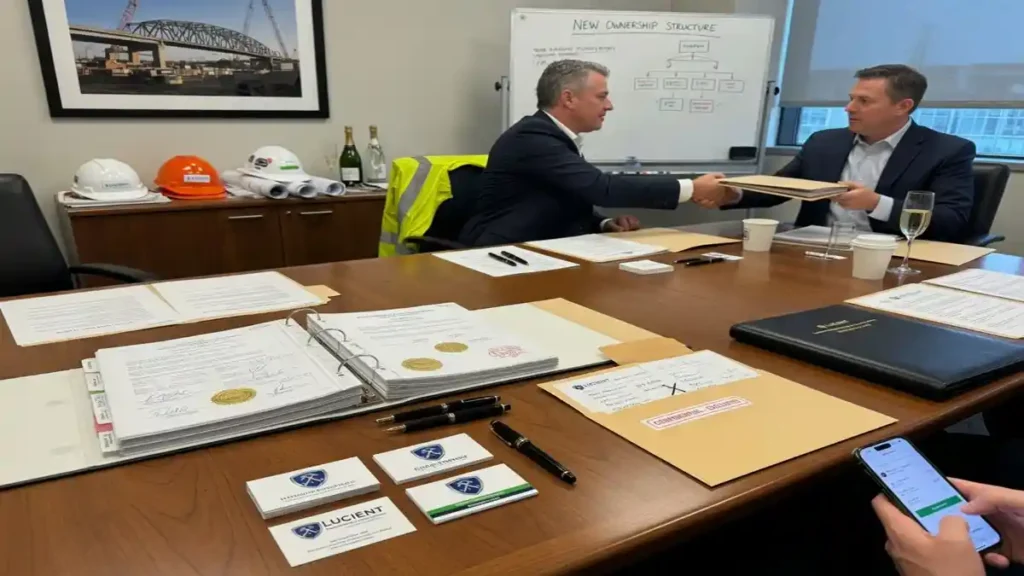
What does this mean for Midwest contractors?
The lucient engineering and construction ownership transition after 2023-08-16 is a contract-risk issue first.
Construction industry insiders are noting that ownership changes have become a frequent topic in ENR coverage of design-firm deals.
If you’ve been following construction technology trends across the Midwest, this won’t come as a surprise.
Our contractors note three common friction points after a firm changes hands:
- Assignment clauses: AIA documents, available through AIA Contract Documents, include a successors-and-assigns provision that governs whether obligations transfer.
- Licensure gaps: The NCEES maintains licensure standards, and firm registrations often must be updated after a legal-entity change.
- Spec continuity: Precast designs must still meet ACI 318 from the American Concrete Institute and plant quality standards such as PCI MNL-116 from the Precast/Prestressed Concrete Institute.
A change in ownership does not change the code.
It can change who is accountable for meeting it.
How do you vet an engineering partner after a transition?
Vetting a partner after the lucient engineering and construction ownership transition after 2023-08-16 takes a structured review, not a phone call.
Use these steps before you sign a change order or a new contract.
- Confirm the legal entity. Search your state’s business registry for the exact name on the contract.
- Verify the PE stamp. Check the engineer of record against your state licensing board.
- Request current insurance certificates. Confirm that professional liability (E&O) coverage names the current entity and includes prior acts.
- Audit data ownership. Get written confirmation of who owns your BIM models, IFC files, and cloud project folders.
- Review the assignment clause. Compare your contract’s successors-and-assigns language to the new ownership structure.
- Check spec references. Make sure drawings still cite ACI 318 and the right PCI certification for your precast supplier.
- Document everything. Store every confirmation letter in your project management platform with a date stamp.
Start with Step 1 today, because every later step depends on knowing the correct legal name.
AI Startup Construction Defect Claims Management Automation Funded 2024 2025
Lucient Engineering and Construction Ownership Transition After 2023-08-16: Protect Your Build That is why the lucient engineering and construction ownership transition after… @ConstructionMag @engineeringcom @ConstructConnx https://t.co/uRdN3EUFUL
— US News (@Us_news_ways) October 19, 2026
How will this impact your next build?
The impact depends on how much of your project lives in shared digital files.
Teams running model-based coordination carry more exposure than teams working from static PDFs.
Our analysis suggests property owners should ask one direct question during preconstruction: Who owns the model if the firm changes hands again?
The Lucent timeline shows that a second or third ownership change is a realistic possibility.
For any project affected by the lucient engineering and construction ownership transition after 2023-08-16, add a data-escrow clause (a provision requiring a neutral party to hold copies of project files).
That clause keeps your models accessible regardless of future deals.
Edward St John Learning and Teaching Center Raises The Bar
What should you do next?
Treat the lucient engineering and construction ownership transition after 2023-08-16 as a prompt to audit every engineering relationship on your books.
Ownership history, from AT&T to Lucent to Alcatel to Nokia, proves that stability is never guaranteed.
Download your active contracts, run the seven-step vetting process above, and flag any document that still names a former entity.
That audit takes an afternoon, and it can save you a dispute that lasts months.