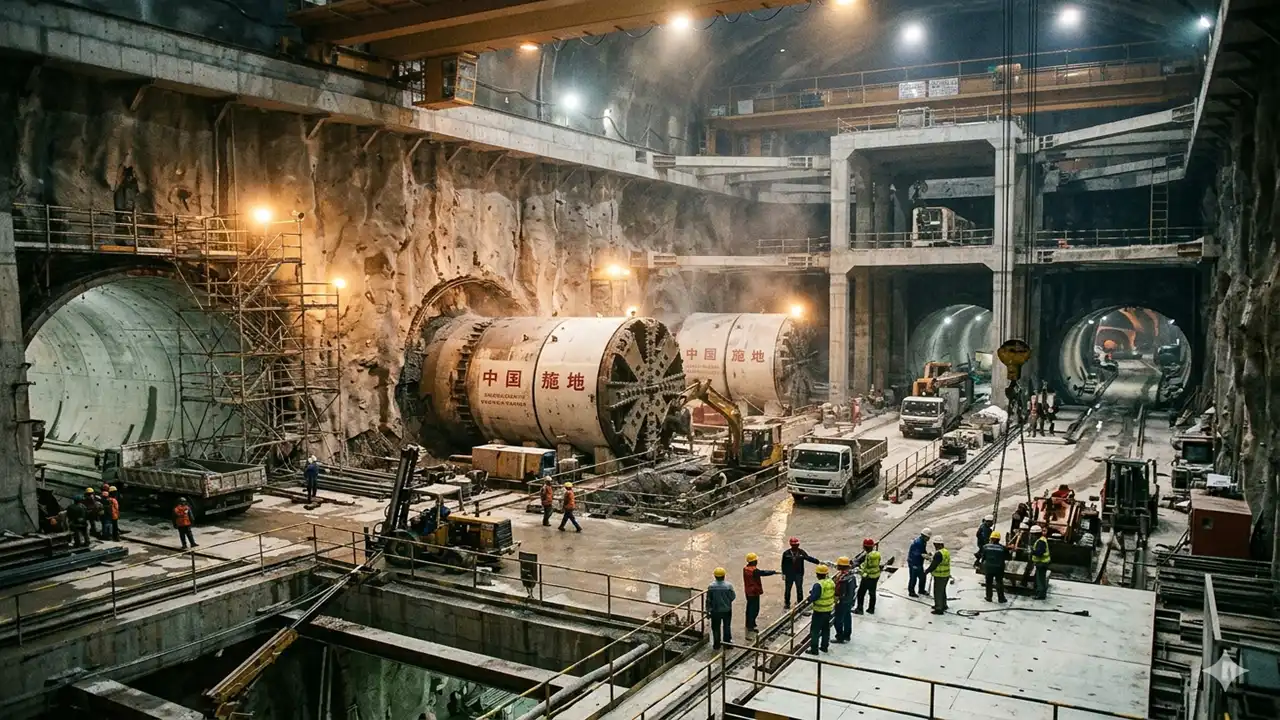
China underground military hub construction has become the most watched engineering story in modern defense circles. For project managers, developers, and property owners, the lesson runs deeper than politics. It shows how hardened concrete, deep excavation, and load-bearing design shape structures built to survive anything.
Key Takeaways
- The “Beijing Military City” site spans roughly 1,500 acres near Qinglonghu, about 10 times larger than the Pentagon, with deep bunkers designed to resist bunker-buster munitions.
- Satellite imagery captured 100+ cranes and major subterranean work, revealing engineering priorities like reinforced concrete, redundancy, and blast resistance.
- These same principles guide our work at Midwest Precast Contractor, where durability and precision engineering meet Midwest-tough weather.
Bringing Survey-Grade Precision to Live Construction Sites
What Is China’s Underground Military Hub Construction
China underground military hub construction refers to a massive fortified complex outside Beijing. US intelligence analysts nicknamed it “Beijing Military City.” The Financial Times first reported it in January 2025, showing deep pits, hardened bunkers, and underground passageways.
The facility is expected to serve as a wartime command center and a shelter for military leadership. Our engineering read is simple. When you dig this deep and reinforce this heavily, you are building for permanence. Learn how we approach durable precast concrete solutions for demanding projects.
Site Location and Scale
The site sits in the Qinglonghu area, roughly 30km southwest of Beijing. It covers about 1,500 acres, or nearly 5 square kilometers of active construction. That scale makes it 10 times the size of the Pentagon, the current record-holder for largest office building.
According to reporting verified against Business Insider satellite analysis, no official Chinese records mention the project. That silence speaks volumes. Our crews know that projects of this scale, depth, and secrecy demand extraordinary foundation and formwork planning.
Construction Timeline (2022–2025)
If you have tracked satellite imagery, the timeline tells a clear story. Here is what the record shows:
| Date | Site Condition |
|---|---|
| Feb 2022 | Residential land, open tracts, no major work |
| Feb 2023 | Cleared of housing, prepped for excavation |
| Mid-2024 | Major construction begins, tunnels and roads appear |
| Jun 2024 | Central block reserved, 100+ cranes active |
| Mar 2025 | Rapid vertical and subterranean progress |
The clearing phase, the excavation phase, and the vertical build all moved fast. Speed at this scale is rare. Our own structural framing crews respect that kind of pace only when precision holds.
Underground Engineering and Bunker Specifications
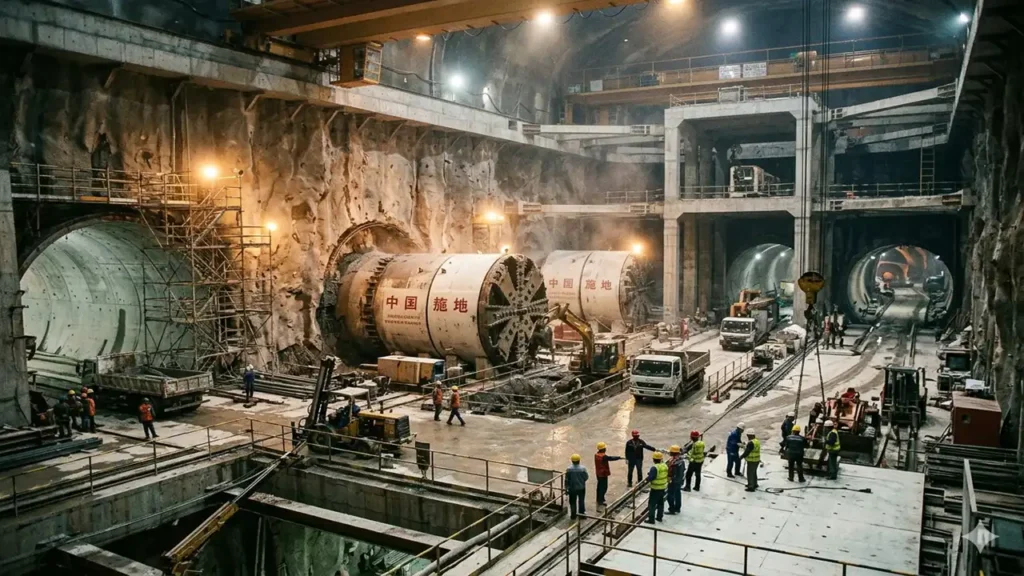
Renny Babiarz, a former imagery analyst at the National Geospatial-Intelligence Agency, noted 100+ cranes working across a 5 sq km area on underground facilities and passageways. The design points to hardened bunkers built for leadership survival.
Dennis Wilder, former head of China analysis for the CIA, said the bunker signals intent to build an advanced nuclear warfighting capability. The goal is resistance against US bunker-buster munitions. Achieving that requires deep burial, thick concrete shells, and shock-absorbing layers. These are the same load principles behind our precast foundation systems.
Structural Materials and Load-Bearing Design
Heavily reinforced concrete does the real work in any hardened facility. Compressive strength, rebar density, and blast absorption decide whether a structure survives. Standards from the American Concrete Institute guide how engineers specify these mixes worldwide.
How Barhale Trant Utilities Drives Civil Infrastructure
Here is how key materials compare for deep, protective construction:
| Material System | Load Capacity | Blast Resistance | Durability | Midwest Weather Fit |
|---|---|---|---|---|
| Precast reinforced concrete | Very High | Excellent | 75+ years | Excellent |
| Cast-in-place concrete | High | Very Good | 50+ years | Good |
| Steel framing | High | Moderate | 40+ years | Fair (corrosion risk) |
| Masonry block | Moderate | Low | 40+ years | Fair |
Precast wins on consistency. Our controlled casting delivers repeatable strength, tighter tolerances, and faster on-site assembly.
China’s Military Modernization Context
The hub fits a larger push. The Pentagon estimates China’s nuclear arsenal held 600+ warheads as of 2024, with projections near 1,500 by 2035. The PLA targets a 2027 centenary milestone and a world-class force by 2049.
These dates matter for engineers too. Deadlines this firm drive material choices, construction speed, and redundancy planning. When timelines cannot slip, teams lean on prefabricated components and proven load-bearing design, the same values we build into every restoration and structural project.
Western Hills vs. New Facility Comparison
A former US official told reporters the new site will likely replace the Cold War-era Western Hills complex. Here is how the two compare:
| Feature | Western Hills (Old) | Beijing Military City (New) |
|---|---|---|
| Era built | 1960s Cold War | 2024 onward |
| Size | Compact | ~1,500 acres |
| Bunker depth | Limited | Deep, hardened |
| Blast resistance | Dated | Bunker-buster resistant |
| Communications | Legacy | Advanced, secure |
The upgrade gap is generational. Older facilities lacked the depth, reinforcement, and redundancy modern threats demand.
Strategic Implications for Global Security
Michael Beckley, a political scientist at Tufts University, described the project as Xi Jinping’s move to “build a fortress” resistant to nuclear strikes. That framing highlights survivability, command continuity, and deterrence.
For a US audience, the takeaway is engineering-focused. Protective construction, deep foundations, and blast-hardened shells are no longer niche. They are becoming benchmarks. The American Society of Civil Engineers tracks how such resilience standards influence civilian infrastructure too.
Fixing the Bellevue School District HVAC Delay
Infrastructure Expansion Beyond Beijing
The Beijing hub is not isolated. According to CSIS ChinaPower, China built or upgraded 37 airports and heliports across Tibet and Xinjiang since 2017. At least 22 are military or dual-use.
Key infrastructure gains include:
- New roads linking the G219 highway to the India border.
- High-speed rail connecting Lhasa to Nyingchi.
- High-altitude runways stretching up to 5,500 meters.
- Underground facilities near Shigatse Peace Airport.
The pattern is clear. China pairs hardened structures with logistics networks built to move fast and endure.
Precast Concrete Lessons from Underground Military Engineering
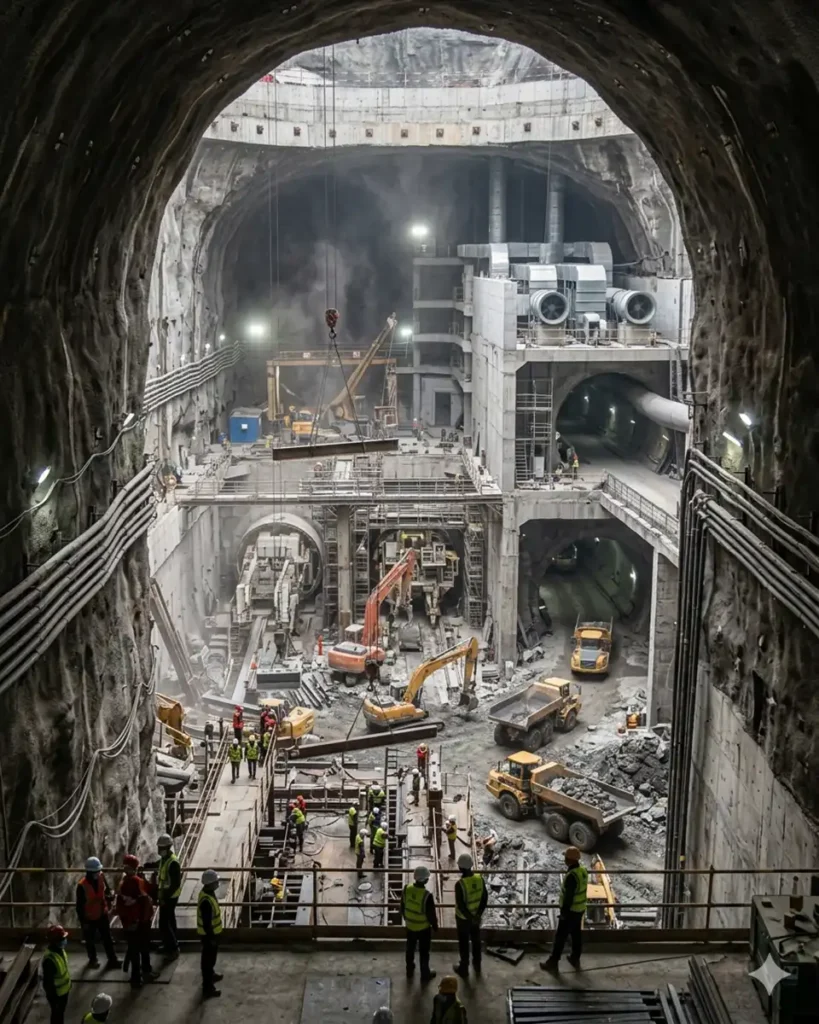
Military-grade construction teaches civilian builders real lessons. Controlled curing, dense reinforcement, and modular assembly all improve durability. These are precast strengths, not afterthoughts.
Three lessons stand out:
- Consistency beats improvisation. Factory casting removes field variables.
- Depth demands planning. Deep loads require engineered footings and drainage.
- Redundancy saves structures. Multiple load paths prevent single-point failure.
We apply each daily. Our teams treat every foundation as a long-term investment, not a short-term pour.
How Midwest Precast Contractor Applies These Engineering Standards
At Midwest Precast Contractor, our hands-on engineering experience shows that durability, precision, and on-time delivery win projects. We serve Milwaukee, Des Moines, and surrounding Midwest communities with architectural precast, foundations, and restoration.
We build for freeze-thaw cycles, heavy loads, and decades of service. That mindset mirrors hardened construction principles. Every panel we cast meets strict codes and exceeds expectations. Contractors noting the rise of protective design will find our precast expertise ready for demanding, weather-tough builds.
Women In Construction Leadership Programs Events Contact Director USA
FAQ
1. What is the Beijing Military City project?
It is a large fortified complex near Beijing, believed to serve as a wartime command center with deep hardened bunkers.
2. How big is the site?
About 1,500 acres, roughly 10 times the Pentagon’s footprint.
3. Why underground?
Deep burial and reinforced concrete protect leadership from bunker-buster and nuclear strikes.
4. When did construction start?
Major work began mid-2024, after clearing in 2023.
5. What can builders learn?
Prioritize strength, redundancy, and precast consistency for lasting structures.