
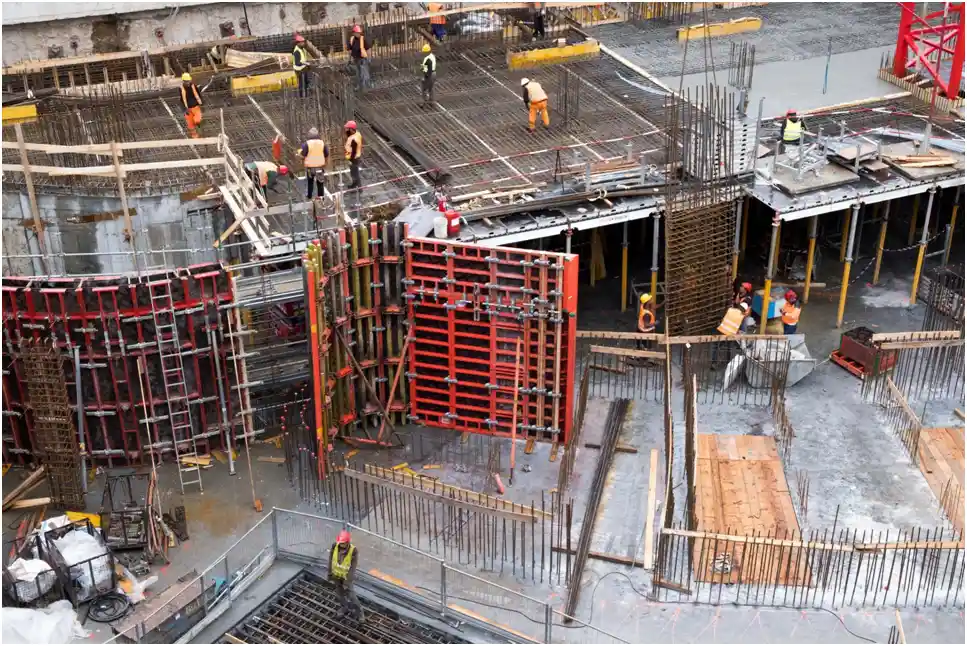
Every active construction site moves. Excavation, heavy loads, and shifting soil push structures and the surrounding ground by fractions of an inch, and those small movements decide whether a project stays safe and on schedule. Survey-grade precision catches that movement while it’s still measured in millimeters, long before it becomes cracks, delays, or a stop-work order. This guide explains how automated total station monitoring delivers that precision on a live site, what it detects, and what it takes to set up.
Why Does Survey-Grade Precision Matter on Active Construction Sites?
Survey-grade precision matters on active sites because construction constantly disturbs the balance of soil and structures. Deep excavation removes lateral support from nearby foundations, and dewatering lowers the water table so the ground settles. Each activity introduces movement that occasional spot checks can miss between visits.
Catching that movement early is what separates a minor adjustment from an expensive failure.
Keeping ahead of that movement is exactly what continuous instrument networks are built for. Providers like Sixense run AMTS monitoring programs that track a site’s structures around the clock and flag movement the moment it crosses a set threshold. That real-time visibility gives crews the lead time to act before a small shift becomes a costly problem.
What Does “Survey-Grade” Precision Actually Mean?
Survey-grade precision means measurements accurate to the millimeter, repeated consistently over time. A survey-grade instrument doesn’t just locate a point once. It returns to the same target again and again and reports how far it has shifted between readings.
That repeatability is what makes the data trustworthy for structural decisions. General-purpose GPS and handheld tools can’t reach this level on a busy site, because they drift and rarely resolve the small movements that matter most.
How Do Millimeter Movements Escalate Into Structural Risk?
Small movements escalate because structures fail progressively, not all at once. A retaining wall that leans a few millimeters redistributes load to nearby elements, those elements move too, and the cumulative shift can crack facades or compromise a foundation.
Time is the deciding factor. When crews see movement in real time, they can pause, brace, or adjust before the trend accelerates. When they find out days later, the cheapest fixes are already gone.
What Is Automated Total Station Monitoring?
Automated total station monitoring uses a robotic surveying instrument to track the position of fixed targets around a site continuously. It replaces the manual crew that would otherwise return day after day, and it does the same work around the clock without anyone on site.
How Does an Automated Total Station Work?
An automated total station, or AMTS, is a motorized instrument that measures precise angles and distances to reflective prisms mounted on the structures being watched. It rotates to each prism on a set schedule, records the exact position, and compares it to the baseline, so any deviation shows up as displacement.
The instrument sits in a stable, protected position with a clear line of sight to every prism it reads. Reference prisms placed on stable ground let the system correct for its own tiny movements, so the readings reflect the structure and not the instrument. Most installs use several reference prisms, often 6, so the network keeps working if one control point is blocked or damaged.
AMTS Monitoring vs Traditional Manual Surveys
Traditional manual surveys capture a single snapshot whenever a crew visits. AMTS monitoring captures a continuous record, and that difference changes what a project can see.
A manual survey tells you where things stood at 10 a.m. on Tuesday. Automated monitoring tells you what happened overnight, during a heavy pour, or right after a nearby blast. It also removes the labor cost and safety risk of sending surveyors into an active zone every day.
How Does Continuous Monitoring Protect a Live Construction Site?
Continuous monitoring protects a site by turning movement into an early warning system. Instead of discovering a problem at the next scheduled check, the team watches the trend develop and acts on it.
What Movements Can the System Detect in Real Time?
The system detects the movements that matter most during construction:
- Settlement and heave in the ground beneath foundations and slabs
- Lateral movement of retaining walls, shoring, and excavation supports
- Tilt and rotation in buildings, bridges, and towers next to the work
- Convergence in tunnels and shafts as the surrounding ground adjusts
Each of these shows up as a change in a prism’s position, plotted over time so the trend is obvious at a glance.
How Do Automated Alerts Prevent Costly Delays?
Automated alerts prevent delays by shrinking the gap between a problem and a response. Project specs set tolerances and alert thresholds for each target, and when a reading crosses a threshold, the platform sends an email and a text message to the people who need to know.
A web platform brings the data together. It shows displacement trends and time-series graphs, live plan views of every target, automated reports, and a project journal of what happened and when. Crews can check the site’s condition from anywhere instead of waiting for the next report.
What Does It Take to Set Up Precision Monitoring on Site?
Setting up precision monitoring comes down to three things: what you need to watch, where the instrument can see, and how often it has to read.
Placing Reference Prisms and Instruments for Full Line of Sight
Placement starts with line of sight. The total station needs an unobstructed view of every prism it reads, so it goes where buildings, equipment, and terrain won’t block the shot. Crews also pick a protected, theft-resistant spot, because the instrument runs unattended for weeks.
Monitoring prisms attach to the structures and ground under watch, while reference prisms go on stable ground away from the work. Using several reference prisms, often 6, builds in redundancy so the network survives a blocked sightline or a damaged control point.
How Often Should the System Take Readings?
Reading frequency depends on how fast the site can move and how quickly the team needs to know. A quiet phase might need a reading every few hours, while an active excavation next to a sensitive structure might need one every few minutes.
Frequency also shapes the hardware. Faster cycles across many prisms can push a single instrument past its limits, so a large or fast-moving site sometimes needs more than one total station to cover every point in time.
Keeping the Monitoring Network Accurate Over Time
The network stays accurate through routine upkeep. Site visits every 1 to 3 months handle prism cleaning, instrument servicing, and verification of the reference coordinates. Between visits the system runs on its own, and automated alerts catch anything unusual in real time.
This mix of unattended operation and short maintenance visits is what makes long-term monitoring practical. The instrument does the daily work, and a quick check keeps its readings honest.
Key Takeaways for Precision Monitoring on Construction Sites
Survey-grade precision gives a construction team the one thing manual surveys can’t: a continuous view of how the site is moving. Automated total station monitoring measures millimeter-level displacement around the clock, flags it the moment it crosses a threshold, and gives crews time to act while fixes are still simple.
For any project working next to sensitive structures or unstable ground, that early warning is the difference between a scheduled adjustment and an emergency.
Frequently Asked Questions About Automated Total Station Monitoring
How Accurate Is Automated Total Station Monitoring?
Automated total station monitoring delivers survey-grade, millimeter-level accuracy. Because the instrument returns to the same prisms on a fixed schedule and corrects itself against stable reference points, it resolves the small, gradual movements that matter for structural safety.
How Many Reference Prisms Does an AMTS Need?
An AMTS needs at least 3 reference prisms, but most installs use more, often around 6. The extra prisms build in redundancy, so the network keeps producing reliable readings even if a control point is blocked or damaged.
Can an AMTS Operate Without On-Site Staff?
Yes. An AMTS is built to run unattended for long stretches. It reads its targets automatically, sends the data to a web platform, and triggers alerts on its own, so crews visit only for periodic maintenance rather than daily readings.
How Often Does an AMTS Require Maintenance?
An AMTS typically needs a maintenance visit every 1 to 3 months. Those visits cover prism cleaning, instrument servicing, and verification of the reference coordinates, which keeps the readings accurate over a long monitoring campaign.