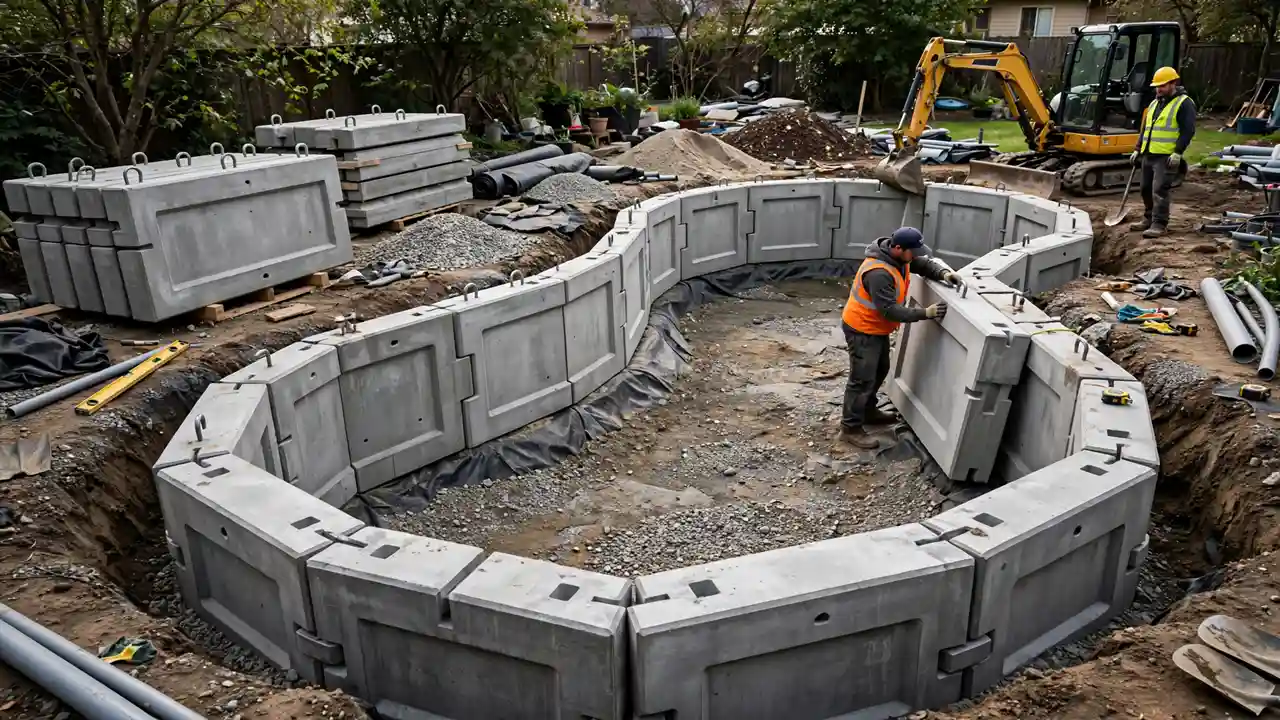
Koi pond construction is no longer a backyard afterthought. Contractors and property owners across the Midwest are treating it as a serious structural investment and the materials chosen at the start determine whether that investment holds for decades or fails within seasons.
If you’ve been following precast concrete trends across the Midwest, this won’t come as a surprise.
Construction Tape Techniques That Strengthen Precast Builds
Key Takeaways
- Precast concrete panels reduce on-site labor time by up to 40% compared to poured-in-place methods for pond basins
- Structural integrity in koi pond builds depends on wall thickness, rebar placement, and waterproof membrane compatibility
- Long-term cost efficiency favors precast solutions, with maintenance costs averaging 30–50% lower over a 10-year period
Why Are Contractors Reconsidering Traditional Pond Methods?
Our analysis suggests that the biggest failures in koi pond construction come from underestimating hydrostatic pressure and soil movement.
Traditional liner-based ponds shift, crack, and degrade under freeze-thaw cycles that are simply part of Midwest winters.
Precast concrete eliminates most of those failure points from the very first pour.
Construction industry insiders are noting a clear move toward engineered, modular approaches for water feature builds.
A report from the American Concrete Institute highlights that precast elements outperform cast-in-place concrete in controlled load and water retention scenarios.
That data translates directly to better outcomes on residential and commercial pond projects.
Computer Vision Projects Transforming Precast Concrete Builds
What Makes Precast Concrete the Structural Choice for Koi Ponds?
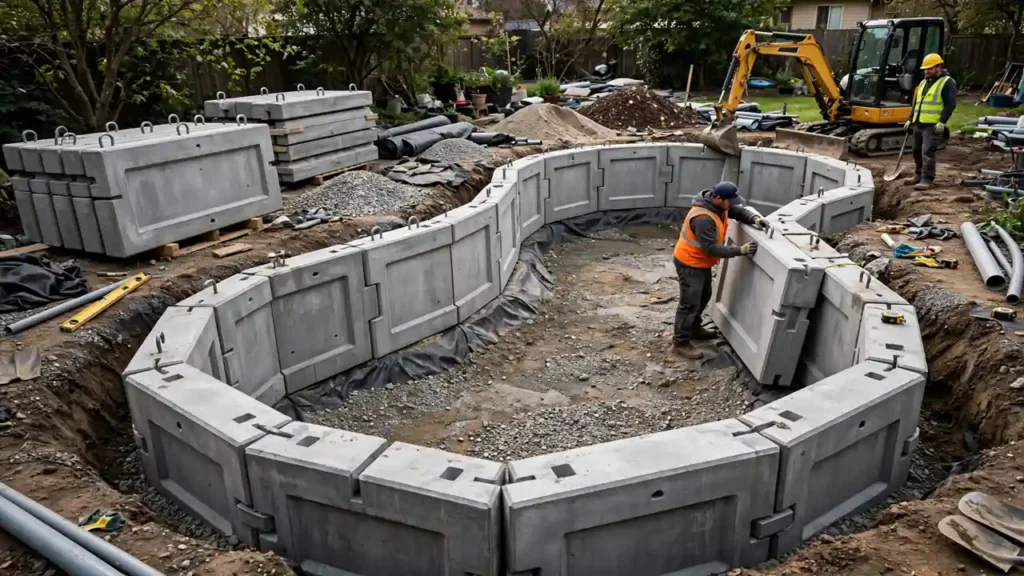
Precast concrete panels are manufactured under controlled factory conditions, which means consistent density, curing time, and reinforcement placement.
Our team observed that panels produced off-site and delivered to the project location reduce exposure to unpredictable weather during the critical curing phase.
This alone significantly reduces the risk of micro-cracking, which is a primary cause of water loss in pond basins.
The Portland Cement Association confirms that properly cured precast concrete achieves compressive strengths between 4,000 and 8,000 PSI, making it more than capable of handling the lateral pressure exerted by a fully loaded koi pond.
Wall thickness recommendations for residential koi pond construction typically begin at 6 inches for smaller features and scale upward based on basin depth and volume.
Our contractors note that anything deeper than 4 feet requires engineered structural review before breaking ground.
Step-by-Step: How We Approach Koi Pond Construction With Precast
Phase 1 — Site Assessment and Planning
- Conduct a soil bearing capacity test to determine foundation stability
- Identify the pond footprint, accounting for fish load, filtration equipment, and water volume
- Obtain local permits — the U.S. Army Corps of Engineers permitting database is a critical starting point for water feature regulations near waterways
- Finalize structural drawings with load calculations for walls and base slab
Phase 2 — Foundation and Base Slab Preparation
- Excavate to the design depth plus 12 inches for gravel sub-base
- Compact Class A crushed stone to a minimum 6-inch base layer
- Place #4 rebar at 12-inch centers in both directions across the base slab form
- Pour a 3,500 PSI minimum concrete slab and allow full 28-day cure before panel installation
Phase 3 — Precast Panel Installation
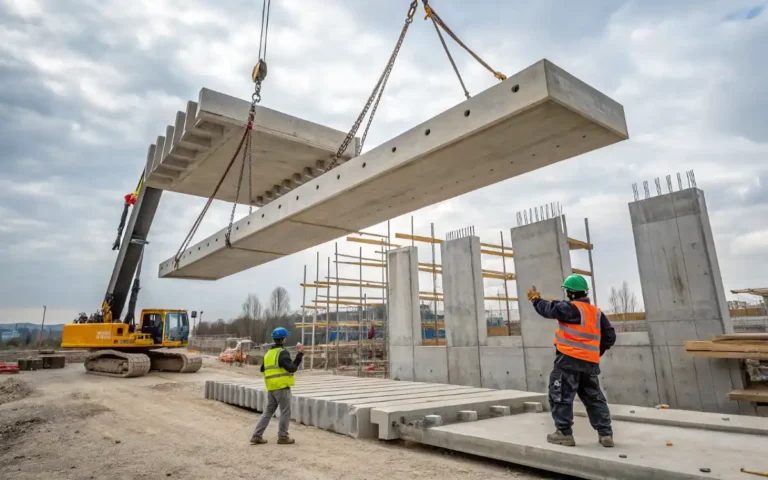
- Set panels using a crane or boom lift never drag panels across the slab
- Apply hydraulic waterproofing cement to all panel joints before grouting
- Backfill in 6-inch lifts, compacting each layer to prevent lateral panel movement
- Install a EPDM or crystalline waterproof membrane on interior pond walls
Phase 4 — Systems Integration and Water Testing
- Connect filtration, aeration, and return lines before final water fill
- Fill the pond in stages over 48–72 hours to monitor for settlement or joint movement
- Test water chemistry according to USDA Natural Resources Conservation Service water quality guidelines
- Introduce fish only after a full biological cycle is established
Construction Injury Lawyers Protect Precast
Koi Pond Construction Right With Precast
— US News (@Us_news_ways) July 10, 2026
Koi pond construction is no longer a backyard afterthought. Contractors and property owners across the Midwest are treating it…@precastconcrete
@companyconcrete @Landscapecture https://t.co/tGatsl6HAM
Precast vs. Traditional Methods: A Direct Comparison
| Feature | Precast Concrete Pond | Poured-In-Place | Liner-Based Pond |
|---|---|---|---|
| Installation Time | 3–5 days | 10–14 days | 1–2 days |
| Lifespan | 40–60 years | 25–40 years | 7–15 years |
| Freeze-Thaw Resistance | Excellent | Good | Poor |
| Structural Load Rating | High (4,000–8,000 PSI) | Moderate | None |
| Maintenance Cost (10-year avg.) | Low | Moderate | High |
| Customization | High | Very High | Limited |
How Does Koi Pond Construction Scale for Commercial Properties?
Commercial-scale koi pond construction introduces additional structural considerations that go well beyond residential builds.
Our team has worked on projects exceeding 50,000 gallons, where precast wall panels were engineered to resist soil pressure equivalent to lateral loads of 30 PSF or greater.
According to research published through the National Precast Concrete Association, modular precast systems can be adapted for virtually any water containment application with proper engineering oversight.
The scalability of precast makes it the preferred structural framing solution when pond features are integrated into commercial landscapes, resort properties, or public installations.
Every additional gallon of water volume adds weight and pressure a fact that liner and poured-in-place methods simply cannot address at scale the way precast can.
Shizuoka Governor Oks Start Of Construction For Stalled Maglev Train Project
What Should Your Next Koi Pond Project Prioritize?
Our contractors note three non-negotiables on every koi pond construction job: engineered foundation design, factory-quality precast panels, and professional waterproofing application.
Cutting corners on any one of these three elements creates compounding problems that surface often literally within the first two winters.
Koi pond construction done right is a structural project first and a landscaping project second.
At Midwest Precast Contractor, we build water features the same way we build structural walls with engineered precision, quality materials, and zero shortcuts.
Contact our team at midwestprecastcontractor.com to discuss your next water feature project.