Computer vision projects are no longer a distant promise reserved for tech campuses or automotive assembly lines.
They are actively reshaping how precast concrete is manufactured, inspected, and installed across Midwest job sites right now.
If you’ve been following precast concrete trends across the Midwest, this acceleration won’t come as a surprise but the speed and precision of adoption might.
Construction Site Fencing That Protects Precast Operations
Key Takeaways
- Computer vision systems can detect precast panel defects up to 40% faster than manual inspection, reducing costly rework before elements reach the job site.
- Integrating vision-based quality control into structural framing workflows can compress project timelines by 15–20%, according to industry performance benchmarks.
- Midwest contractors adopting this technology early are reporting measurable reductions in material waste and significant improvements in load-bearing consistency across poured panel runs.
Why Is This Technology Landing in Precast Facilities Now?
The construction labor shortage is real, and it is tightening.
Our team has observed firsthand that skilled quality-control inspectors are increasingly difficult to retain across precast fabrication yards.
According to the Associated General Contractors of America, over 85% of construction firms report difficulty filling craft worker positions, and that pressure is pushing fabricators toward automated alternatives.
Computer vision projects fill that gap directly.
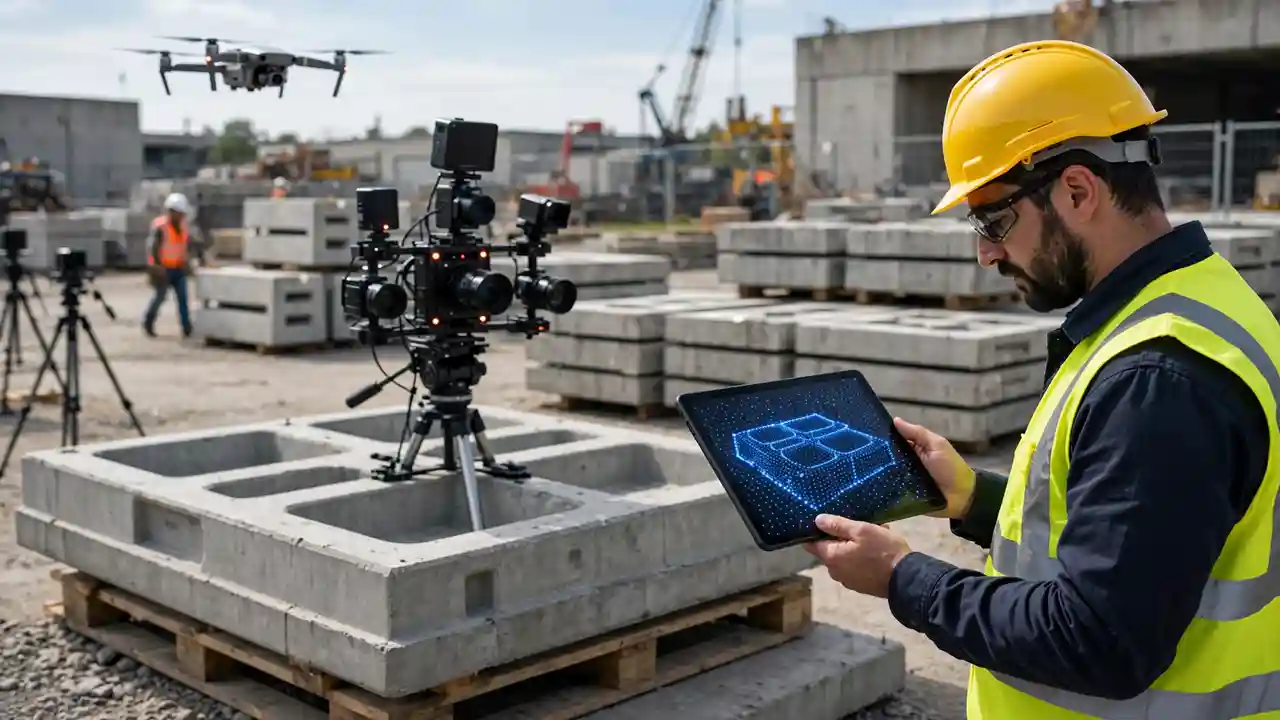
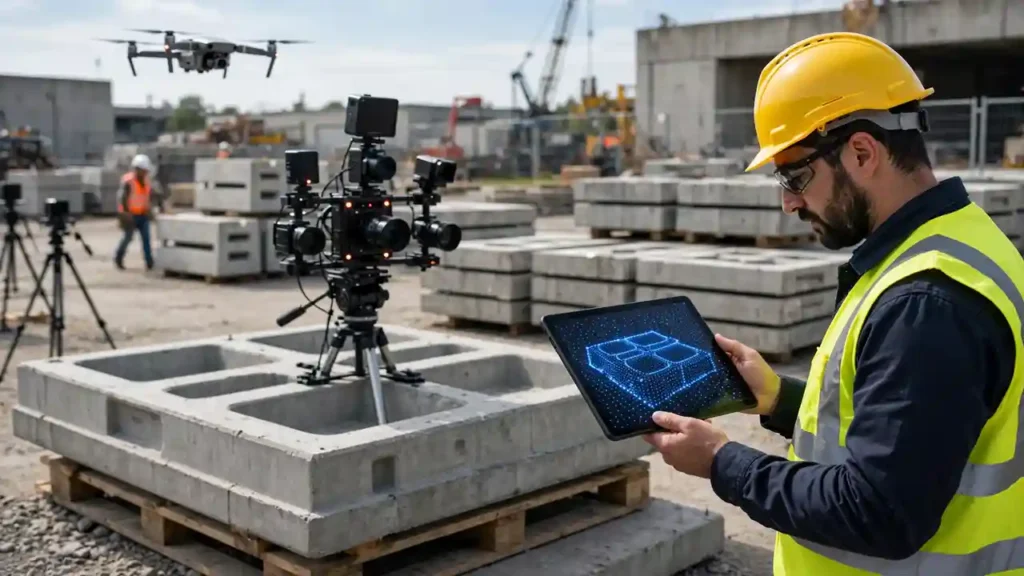
Camera arrays mounted above casting beds can scan panels in real time, flagging hairline cracks, honeycombing, edge spalling, and reinforcement displacement before the element is ever stripped from the form.
That kind of early detection is not just convenient it is structurally critical in precast construction.
Permit for Deck Construction Smart With Precast
How Do Computer Vision Systems Actually Work on a Precast Site?
Our contractors note that understanding the mechanics builds confidence before any capital investment is committed.
Below is a practical breakdown of how these systems integrate into a standard precast production workflow.
Step-by-Step: Implementing Vision-Based QC in a Precast Facility
Step 1 — Baseline Camera Installation
Mount high-resolution industrial cameras above each casting bed at a fixed elevation, typically 8–12 feet, to ensure full panel coverage without distortion.
Step 2 — Software Calibration
Work with your system provider to calibrate the vision software against your facility’s standard panel dimensions, aggregate finish types, and accepted defect thresholds per your structural framing specifications.
Step 3 — Training the Detection Model
Feed the AI model a library of at least 500–1,000 labeled images both acceptable and defective panels drawn from your own production history where possible.
Generic datasets exist, but your specific mix design and curing conditions will produce unique surface signatures.
Step 4 — Live Production Integration
Run the system in parallel with manual inspection for the first 30 days.
This verification period confirms that false-positive rates stay below 5%, which is the industry benchmark referenced in NIST’s manufacturing quality control guidelines.
Step 5 — Data Logging and Reporting
Configure your platform to export defect reports tied to each panel’s batch ID, pour date, and mix design.
This creates a traceable quality record that directly supports structural documentation packages submitted to engineers and building officials.
Step 6 — Iterative Model Refinement
Schedule quarterly model reviews where new defect images captured on-site are used to improve detection accuracy.
Computer vision projects improve with operational data, making your system more valuable over time, not less.
New Construction Apartments The Colony TX
What Does This Mean for Midwest Contractors Specifically?
Our analysis suggests that regional precast producers here carry a distinct advantage.
Midwest fabrication yards tend to operate with tighter vertical integration than coastal markets — meaning the distance between the casting bed and the job site is shorter, and quality control decisions have immediate downstream consequences.
A panel rejected on Thursday in a traditional workflow might delay a structural framing erection sequence the following Monday.
With vision-based inspection running continuously, that rejection happens Tuesday morning when the correction is still manageable.
The National Precast Concrete Association has begun publishing guidance specifically addressing how digital inspection tools interface with plant certification requirements.
That alignment matters for contractors who need their quality systems to satisfy third-party auditors without creating additional documentation burdens.
Construction Screws That Strengthen Precast
Computer Vision Projects Transforming Precast Concrete Builds
— US News (@Us_news_ways) July 8, 2026
Computer vision projects are no longer a distant promise reserved for tech campuses or automotive assembly lines.@procoretech @TrimbleCorpNews @autodesk https://t.co/x4qSe3NY6l
Comparing Traditional vs. Vision-Assisted Inspection
| Inspection Method | Detection Speed | Defect Categories Covered | Labor Required | Traceability |
|---|---|---|---|---|
| Manual Visual Inspection | 8–15 min per panel | Surface cracks, visible spalls | 1–2 inspectors | Paper-based logs |
| Automated Computer Vision | 45–90 sec per panel | Surface, edge, reinforcement alignment | Monitoring only | Digital, batch-linked |
| Hybrid (Vision + Manual) | 3–5 min per panel | Full surface + embedded defects | 1 inspector | Integrated digital record |
Construction industry insiders are noting that the hybrid model is currently the most practical entry point for mid-sized Midwest precast operations.
Full automation makes sense at scale; the hybrid approach delivers most of the speed and traceability gains at a fraction of the upfront cost.
Are the Costs Justified for Structural Framing Applications?
According to research compiled by McKinsey’s Global Infrastructure Practice, construction projects that integrate digital quality monitoring in fabrication phases reduce overall rework costs by an average of 12–18%.
For structural framing work where precast load-bearing elements must meet tight tolerance requirements, that figure translates directly into fewer field modifications and fewer engineer-of-record callbacks.
Computer vision projects positioned specifically for structural precast are also attracting attention from insurance underwriters.
Our team has seen early signals that documented, automated quality records are beginning to influence premium structures on large commercial projects a trend worth monitoring as the 2025–2026 building cycle develops.
The Construction Industry Institute continues to publish benchmarking data confirming that pre-installation defect detection is the single highest-value point for quality investment across all precast construction categories.
Construction Loan Interest Rates
The Bottom Line for Your Next Precast Project
Computer vision projects are not speculative technology reserved for pilot programs.
They are operating production tools delivering real defect reduction, real timeline compression, and real documentation value on precast concrete job sites today.
If your fabrication process still relies entirely on manual inspection, you are carrying a quality risk your competitors are actively eliminating.
Our team at Midwest Precast Contractor is closely tracking adoption patterns across the region.
The fabricators moving first are building a quality record and a production efficiency profile that will be very difficult to match later.