The urgency to reduce carbon footprints has fundamentally shifted how we evaluate project lifecycles.
Sustainable construction companies are no longer treating eco-friendly building practices as a premium upgrade.
Instead, they are leveraging advanced precast concrete technologies to meet strict environmental metrics while simultaneously slashing job-site timelines.
Key Takeaways
- Accelerated Schedules: Precast elements manufactured off-site reduce total construction timelines by up to 20–30%.
- Carbon Reduction: Optimal aggregate blending and controlled curing environments significantly lower the embodied carbon of structural framing.
- Zero Waste: Factory-controlled fabrication eliminates typical on-site material waste, optimizing every cubic yard of concrete.
Masonry contractors near me precast switch drives efficiency
Why are sustainable construction companies shifting to structural precast?
If you have been following structural framing and precast concrete trends across the Midwest, this shift won’t come as a surprise.
Our analysis suggests that traditional cast-in-place methods struggle to match the tight environmental and quality controls required by modern green building standards.
Commercial developers are under intense pressure to secure LEED certification and minimize structural waste.
When sustainable construction companies partner with specialized precast manufacturers, they effectively move the heavy manufacturing away from the chaotic job site into a highly optimized, indoor setting.
This shift allows for the precise measurement of alternative cementitious materials, such as fly ash and slag cement, which drastically lowers the net carbon output of the structural framework.
Residential masonry contractors near me
How does precast compare to traditional cast-in-place framing?
To sustainable construction companies why sustainable construction companies increasingly choose structural precast components, it is helpful to look at the raw structural and logistical advantages.
The table below highlights key performance differences observed across typical commercial projects in the Midwest.
| Performance Metric | Traditional Cast-In-Place Concrete | Structural Precast Framing |
| Material Waste Generation | High (typically 5–7% on-site waste) | Near Zero (controlled factory recycling) |
| Curing Time & Strength | 28 days on-site before full load-bearing | Pre-cured to optimal PSI before delivery |
| Weather Dependency | Highly vulnerable to Midwest winter freezes | Year-round fabrication regardless of weather |
| Embodied Carbon Control | Difficult to monitor mix consistency on-site | Highly precise mix designs with carbon-capture tech |
Our contractors note that eliminating weather dependencies alone can save project owners thousands of dollars in winter heating and hoarding costs.
What steps ensure a successful precast installation?
Achieving maximum structural efficiency requires a highly synchronized installation strategy.
We sustainable construction companies that the most successful projects follow a rigorous, phase-based sequence to ensure safety, structural integrity, and minimal environmental disruption.
1.Engineering and Digital Modeling:Phase 1.
Engineers design all structural members using BIM software to ensure perfect alignment.
The exact structural load requirements and lifting point inserts are integrated directly into the digital shop drawings.
2.Controlled Factory Fabrication:Phase 2.
The components are cast inside an indoor facility using reusable steel molds.
Technicians introduce low-carbon concrete mixes, then steam-cure the components to achieve high early compressive strength rapidly.
Masonry contractors near me precast switch drives efficiency
3.Site Preparation and Geotechnical Verification:Phase 3.
On-site crews pour foundations and verify the subgrade load capacities.
Engineers inspect the structural anchor bolts and grade beams to guarantee they match the exact tolerances required by the incoming precast columns.
4.Sequenced Delivery and Rigging:Phase 4.
Precast pieces arrive on site in the precise order they will be erected, eliminating the need for extensive structural storage space.
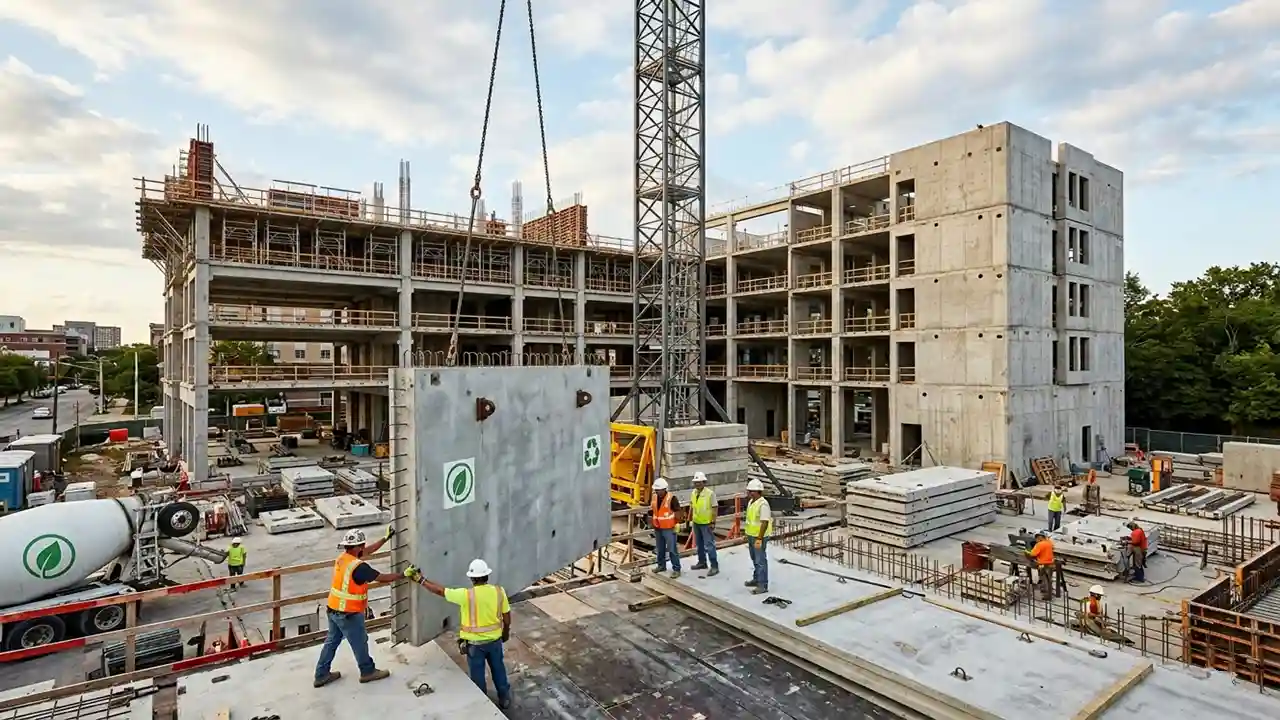
A heavy-duty crane lifts each panel directly from the flatbed truck into its final structural position.
5.Structural Grouting and Connection Ties:Phase 5.
Crews secure sustainable construction companies connections using high-strength non-shrink grout and heavy structural steel weld plates.
Inspectors verify the structural alignment before the crane releases the load, ensuring immediate structural stability.
Suppliers of Construction Materials New Precast Standard
How will this impact your next commercial build?
Choosing to work with sustainable construction companies that specialize in precast systems changes the financial calculator of a project.
Because the structural components are built off-site, you can perform excavation, grading, and foundation work concurrently with the manufacturing of your walls and floors.
This compressed timeline means your building is enclosed faster, allowing interior trades to begin their installations weeks ahead of schedule.
Furthermore, the thermal mass of heavy precast concrete walls inherently improves the energy efficiency of the completed building.
According to long-term sustainability metrics published in the AISC Engineering Journal, structures built with high-thermal-mass concrete shells require significantly less HVAC energy over their lifetime to maintain comfortable interior temperatures.
Traveling Construction Jobs Midwest Precast Projects
Sustainable Construction Companies Lead the Precast
— US News (@Us_news_ways) June 4, 2026
Sustainable construction companies are no longer treating eco-friendly building practices as a premium upgrade.@ConstWorldSA @4ConstructnPros @ConcreteNetwork https://t.co/lU76Mfz5Zd
What should project owners look for in green builders?
Not all contracting firms approach green building with the same level of analytical depth.
Leading sustainable construction companies back up their environmental claims with concrete data, such as verified Environmental Product Declarations (EPDs).
These documents outline the exact carbon footprint of the materials from raw extraction through final delivery to the job site.
Construction industry insiders are noting that developers who ignore these transparency metrics risk facing compliance penalties as municipal building codes tighten across the country.
By opting for structural precast framing, you are investing in a system that naturally aligns with the circular economy.
The steel forms are used hundreds of times, and any leftover concrete mix within the plant is instantly recycled into smaller components like road barriers or retaining wall blocks.
Ultimately, working with forward-thinking sustainable construction companies allows you to balance environmental stewardship with fiscal responsibility.
You receive a stronger, highly fire-resistant, and seismically stable building without paying a premium for the “green” label.
The efficiency of precast manufacturing ensures that reducing your project’s environmental footprint directly supports a faster, safer, and highly profitable build.