

Concrete crews carry real exposure every shift, from crane picks to curing windows. A strong risk management plan construction teams can trust turns that exposure into controlled, predictable work. For project managers, developers, and property owners, the payoff is direct. Fewer surprises, safer sites, and tighter budgets.
Key Takeaways
- A written plan follows five steps: identify, assess, plan, mitigate, and monitor.
- Granular 1 to 10 scoring beats vague high-medium-low ratings for prioritizing risk.
- Plant-controlled precast reduces weather and quality variability on demanding Midwest jobs.
Building the Dallas Holocaust and Human Rights Museum: A Study
Market Context
Construction stays one of the highest-exposure industries in the country. Heavy equipment, tight schedules, and shifting weather stack risk fast. Midwest Precast Contractor builds with that reality in mind. We plan before we pour.
The reason is structural, not just administrative. Load paths, embeds, and curing conditions all carry consequences. Guidance from the American Concrete Institute anchors how we set those controls. Our hands-on engineering experience shows that early planning protects both crews and budgets.
Why Risk Planning Matters on Real Jobsites
Risk on a jobsite is anything that adds cost, delay, or danger. Concrete and precast work concentrate several risk types at once. That density is why planning matters.
- Crane and rigging picks carry high-severity safety risk.
- Weather swings affect pours and curing.
- Embed errors trigger costly rework.
- Change orders disrupt sequence and budget.
Industry contractors are noting how front-loaded planning pays off. The Occupational Safety and Health Administration sets the safety floor we build above. Discipline early means fewer fires later.
What a Risk Management Plan Construction Process Includes
A solid plan is a living document, not a filing-cabinet formality. It steers decisions from preconstruction through closeout. We treat it as a jobsite tool.
The industry has settled on a standard five-step process. Every step feeds the next. Here is how the cited sources line up on the core ideas.
| Idea | What Sources Agree On |
|---|---|
| Purpose | Identify, evaluate, and plan for possible risks |
| Process | Identify, assess, plan, mitigate, monitor, report |
| Why construction differs | Weather, heavy equipment, materials, changing crews |
| Core risk types | Safety, financial, legal, project, environmental |
| Key documents | Risk register, risk matrix, response plan |
| Ongoing need | Monitoring and reporting never stop |
These points hold across every source we reviewed. Consistency here is a good sign. A risk management plan construction teams follow should reflect all six.
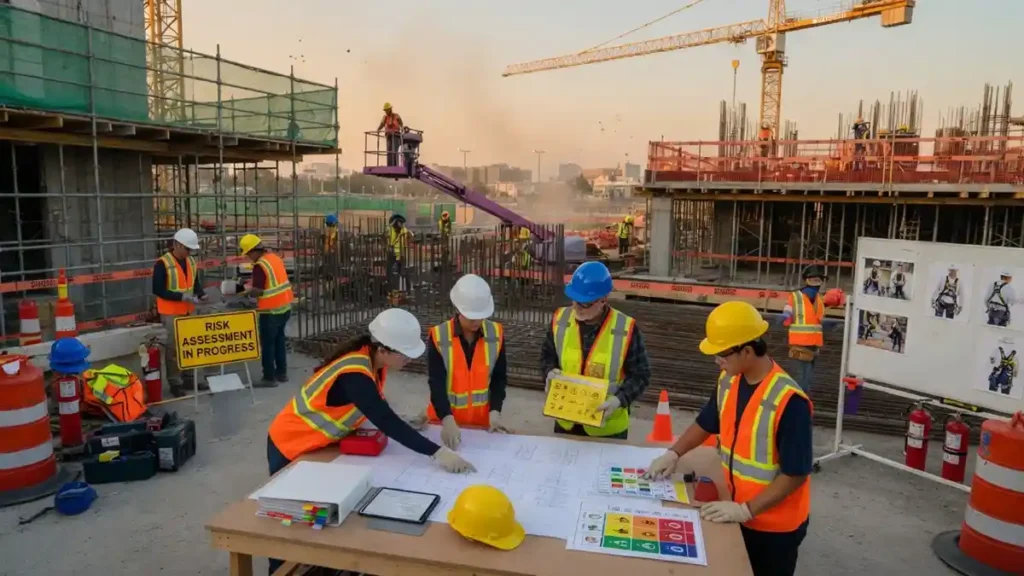
Risk Register, Matrix, Owners, and Reporting
The plan lives inside a few key tools. Each tool has a clear job. Skip one and gaps appear.
- Risk register: logs each risk, its rating, owner, and response.
- Risk matrix: maps likelihood against impact visually.
- Risk owner: one named person accountable for action.
- Risk budget: contingency set aside for surprises.
- Communication plan: keeps stakeholders aligned.
The NIST Computer Security Resource Center defines a risk register as a central record of risk data. That definition fits construction cleanly. Reporting keeps clients and crews on the same page. Key risk indicators flag trouble early.
Reuben Brothers & Alan Faena Miami Development Project
Major Risk Categories in Concrete and Structural Work
Risk clusters into predictable categories. Naming them helps crews plan responses. We rate each one honestly.
Best practice favors a 1 to 10 scale over high-medium-low. Three-point scales feel simple but blur priorities. Granular scoring makes it easier to rank and act. Here is a sample framework we use.
| Likelihood (1-10) | Impact (1-10) | Score (L x I) | Response Threshold |
|---|---|---|---|
| 8 | 9 | 72 | Immediate mitigation, senior review |
| 6 | 7 | 42 | Active mitigation, weekly tracking |
| 4 | 5 | 20 | Standard controls, monitor |
| 2 | 3 | 6 | Accept, note in register |
Multiplying the two scores gives a priority number. Higher numbers get resources first. This keeps attention where it belongs.
Technical, Financial, Safety, and Schedule Exposure
Each category demands its own response. Safety always ranks critical when life is at stake. That rule never bends.
| Category | Example Risk | Typical Response |
|---|---|---|
| Technical | Design change, embed error | Redesign, QA verification |
| Financial | Material cost spike, delayed payment | Contingency, locked contracts |
| Safety | Fall hazard, crane pick failure | Training, rigging review |
| Schedule | Weather delay, labor shortage | Buffer time, phased sequence |
| Legal | Contract dispute, code violation | Documentation, site audits |
| Environmental | Flood, freeze, storm | Insurance, weather protection |
A sample risk register brings this to life on a precast job.
| Risk | Score | Owner | Response |
|---|---|---|---|
| Panel connection misalignment | 56 | Field engineer | Verify embeds pre-erection |
| Cold-weather curing failure | 48 | Site super | Heated enclosure, monitoring |
| Crane setup on soft subgrade | 63 | Lift director | Ground assessment, mats |
| Late shop drawing approval | 35 | PM | Early submittal schedule |
Materials and Structural System Risk Comparison
System choice shifts risk in real ways. No system is risk-free. The goal is matching risk to the job. If you have tracked precast concrete standards, this comparison will feel familiar.
- Precast moves work into a controlled plant.
- Cast-in-place stays exposed to site conditions.
- Steel shifts risk toward coatings and detailing.
- Restoration depends on substrate and moisture.
The Precast/Prestressed Concrete Institute documents how plant curing tightens quality control. Midwest Precast Contractor builds with durable materials and engineering precision across all four systems.
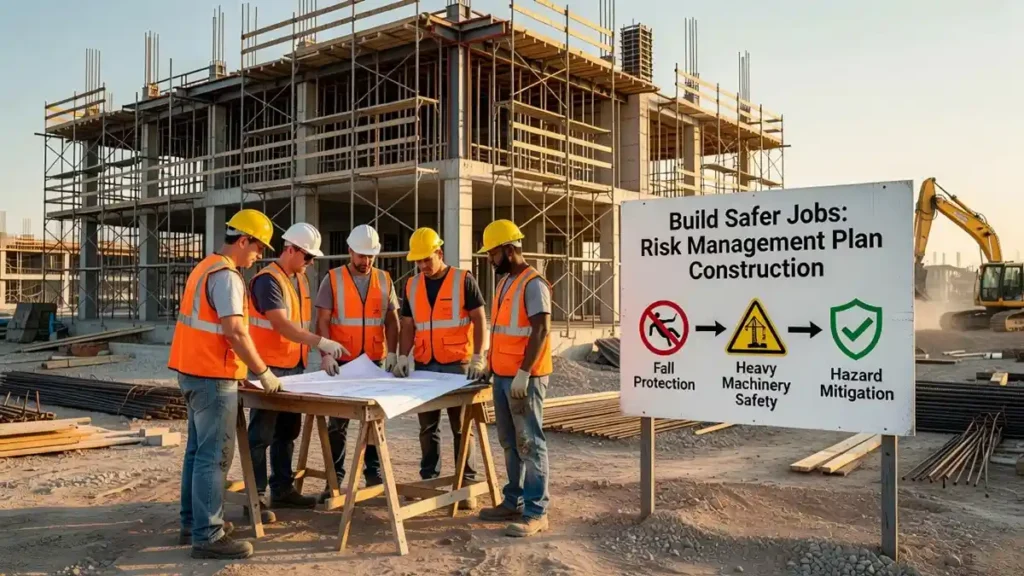
Build Safer Jobs Risk Management Plan Construction
— US News (@Us_news_ways) September 8, 2026
A strong risk management plan construction teams can trust turns that exposure into controlled, predictable work.@NIOSH @CPWR @OSHA_DOL https://t.co/5MzHB4l4ZZ
Durability Comparison Table
Here is how the systems compare on demanding Midwest jobs. Ratings reflect general performance, not any single project.
| System | Durability | Load Performance | Schedule Reliability | Quality Control | Cost Efficiency | Midwest Weather Resistance |
|---|---|---|---|---|---|---|
| Precast Concrete | Excellent | High, engineered | High, plant-cured | Excellent, factory QC | Strong lifecycle value | Excellent, weather-independent casting |
| Cast-in-Place | Very good | High, site-poured | Moderate, weather-tied | Good, cure-dependent | Moderate | Good, needs cold-weather care |
| Structural Steel | Good | Very high | High erect speed | Good, shop-fabricated | Higher with coatings | Fair, corrosion and coating risk |
| Restoration Systems | Good, extends life | Restores rating | Moderate, condition-driven | Fair, substrate-dependent | High for targeted repair | Good with proper sealers |
Plant control is precast’s biggest risk advantage. Freeze-thaw cycles and wet seasons hit site work harder. Our weather-resistant builds handle Midwest-tough conditions.
Risk Response and Field Execution
Plans only matter if the field executes them. Response follows four paths: avoid, mitigate, transfer, or accept. Most concrete risks get mitigated.
The International Code Council explains why code-driven controls guide field work. Our crews run pre-task planning before every high-risk activity. That habit catches problems early. Contingency plans stand ready for the risks we accept.
The Fire Engineering Value of Fire Resistance Period
Site Controls, Sequencing, and Inspections
Field discipline is where risk gets controlled. Hold points and sequencing protect quality. Every step has a checkpoint.
- Pre-task planning: brief the crew before each task.
- Crane and rigging reviews: confirm picks, loads, and ground.
- Embed and anchor verification: check placement before erection.
- Subgrade and formwork checks: confirm bearing and alignment.
- Curing and weather protection: enclose and heat when needed.
- Moisture management: control water in slabs and substrates.
- Trade coordination: sequence MEP and structure cleanly.
- Permit and inspection hold points: stop work until sign-off.
- Change order discipline: document scope shifts fast.
- Punch list closeout: verify every item before handover.
Here is how those controls map to sequence.
| Phase | Control | Inspection Hold Point |
|---|---|---|
| Preconstruction | Risk register, pre-task plans | Plan sign-off |
| Foundations | Subgrade, formwork checks | Pre-pour inspection |
| Erection | Rigging, embed verification | Pre-lift review |
| Curing | Weather protection, moisture | Strength verification |
| Closeout | Punch list, documentation | Final inspection |
Guidance from the Federal Highway Administration reinforces these staged checks. Sign-off before the next phase keeps schedules intact.
What This Means for Midwest Owners and Contractors
For owners, a strong plan means fewer budget shocks. For contractors, it means safer crews and cleaner schedules. Both sides win when risk is managed.
Midwest Precast Contractor runs a clear process: consultation, planning and design, execution, and final inspection. Each stage builds risk controls in. We are licensed and insured for that reason. Publicly posted plan examples, like generic civil construction templates, confirm the same backbone: objectives, risk team, assessment, contingency, KPIs, and continuous improvement.
Seattle Children’s Bellevue Clinic And Surgery Center Bellevue WA: A Precast Blueprint
Practical Applications for Precast, Formwork, and Restoration
Different project types carry different risk profiles. Matching scope to method reduces exposure. We label these as applied lessons.
| Project Type | Primary Risk | Best-Fit Approach |
|---|---|---|
| Industrial foundations | Subgrade, load capacity | Engineered slabs, verification |
| Precast installation | Rigging, connection accuracy | Plant QC, pre-lift review |
| Structural framing | Alignment, sequencing | Coordinated erection plan |
| Renovation | Hidden conditions | Survey, selective demolition |
| Restoration | Substrate, moisture | Condition assessment, sealers |
The American Society of Civil Engineers supports this condition-first approach. Restoration especially lives or dies on substrate quality. We assess before we commit on every reuse job.
UNESCO Building V Completed 1970: A Concrete Lesson
Why Midwest Precast Contractor Fits Complex Risk-Controlled Work
We build for demanding, code-driven sites. Our team is licensed and insured with 15+ years of experience. We use durable materials and honor timelines.
What sets our work apart:
- Precast concrete solutions for panels, towers, and foundations.
- Formwork and concrete systems for accurate shaping.
- Structural framing with safety-first practices.
- Renovation and remodeling for aging structures.
- Large-scale precast installation experience.
On-time delivery and weather-resistant builds anchor every job. Our four-step process keeps quality high and surprises low. That is risk management in practice, not just on paper.
Final Thoughts
A written risk management plan construction teams actually use turns uncertainty into control. Identify early, score honestly, and execute with discipline. As of the latest industry context in August 2026, the fundamentals hold steady. Plan the work, then work the plan. Contact Midwest Precast Contractor to build your next project the right way.


