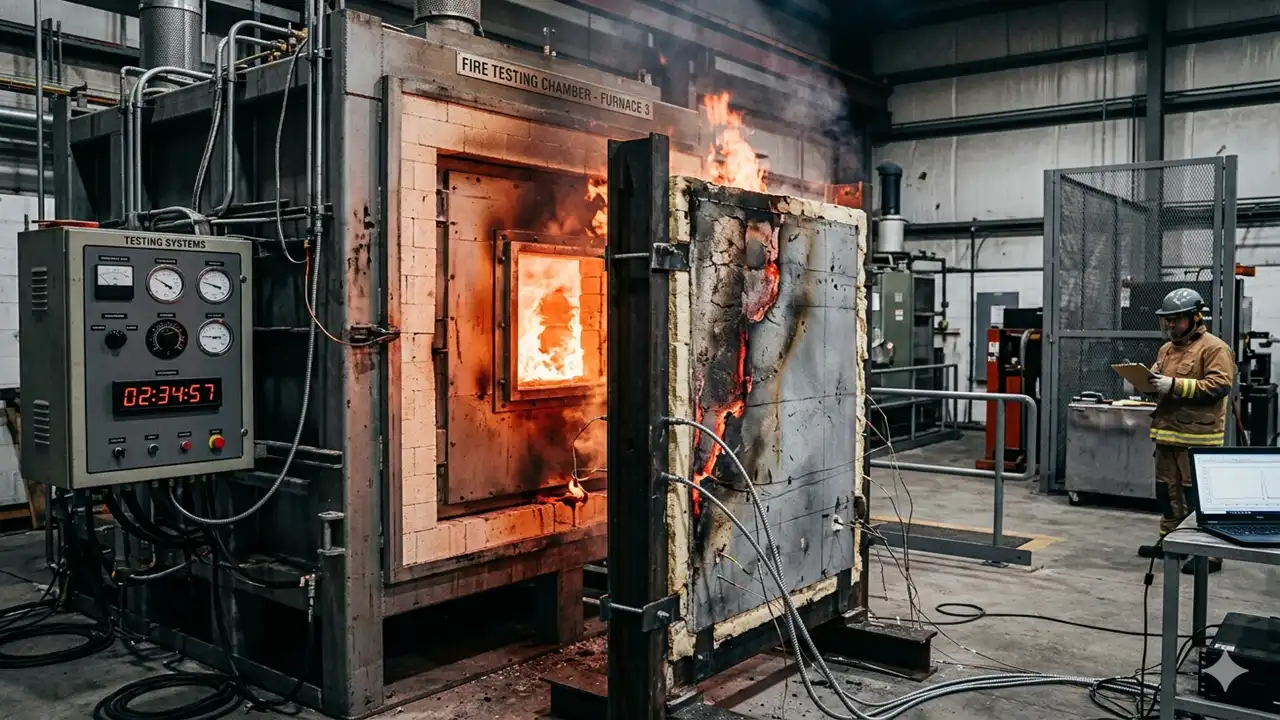
When a fire starts, minutes decide whether a structure stands or falls. The fire resistance period measures exactly how long a building assembly holds up under flame before it fails. For developers, project managers, and property owners, that number is the difference between safe evacuation and total loss.
At Midwest Precast Contractor, we treat this metric as a design cornerstone, not a checkbox.
Read also: Northumberland Development Project in Large-Scale Precast Concrete Construction
Key Takeaways
- The fire resistance period measures how long an assembly resists fire, rated in minutes or hours, and tested to ASTM E119 conditions.
- Concrete and precast outperform steel and wood because they are non-combustible and hold structural load far longer under heat.
- IBC 2024 ties required ratings to building height, occupancy, and construction type, with sprinkler concessions available.
What Is the Fire Resistance Period?
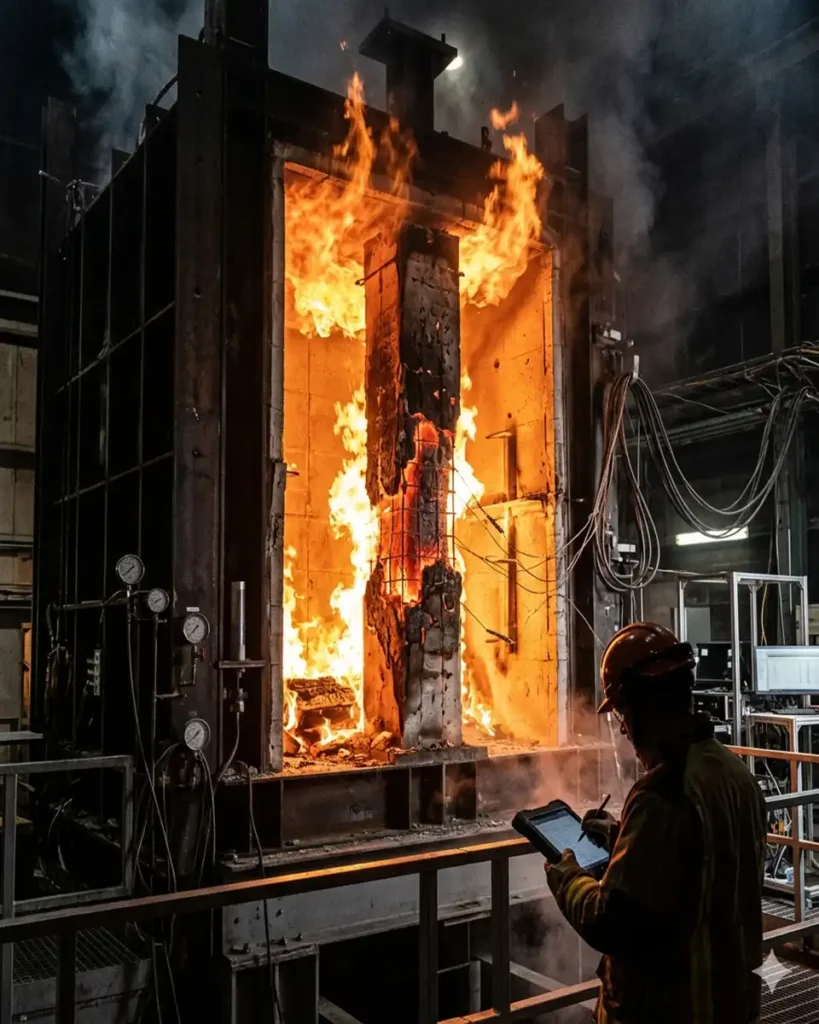
The fire resistance period is how long a construction assembly can resist a standard fire before it loses function. It is expressed in minutes or hours. Fire experts measure it by exposing the assembly to a controlled heat curve and recording when it fails.
Think of it as a countdown clock for structural survival. Walls, floors, and roofs each carry their own rating. Our crews design every element to meet or beat the required number.
The Three Pillars of Fire Resistance Classification
Testing labs judge every assembly against three critical criteria. An assembly earns its rating only while it passes all three at once.
- Load-Bearing Capacity: The element must keep supporting its designed load under intense heat. A wall or floor cannot buckle.
- Integrity: The assembly must block flames and hot gases from passing through cracks or gaps to the far side.
- Insulation: The unexposed face must stay cool enough to prevent ignition of nearby materials.
Once any one criterion fails, the clock stops. That failure point becomes the recorded rating.
How the Fire Resistance Period Is Measured and Tested
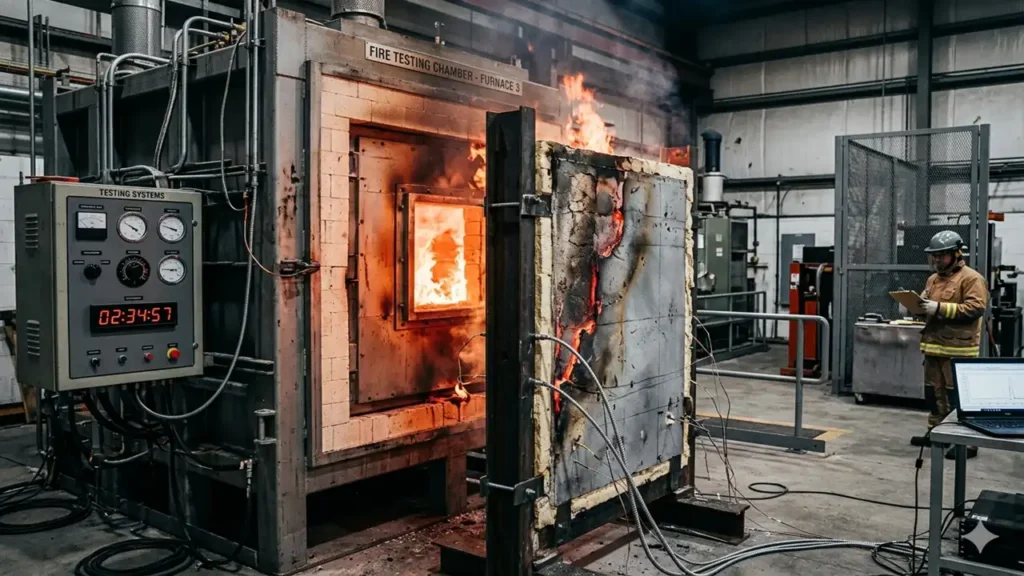
Labs use the standard fire curve to simulate a real blaze. The two governing standards in the US are ASTM E119 and NFPA 251, which define furnace temperatures and pass/fail rules.
The furnace ramps to roughly 1,000°F in 5 minutes and climbs past 1,700°F by the one-hour mark. Technicians watch for load failure, flame passage, and heat transfer. Whichever comes first sets the rating. Our specifications reference these tests directly for every precast panel we cast.
Shuttering and Shuttering Structural Guide
IBC 2024 Construction Type Requirements
The International Building Code links required ratings to construction type, height, and occupancy. Table 601 sets the baseline for structural elements. Here is a simplified view.
| Construction Type | Structural Frame | Bearing Walls (Ext.) | Floors | Roofs |
|---|---|---|---|---|
| Type I-A | 3 hr | 3 hr | 2 hr | 1.5 hr |
| Type I-B | 2 hr | 2 hr | 2 hr | 1 hr |
| Type II-A | 1 hr | 1 hr | 1 hr | 1 hr |
| Type III-A | 1 hr | 2 hr | 1 hr | 1 hr |
| Type V-A | 1 hr | 1 hr | 1 hr | 1 hr |
Taller buildings and high-occupancy uses push ratings higher. Precast systems make hitting Type I targets straightforward.
Precast Concrete Fire Resistance Specifications
Concrete earns high ratings because it is dense, non-combustible, and slow to transfer heat. Per ACI/TMS 216.1, the fire resistance period rises with slab thickness and depends on aggregate type. The PCI Design Manual sets cover and prestress rules.
| Slab Thickness | Carbonate Aggregate | Siliceous Aggregate | Lightweight |
|---|---|---|---|
| 3.5 in | 1 hr | 1 hr | 1.5 hr |
| 5.0 in | 2 hr | 2 hr | 2.5 hr |
| 6.2 in | 3 hr | 3 hr | 3.5 hr |
| 7.0 in | 4 hr | 4 hr | 4+ hr |
Concrete cover over prestressing strands protects the steel from heat. More cover means a longer rating.
Material Comparison for Midwest Builds
Our crews weigh durability, cost, and fire performance on every project. Here is how the main structural options stack up for Midwest conditions.
| Material | Combustible? | Typical Rating | Weather Resistance | Relative Cost |
|---|---|---|---|---|
| Precast Concrete | No | 1 to 4 hr | Excellent | Moderate |
| CMU (Block) | No | 1 to 4 hr | Very good | Moderate |
| Structural Steel | No (but weakens) | 0 to 2 hr* | Good | Moderate–High |
| Wood Frame | Yes | 0 to 1 hr | Fair | Low |
*Unprotected steel loses strength fast and needs added fireproofing. Precast wins on freeze-thaw endurance too.
How Sprinkler Systems Affect the Required Fire Resistance Period
Active suppression can reduce the passive rating a code demands. Sprinklers slow fire growth, which buys time and lowers structural risk.
- Sprinklers often allow a 30-minute reduction in required structural ratings.
- The concession also applies to doors, floors, and compartmentation.
- Tall buildings still require sprinklers regardless of the concrete rating.
Even so, we never treat sprinklers as a substitute for a solid passive shell. Water systems can fail; concrete does not.
CIIIB Cement Built for Midwest Durability
Calculating and Verifying the Fire Resistance Period
You can confirm a rating two ways. Both are valid under code and insurance review.
- Prescriptive tables: Match your assembly to published ratings in ACI 216.1 or IBC tables.
- Calculated methods: Use documented equations for thickness, aggregate, and cover.
- Tested assemblies: Cite a listed ASTM E119 furnace result.
- Third-party review: Have an engineer verify the fire resistance period against the design load.
At Midwest Precast Contractor, we document every calculation so inspectors sign off fast and your schedule stays on track.
Sector-Specific Requirements
Different occupancies carry different stakes. Guidance from FEMA and structural fire memos shape these thresholds.
- Commercial/Office: Commonly 60 minutes for mid-rise structures.
- Industrial/Storage: Often 90 minutes, more for deep or unsprinklered spaces.
- Healthcare: High ratings plus compartmentation for non-ambulatory occupants.
- Schools: Sprinklers plus robust ratings, given frequent fire incidents.
- Electrical Substations: Minimum 1 hour, up to 4 hours near transformers.
Each sector demands its own fire resistance period strategy. We tailor mixes and cover accordingly.
Building the Dallas Holocaust and Human Rights Museum: A Study
How Midwest Precast Contractor Engineers Fire Resistance Into Every Build
We build the fire resistance period into the design phase, not as an afterthought. Our precast panels ship with documented ratings and verified cover depths.
- Engineering precision: Every mix and strand cover is calculated and logged.
- Weather resistance: Our concrete handles Midwest freeze-thaw and fire alike.
- On-time delivery: Factory casting keeps schedules tight and quality consistent.
OSHA fire safety guidance from OSHA informs our jobsite protocols. Contact us to spec a compliant assembly for your next project.
Pros and Cons of High Fire Resistance Ratings
Higher is not always the only answer. Here is the honest trade-off.
Pros
- Longer safe evacuation windows for occupants.
- Lower insurance premiums and better underwriting terms.
- Reduced property loss and faster recovery after an event.
Cons
- Higher upfront material and design cost.
- Thicker elements add weight and footprint.
- May exceed code minimums where sprinklers already apply.
We help you land on the right rating, not just the highest.
Reuben Brothers & Alan Faena Miami Development Project
FAQ
| Question | Answer |
|---|---|
| Is fire resistance the same as fireproof? | No. Nothing is fireproof. The fire resistance period measures how long an assembly resists before failing. |
| Which test governs US ratings? | Primarily ASTM E119 and NFPA 251. |
| Does concrete thickness matter? | Yes. Thicker slabs and more cover mean a longer rating. |
| Can sprinklers lower my required rating? | Often yes, typically by 30 minutes under code concessions. |
| Does precast beat steel in a fire? | Usually. Concrete stays stable while unprotected steel weakens fast. |
The Bottom Line
The fire resistance period is one of the clearest measures of how safe your structure truly is. It shapes evacuation time, insurance, and code approval. Concrete and precast give you the longest, most reliable protection for Midwest conditions.