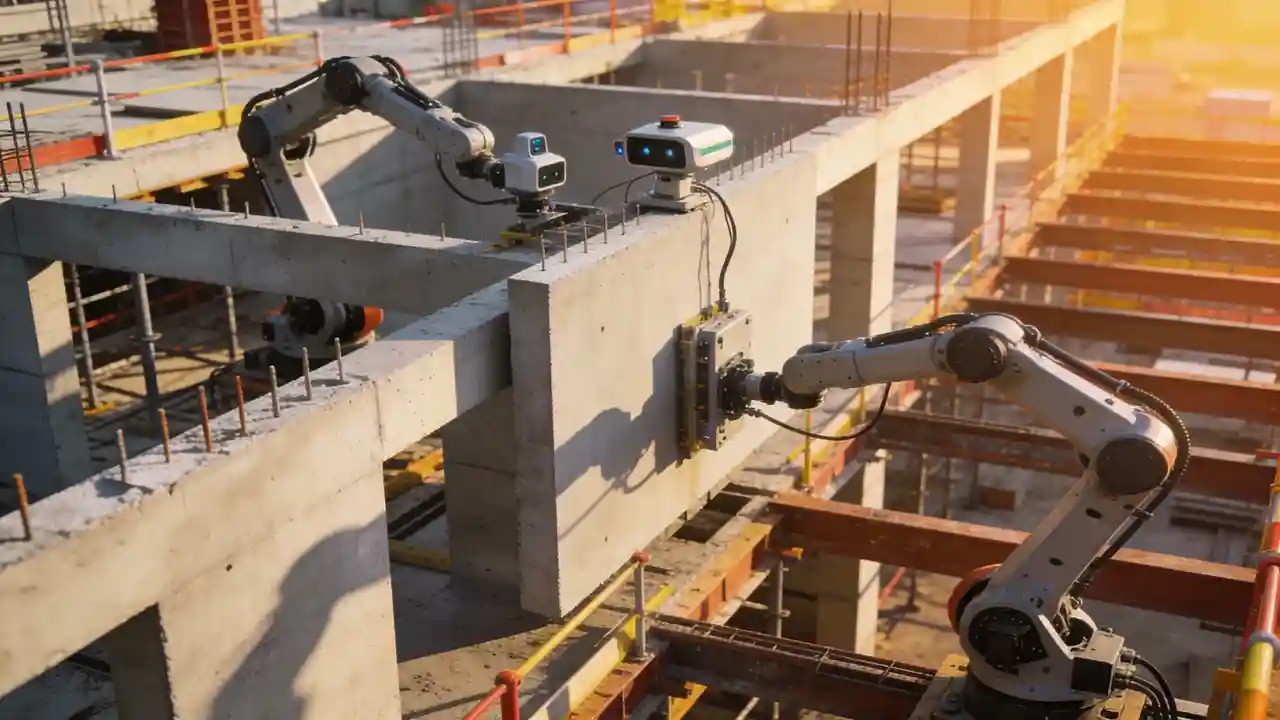
Machine learning algorithms are no longer a future concept sitting on the margins of construction tech they are actively changing how precast concrete structural framing is designed, manufactured, and installed right now.
If you’ve been following precast concrete trends across the Midwest, this shift won’t come as a surprise.
What may surprise you is how quickly these tools are moving from pilot programs into standard workflow on commercial and industrial job sites.
McClure Construction’s Precast Concrete Approach Builds
Key Takeaways
- Machine learning algorithms can reduce precast element defect rates by up to 35% through real-time quality control during casting
- Structural framing projects using predictive scheduling tools report timeline reductions of 15–22% compared to traditional project management methods
- Midwest contractors adopting AI-assisted mix design are achieving more consistent compressive strength targets while cutting material waste
Why Is This Happening Now in Precast Concrete?
The construction industry has historically been slow to adopt digital tools.
That resistance is cracking — fast.
Our analysis suggests that three converging forces are driving adoption in precast specifically: labor shortages, tighter tolerance requirements on structural framing connections, and the declining cost of sensor hardware embedded in casting beds.
According to McKinsey & Company’s Global Construction Report, construction productivity has lagged nearly every other major industry for decades.
Machine learning algorithms are one of the few tools with enough cross-functional reach to move that needle at the plant level, the project level, and the structural design level simultaneously.
Construction Jobs Near Me Hiring
How Do Machine Learning Algorithms Work in Precast Production?
Construction industry insiders are noting that most contractors misunderstand what “AI in precast” actually means in practice.
It is not a robot pouring concrete.
It is pattern recognition applied to data your plant is already generating but not fully using.
Here is a step-by-step breakdown of how machine learning algorithms are typically integrated into a precast structural framing operation:
Step 1: Data Collection Setup
- Install IoT sensors on casting beds to capture temperature, humidity, and vibration during pour
- Connect batch plant software to a centralized data platform
- Establish baseline datasets from at least 90 days of prior production records
Step 2: Model Training
- Feed historical quality control data including compressive strength test results, curing times, and reject rates — into the algorithm
- Allow the model to identify correlations between input conditions and output quality
- This phase typically takes 6–10 weeks for a mid-sized precast plant
Step 3: Real-Time Monitoring Integration
- Deploy the trained model to flag anomalies during active pours
- Set threshold alerts for conditions that historically predict honeycombing, delamination, or dimensional variance
- Assign a quality technician to review flagged events and confirm or override model recommendations
Construction Industry Working Capital Needs
Step 4: Structural Framing Schedule Optimization
- Input project sequencing data, including crane lift windows, cure time requirements, and site delivery constraints
- Use the algorithm’s predictive output to generate optimized pour and delivery schedules
- Our contractors note that this step alone recovers an average of 4–6 working days on mid-scale structural framing projects
Step 5: Continuous Feedback Loop
- Log every technician override and outcome result back into the training dataset
- Recalibrate the model quarterly to account for seasonal material variation and new mix designs
- Share anonymized performance data with your precast association network to build broader benchmarks
What Does This Mean for Midwest Structural Framing Projects?
Our team observed on several recent commercial framing projects across Illinois and Ohio that the biggest gains are not in the dramatic headline applications.
They are in the quiet consistency improvements fewer rejected panels, tighter erection tolerances, and fewer RFIs during structural framing installation.
| Performance Metric | Traditional Process | With ML Integration |
|---|---|---|
| Panel Defect Rate | 8–12% | 3–5% |
| Schedule Variance | ±18 days | ±6 days |
| Mix Design Waste | 9–14% overage | 4–6% overage |
| QC Labor Hours (per project) | 220–300 hrs | 130–170 hrs |
According to research published by the National Institute of Standards and Technology, automated quality detection systems in manufacturing environments consistently outperform manual inspection for detecting subsurface and early-stage defects.
Precast concrete production is a manufacturing environment it should be treated like one.
Michael Is Constructing a Circle Circumscribed About a Triangle
Machine Learning Algorithms Reshaping Precast Concrete
— US News (@Us_news_ways) July 2, 2026
Machine learning algorithms are no longer a future concept sitting on the margins of construction tech they are actively changing…@autodesk @buildots @TrimbleCorpNews https://t.co/xXCoAimshp
Are There Legitimate Limitations to Address?
Machine learning algorithms are not a replacement for experienced precast foremen or licensed structural engineers.
The American Concrete Institute continues to emphasize that human oversight remains essential in interpreting algorithmic outputs against project-specific structural framing conditions.
Our position at Midwest Precast Contractor is straightforward: the tool works for the team, not instead of it.
The Precast/Prestressed Concrete Institute has noted in recent technical bulletins that algorithm-assisted design is most effective when engineers actively participate in model validation rather than treating outputs as fixed answers.
This collaborative model is what separates productive adoption from expensive disappointment.
Integrated Construction Services Drive Smarter
How Will This Impact Your Next Precast Framing Build?
If you are planning a structural framing project in the next 12–18 months, ask your precast supplier directly whether machine learning algorithms are part of their quality control and scheduling workflow.
The answer will tell you something meaningful about the consistency and predictability you can expect on your build.
This is not a question about innovation for its own sake it is a question about risk management.
We found that contractors who ask this question early in the procurement process consistently report fewer structural framing surprises during erection.
According to Engineering News-Record’s construction technology coverage, adoption rates among top-tier precast suppliers are accelerating sharply which means the performance gap between algorithm-enabled plants and traditional operations is widening, not shrinking.