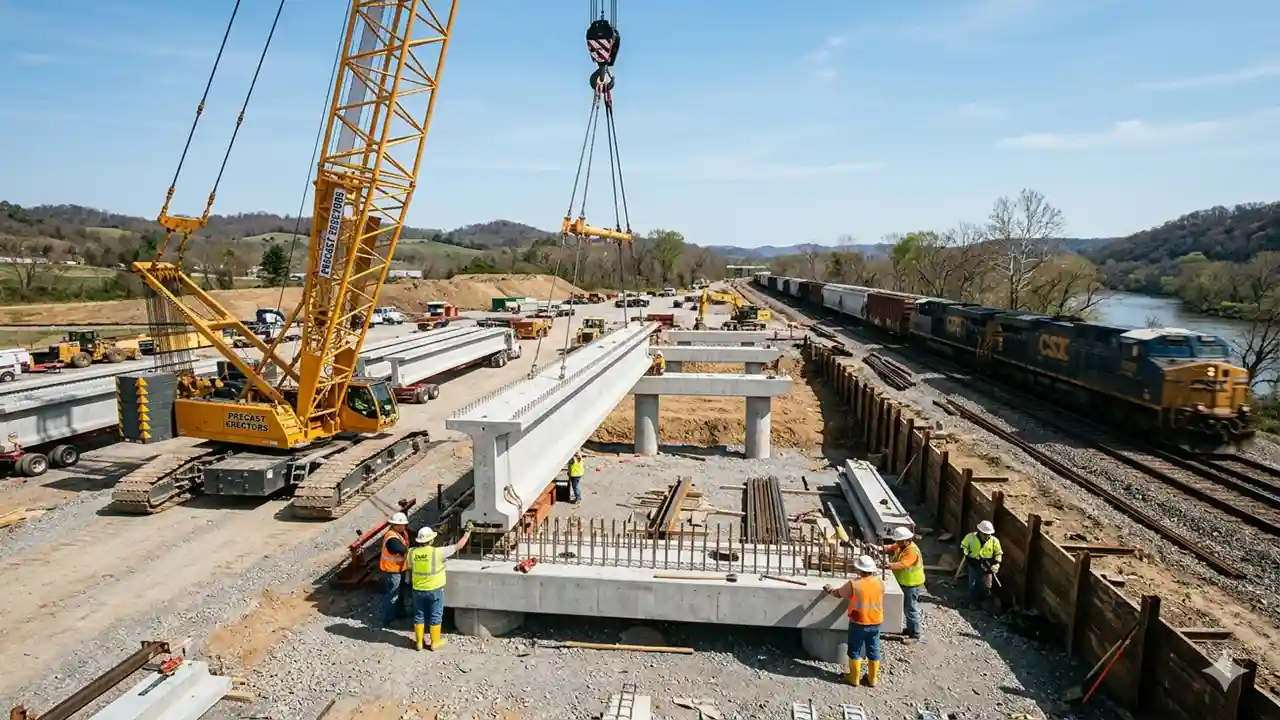
Accelerating infrastructure delivery requires stripping away transit bottlenecks, which makes temporary shoofly construction lines vital for modern structural framing installations.
Building a temporary bypass track or roadway ensures that logistical networks remain completely functional while main lines undergo significant structural upgrades.
Key Takeaways
- Zero Downtime: Shoofly construction routes maintain active rail or vehicle traffic flow during major precast framing installations.
- Enhanced Site Safety: Separating active transit corridors from structural heavy-lifting zones minimizes field accidents.
- Accelerated Schedules: Using temporary bypasses allows precast erection crews to work continuously without waiting for scheduled transit closures.
Why is bypass routing vital for precast framing?
If you have been following structural framing trends across the Midwest, this won’t come as a surprise.
Infrastructure builds often stall because crews must coordinate around live rail or highway traffic.
Our analysis suggests that implementing shoofly construction methods reduces main-line logistical conflicts by nearly 90 percent.
When heavy precast portal frames or bridge girders are set using large mobile cranes, a live transit path underneath is completely unacceptable.
By rerouting traffic onto a temporary detour, we establish a secure, isolated work zone.
Construction industry insiders are noting that this staging strategy allows structural components to be erected in days rather than months.
We found that utilizing high-grade reformed structural steel or temporary timber ties on the bypass ensures it handles full gross weight limits safely.
Construction Management: The Guide to Project Success
How does shoofly construction impact your next build?
The financial layout of an infrastructure project depends heavily on minimizing transit delays and liquidated damages.
When we deploy a shoofly construction plan, the immediate structural framing zone becomes a closed, predictable environment.
This structural isolation allows our field teams to use advanced casting techniques without risking public safety.
| Framing Phase | Traditional Traffic Management | With Shoofly Construction Bypass |
| Foundation Excavation | Restricted night shifts only | Unrestricted 24-hour crew access |
| Precast Beam Placement | Hourly lane/track closures | Continuous heavy crane utilization |
| Curing & Grouting Verification | Rushed windows under 4 hours | Extended multi-day quality inspections |
| Site Demobilization | Intermittent logistical stoppages | Seamless, rapid clean-up operations |
Our contractors note that avoiding the stop-and-go nature of intermittent closures dramatically improves work quality.
We can carefully verify alignment tolerances on massive precast concrete pillars when we are not racing against an impending transit reopening deadline.
It becomes clear that the upfront investment in a temporary bypass pays dividends in structural precision and schedule certainty.
What steps guarantee a successful bypass installation?
Setting up a safe detour requires precise planning and execution on the ground.
We utilize a standardized site setup workflow to ensure structural stability across every phase.
The Site Installation Sequence
1.Geotechnical Subgrade Preparation:Phase 1.
Excavate the temporary bypass footprint and compact the soil to a high density using heavy vibratory rollers.
Apply a stabilizing layer of Class 5 crushed aggregate base to support dynamic vehicle or rail loads.
2.Bypass Infrastructure Placement:Phase 2.
Lay temporary ties and rails, or apply thick layers of heavy-duty asphalt depending on the transit type.
Ensure the geometry features smooth, low-degree curves to maintain normal transit speeds wherever possible.
Concrete Mix Ratio for Any Construction Project
3.Traffic Divergence & Activation:Phase 3.
Complete the final tie-in switch during a brief, pre-coordinated low-traffic window.
Route all active traffic onto the shoofly construction bypass line and verify track or lane signaling integrity.
4.Core Structural Framing Execution:Phase 4.
Mobilize heavy equipment onto the now-vacant primary corridor to begin main structure demolition and excavation.
Erect your permanent precast concrete substructure and frame out the new bridge or overpass components efficiently.
5.Main Line Reconnection & Deconstruction:Phase 5.
Switch traffic back to the newly framed permanent route once structural certifications are finalized.
Remove all temporary shoofly construction materials and restore the environment to its original grading profile.
What are the primary structural challenges to watch for?
Every temporary route comes with specific field risks that require consistent engineering oversight.
Because a shoofly construction corridor is built quickly, monitoring soil settlement and drainage patterns is absolutely critical.
If water pools near the temporary subgrade, the structural framing capacity of the bypass can degrade rapidly under repetitive heavy loads.
- Subgrade shifting: High-frequency vibration from passing trains or heavy trucks can displace poorly compacted base rock.
- Geometric restrictions: Sharp curves on temporary bypass lines increase wear on transit wheels and require reduced speed limits.
- Tie-in alignment: The exact zones where the temporary track departs from and rejoins the main line require daily maintenance sweeps.
We always recommend utilizing continuous remote monitoring sensors on the bypass subgrade.
This real-time tracking provides early warning signs long before any structural degradation impacts traffic safety.
The M20 Concrete Ratio Strong Structural Mixes
How do you optimize project cost efficiencies?
Many project owners hesitate at the thought of building a secondary track or road just to tear it down later.
However, our field data indicates that trying to frame structures over an active line drives up labor costs by over 40 percent.
The constant mobilization and demobilization of crane crews during short nightly windows wastes precious hours.
With shoofly construction handling the traffic burden, your primary structural framing site operates like a controlled factory floor.
Precast panels arrive, cranes lift them immediately, and connection points are secured without interruption.
In the modern commercial landscape, saving months on an infrastructure schedule easily offsets the material costs of a temporary detour.