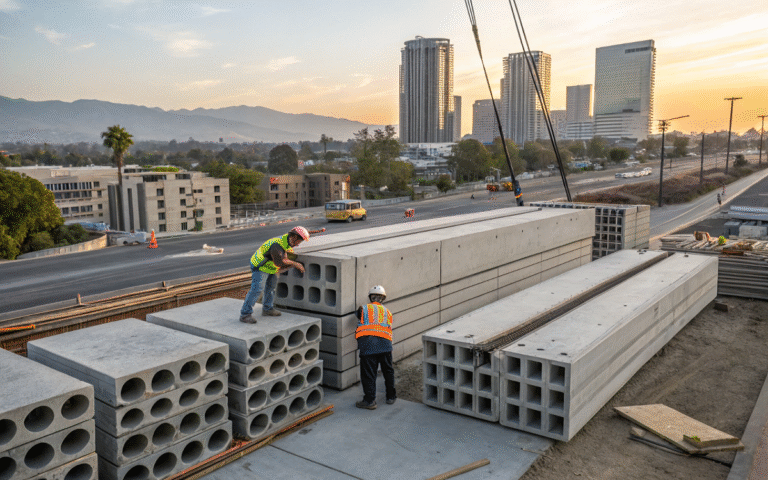
Precast work has a logistical problem built into its main advantage. Fabricating structural elements under controlled conditions produces better quality and faster erection, and it also means the finished product is enormously heavy, awkwardly shaped, and manufactured somewhere other than where it needs to be. Every hour of quality gained in a plant can be given back at the site if the transport was arranged as an afterthought, which is why the delivery plan deserves as much attention as the pour schedule.
Delivery Sequence Is Part of the Design
Unlike materials that can be stockpiled and drawn down as needed, large precast elements frequently go straight from the truck to their final position. That makes the order of arrival a structural question rather than a scheduling convenience. Pieces have to land in the sequence the erection plan requires, spaced so that the crane is never waiting and the site is never storing units it has nowhere to put. Getting this wrong produces the two most expensive outcomes on any site: idle crews and idle equipment, both accruing cost while everyone waits for a truck that is either early with the wrong piece or late with the right one.
Site Access Decides More Than Anyone Expects
The constraints at the delivery end are frequently tighter than anything on the road. Approach roads with weight restrictions, low bridges, tight turning radii, overhead utilities, and soft ground that will not support a loaded trailer all shape what can actually arrive and how. Working with a carrier such as Jori Logistics that has handled construction freight before generally means these questions get asked during planning rather than discovered by a driver at a corner he cannot make.
A site survey ahead of the first delivery is inexpensive and routinely prevents the sort of delay that ripples through an entire schedule. Urban sites bring their own version of the problem. Restricted delivery windows, street closure permits, limited staging area, and traffic management requirements can mean a load that is straightforward to move across three states becomes the difficult part in the final two blocks. Those constraints are knowable in advance and expensive to discover on the morning of a pour.
Permits Run on Their Own Timeline
Anything exceeding standard dimensional or weight limits requires permits, and those permits are issued by each state a load passes through rather than centrally. Requirements differ, processing times differ, and some jurisdictions restrict travel to particular hours or days or require escort vehicles.
The Federal Highway Administration publishes information on freight management and the regulatory framework covering oversize and overweight movements, which is useful context for anyone planning multi-state deliveries. The practical point is that permitting is a lead-time item on the same footing as fabrication, and treating it as paperwork to handle the week before is how loads sit waiting.
Securement and Damage Prevention
Precast elements are strong in the orientations they were designed for and considerably more vulnerable in others, particularly during handling and transport. Proper blocking, bracing, and support at designed lift points matters, as does protecting finished faces on architectural units where a chip or a scuff means a visible defect on a completed building. Damage discovered at site is worse than damage discovered anywhere else, because replacement means refabrication and the schedule absorbs the entire cycle.
Carriers experienced with this cargo understand the difference between securing a load and securing this particular load. Insurance deserves a look on the same basis. Standard cargo coverage may not reflect the replacement value of a custom architectural unit, and the relevant number is rarely the material cost alone once refabrication time and its schedule impact are counted. Confirming coverage limits and how a claim would be handled is a short conversation that matters a great deal on the day it becomes relevant.
Weather Is a Scheduling Input
Midwest conditions add a layer that carriers from milder regions underestimate. Winter storms close routes and make site access unreliable, spring thaw brings seasonal load restrictions on many secondary roads, and soft ground after heavy rain can leave a fully loaded trailer unable to reach a placement position. Building genuine float into a delivery schedule, and agreeing in advance how a weather delay will be handled, prevents a forecast from becoming a dispute. The schedules that hold up are the ones that assumed some days would be lost rather than the ones that assumed none would.
Bring the Carrier In Early
The recurring theme is that transport decisions made late are expensive and transport decisions made early are cheap. Involving a logistics partner while the erection sequence is still being worked out lets constraints on both ends inform each other, so that the fabrication schedule, the delivery plan, and the crane plan are built together rather than reconciled under pressure. On a project where a single delayed piece can stop an entire crew, that coordination is worth considerably more than whatever the difference in freight rate turns out to be.
Communication during the move matters just as much as the planning before it. Knowing where a load actually is, rather than being told it left this morning, lets a site adjust its crew and crane time when something slips instead of discovering the problem when a truck fails to appear. Carriers who provide that visibility as a matter of routine tend to be the ones worth building a long relationship with.