
Construction specialties are the louvers, expansion joints, wall guards, and vents that sit between structure and finish. They decide whether a precast building breathes, moves, and survives an Iowa winter. For project managers, developers, and property owners, the right specs mean less water intrusion, longer HVAC life, and fewer callbacks.
Key Points
- Expansion joint covers must handle real movement. A 100-foot precast run can shift about 0.8 inches across a typical Iowa temperature swing.
- AMCA 540 and 550 certified louvers resist wind-borne debris and wind-driven rain. That is the protection you want on HVAC intakes in Midwest storm country.
- Freeze-thaw exposure classes F2 and F3 under ACI 318 set the concrete limits that every embedded specialty anchor depends on.
How Figuring Siding Protects Midwest Builds
What Are Construction Specialties?
Construction specialties are engineered building products that do one job the main structure cannot do alone. Examples include moving air, absorbing movement, blocking sun, or surviving impact. In spec books, they appear under several CSI MasterFormat divisions, not just one.
The term also names a manufacturer. Construction Specialties, known as CS, was founded in 1948, is family-owned, and set the benchmark for this product class. Most competitor pages stop at that company profile. We go further and show how these products perform on Midwest precast jobs.
Manufacturer Snapshot
| Fact | Detail |
|---|---|
| Founded | 1948, United States |
| Ownership | Family-owned |
| Headquarters | Lebanon, New Jersey |
| Global footprint | 25 offices, 2,000+ employees |
| Notable first | Invented the first extruded aluminum louver |
| Regional production | Dubai facility producing locally since 2001 |
| Core markets | Healthcare, transport, retail, education, leisure, commercial offices |
Where These Products Live in Your Spec Book
| Product | Typical MasterFormat Section | Why It Matters |
|---|---|---|
| Architectural louvers | 08 91 00 Louvers | Controls airflow and rain entry |
| Expansion joint covers | 07 95 00 Expansion Control | Handles thermal and seismic movement |
| Wall and door protection | 10 26 00 Wall and Door Protection | Stops impact damage in busy corridors |
| Entrance mats and grids | 12 48 00 Rugs and Mats | Traps salt, slush, and grit |
| Sun controls | 10 71 13 Exterior Sun Control Devices | Cuts glare and heat gain |
| Explosion relief vents | Project-specific, per NFPA 68 | Releases deflagration pressure safely |
Our hands-on engineering experience shows that coordination fails when these sections live in different bid packages. Flag every specialty that touches a precast panel during your first design review.
Core Product Categories
Six product families cover most commercial and industrial work. Each one connects to concrete, steel, or framing, so each one needs an anchor plan.
Architectural Louvers
Louvers let air move through a wall while keeping water, debris, and pests out. They protect HVAC equipment, cut condensation, and limit mold growth inside the building envelope.
| Model / Type | Depth | Key Performance | Best Use |
|---|---|---|---|
| RS-5800 (vertical) | Extreme-weather | AMCA 540 and 550 certified | Intakes in storm-prone zones |
| A-6177 (drainable) | 6 in. | 57.6% free area, AMCA certified | Exhaust openings |
| RSV-5700 / RSH-5700 | 5 in. | AMCA 540, very low pressure drop | Intakes needing low resistance |
| Blast-resistant | Varies | Rated up to 12 psi | Government and critical sites |
| Thinline | 3 in. max | Fits curtain walls | Thin wall assemblies |
| Acoustical | Varies | Sound reduction plus airflow | Generators, chillers |
| Operable | Varies | Manual or actuator control | Seasonal shutoff |
| Formed metal | Varies | High-heat tolerance | Industrial plants |
The Air Movement and Control Association, through its AMCA certification programs, tests louvers for water penetration, airflow, and impact. Ask for the certified rating, not a “tested to” claim.
Expansion Joint Covers
Expansion joint covers bridge the gaps between building sections. They handle thermal movement, wind sway, settlement, and seismic shift. Systems exist for floors, walls, ceilings, exteriors, traffic-grade decks, and stadiums.
Precast buildings depend on them. Panels expand in July heat and shrink in January cold, and a rigid sealant joint alone will tear within a few seasons.
Sun Control Solutions
Sun controls cut glare and solar heat gain while keeping views open. Blades range from 2 inches to 24+ inches in vertical or horizontal layouts.
- Cantilevered sunshades: spread wind and snow loads back to the main structure
- Suspended sunshades: also distribute loads over a wider area
- Cascading sunshades: hang on suspension cables for a floating look
- Framed sunshades (fins): single blades or pre-assembled panels
- Frameless sunshades: mount on bird mouth brackets
For Iowa projects, snow load decides the bracket design. Ask your engineer to run drift loads on every horizontal blade.
Wall and Door Protection
Wall protection systems such as Acrovyn guards, corner guards, and handrails absorb impact from carts, beds, and pallet jacks. Impact-resistant doors use the same idea on high-traffic openings.
Hospitals, schools, and warehouses see the fastest payback here. Repainting damaged drywall every year adds up quickly.
Entrance Flooring Systems
Entrance flooring, such as Pedisystems grids, uses recessed frames with replaceable treads. The grid catches dirt, water, and road salt before it reaches finished floors.
This matters more in Des Moines than almost anywhere else. Chloride-laden slush stains terrazzo, rots carpet, and creates slip hazards all winter long.
Explosion and Pressure Relief Vents
Explosion vents like Explovent panels open under internal pressure and release a deflagration safely. They follow NFPA 68 venting principles.
Grain handling, ethanol plants, dust collection rooms, and battery storage all fall into this category. In agricultural Iowa, that covers a lot of buildings.

Specifications & Materials
Material choice controls lifespan. Each specialty product combines metals, polymers, and concrete interfaces. The table below compares the factors we weigh on every Midwest bid.
| Material / System | Durability | Load or Impact Capacity | Midwest Weather Resistance | Cost Efficiency |
|---|---|---|---|---|
| Extruded aluminum louver (6063-T6) | High, 30+ yrs with finish | Moderate; AMCA 540 rated options | Excellent with drainable blades | $$ |
| Galvanized formed steel louver | Moderate | High | Good; watch coating breaks | $ |
| Aluminum expansion joint, traffic grade | High | Vehicle-rated options | Excellent with EPDM seals | $$$ |
| Silicone or EPDM seal joint | Moderate, 10 to 20 yrs | Low | Good; UV and cold flexible | $ |
| PVC-free impact wall guard | High | High impact | Interior only | $$ |
| Aluminum sun control blades | High | Designed for wind and snow | Excellent | $$ to $$$ |
| Recessed aluminum entrance grid | High | Rolling load rated | Excellent for salt and slush | $$ |
| Explosion relief panel | High | Calibrated burst pressure | Good with insulated core | $$$ |
Thermal Movement: Why Material Pairing Matters
| Material | Coefficient of Thermal Expansion (approx.) | Movement Over 100 ft, 120°F Swing |
|---|---|---|
| Normal-weight concrete | 5.5 x 10⁻⁶ in/in/°F | ~0.79 in |
| Structural steel | 6.5 x 10⁻⁶ in/in/°F | ~0.94 in |
| Aluminum | 12.8 x 10⁻⁶ in/in/°F | ~1.84 in |
Aluminum moves more than twice as much as concrete. That is why long louver runs need slotted anchors and why joint covers need a rated movement range. If you’ve been tracking precast concrete standards, this specification won’t come as a surprise.
How Long Does Concrete Take to Dry? Plan Your Pour Right
Midwest Weather Performance
Central Iowa swings from -20°F winters to 100°F summers. Construction specialties must survive freeze-thaw cycles, deicing salt, wind-driven rain, and hail in the same calendar year.
The concrete holding those anchors matters just as much. The American Concrete Institute sets freeze-thaw exposure classes in ACI 318, and the Federal Highway Administration explains how air entrainment protects concrete paste.
How Construction Specialties Strengthen Midwest Precast Construction specialties like louvers, expansion joints, and wall protection keep Midwest precast buildings dry and durable. Compare… @PCIprecast @NPCAPride @ACI_Concrete https://t.co/waW0bgHpHV
— US News (@Us_news_ways) November 23, 2026
ACI 318 Freeze-Thaw Exposure Classes
| Class | Condition | Max w/cm | Min f’c | Air Entrainment |
|---|---|---|---|---|
| F0 | No freeze-thaw exposure | N/A | 2,500 psi | Not required |
| F1 | Freezing, limited water contact | 0.55 | 3,500 psi | Required |
| F2 | Freezing, frequent water contact | 0.45 | 4,500 psi | Required |
| F3 | Freezing, water plus deicing chemicals | 0.40 | 5,000 psi | Required |
Most exterior Des Moines work lands in F2 or F3. Entrances, loading docks, and plaza joints see salt every winter. The National Ready Mixed Concrete Association publishes guidance on selecting these classes correctly. Get this wrong and the anchor fails before the louver does.
Midwest Weather Threats by Product
| Threat | Product Most at Risk | Our Field Fix |
|---|---|---|
| Wind-driven rain | Intake louvers | Specify AMCA 550 drainable blades |
| Hail and debris | Louvers, sunshades | Specify AMCA 540 impact rating |
| Freeze-thaw | Embedded anchors | F2/F3 concrete, stainless inserts |
| Road salt | Entrance floors, joints | Recessed grids, sealed joints |
| Snow drift | Horizontal sunshades | Engineer drift loads per ASCE 7 |
| Frost heave | Grade-level joints | Footings at 42 in. frost depth |
Our crews observed the same pattern across dozens of Midwest builds: water finds the weakest interface, not the weakest product. Seal the transition first.
How Construction Specialties Integrate with Precast Concrete
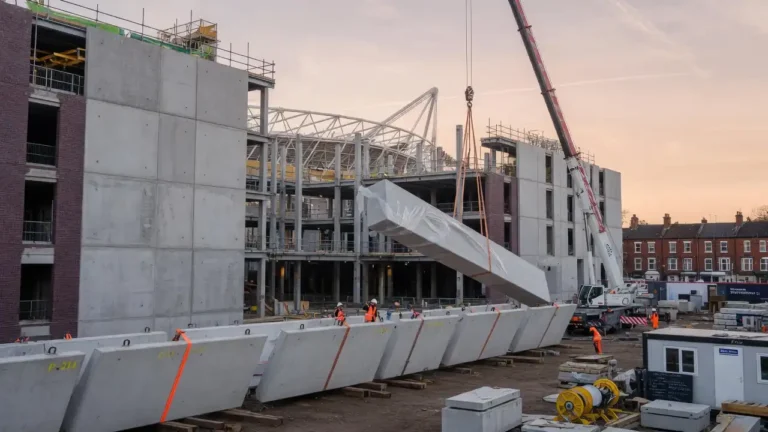
Integration happens at the plant, not the jobsite. Louver openings, joint blockouts, and anchor embeds should be cast into precast panels during production. Field drilling after erection costs more and risks hitting prestressing strand.
The Precast/Prestressed Concrete Institute publishes the quality and tolerance manuals our team follows, including MNL-117 for architectural precast and MNL-135 for tolerances. Tight tolerances keep louver frames and joint covers fitting square.
Precast Interface Checklist
| Interface | Detail to Confirm | Common Mistake |
|---|---|---|
| Louver opening | Rough opening tolerance per PCI | Sizing to nominal louver size |
| Expansion joint | Joint width at mean temperature | Ignoring install-day temperature |
| Sunshade bracket | Cast-in embed plate location | Drilling into strand zones |
| Wall guard backing | Blocking in stud or furring | Anchoring to bare drywall |
| Entrance grid | Recessed pit depth in slab | Forgetting the drain |
| Explosion vent | Frame anchorage design load | Undersized fasteners |
At Midwest Precast Contractor, we coordinate formwork, embed layouts, and specialty shop drawings in one review cycle. That keeps our on-time delivery promise intact.
Installation Steps
Sequence prevents rework. We follow the same steps on commercial and industrial jobs across Des Moines, Ankeny, and Ames.
- Review shop drawings against precast panel drawings and confirm every embed.
- Cast embeds and blockouts at the plant with PCI-compliant tolerances.
- Verify openings after erection with a laser level and a written tolerance log.
- Install anchors with stainless or hot-dip galvanized hardware from trusted suppliers like Simpson.
- Set frames with slotted connections that allow thermal movement.
- Seal perimeters with backer rod and cold-rated sealant.
- Install blades, covers, or guards per manufacturer torque specs.
- Water test louver and joint interfaces before interior finishes.
- Document final inspection with photos and a punch list.
Jobsite Safety Notes
Cutting or drilling concrete creates respirable crystalline silica. OSHA sets a permissible exposure limit of 50 µg/m³ under standard 1926.1153. Our crews use wet methods, shrouded tools, and HEPA vacuums on every specialty install.
Pros and Cons
Construction specialties add cost up front but pay back over the building’s life. Here is the honest breakdown from our crews.
Pros
- Longer envelope life through controlled water and air movement
- Lower HVAC maintenance thanks to cleaner, drier intake air
- Fewer impact repairs in corridors and loading areas
- Code compliance for venting, energy, and life safety
- Better curb appeal with custom finishes, perforated screens, and LED options
Cons
- Higher material cost than generic products
- Longer lead times, often 8 to 14 weeks for custom louvers
- Coordination demands across precast, framing, and MEP trades
- Aluminum tariff exposure on metal-heavy packages
Lead time is the con that hurts schedules most. Release specialty submittals the same week you release precast shop drawings.
Sector Applications
Every sector stresses specialties differently. This table maps the products we specify most often.
| Sector | Priority Products | Key Driver | Midwest Note |
|---|---|---|---|
| Healthcare | Wall protection, acoustical louvers, cubicle tracks | Infection control, impact | Generator louvers need sound control |
| Education | Entrance grids, impact doors, wall guards | Heavy foot traffic | Salt tracking peaks December to March |
| Commercial office | Sun controls, thinline louvers | Energy and appearance | South and west facades gain most |
| Industrial | Formed metal louvers, explosion vents | Heat, dust, process safety | Grain and ethanol facilities |
| Data centers | AMCA 540/550 intake louvers, blank-offs | Cooling, uptime | High demand across the Des Moines metro |
| Parking structures | Traffic-grade joints, screens | Vehicle loads, salt | F3 concrete is standard |
Data centers stand out right now. Large facilities in West Des Moines and Altoona have made intake louver performance a top spec item for regional builders.
Construction Specialties vs. Standard Building Products
Specialty products are engineered and tested. Standard products are usually commodity items with limited performance data. The difference shows up after the third winter.
| Factor | Specialty Products | Standard Products |
|---|---|---|
| Testing | AMCA, ASTM, NFPA certified ratings | Often untested or “meets intent” |
| Movement capacity | Rated in inches, cycle-tested | Sealant only, limited range |
| Water performance | Wind-driven rain rated | Basic drip edge |
| Lifespan | 25 to 40+ years | 5 to 15 years |
| Customization | Custom colors, shapes, perforation, graphics | Stock sizes |
| Upfront cost | Higher | Lower |
| Lifecycle cost | Lower | Higher due to repairs |
| Warranty | Manufacturer plus finish warranty | Limited |
Our hands-on engineering experience shows that lifecycle cost wins this debate almost every time. Ask for a 20-year cost comparison before you value-engineer a louver.
2026 Industry Trends
As of August 2026, several shifts are shaping how Midwest teams buy and install specialty products.
| Trend | What’s Happening | Impact on Your Project |
|---|---|---|
| Data center build-out | Hyperscale campuses keep expanding in central Iowa | Louver demand up, longer lead times |
| Aluminum tariffs | Section 232 duties on aluminum remain elevated | Price volatility on louvers and sunshades |
| Embodied carbon reporting | More owners request EPDs | Favor suppliers with published data |
| Updated codes | Jurisdictions adopting 2024 IBC and IECC | Tighter envelope and energy rules |
| Labor shortages | Skilled trades remain tight | Prefabrication and cast-in embeds win |
| Heat safety focus | OSHA heat illness rulemaking still in progress | Plan summer installs with rest cycles |
| Extreme weather | More intense storms and hail | AMCA 540/550 specs move mainstream |
Price locks matter more than ever. Request escalation clauses and early material releases on any metal-heavy package.
What Post Construction Cleaning Means for Your Build
How Midwest Precast Contractor Supports Your Project
Midwest Precast Contractor brings 15+ years of experience and 500+ completed projects to every build. We are licensed and insured, with 24/7 emergency service across the metro.
| Service | How It Connects to Specialty Products |
|---|---|
| Precast concrete solutions | Cast-in embeds and openings for louvers and joints |
| Formwork and concrete systems | Accurate blockouts and recessed grid pits |
| Structural framing | Backing and blocking for wall protection |
| Custom deck construction | Durable composite builds with TrexDecks |
| Outdoor living spaces | Patios and pergolas with weather-rated details |
| Renovation and remodeling | Retrofitting louvers, joints, and guards |
We source from trusted brands including QuikCrete, TrexDecks, USG Corp, Oldcastle, and Simpson. We serve Des Moines, Ankeny, West Des Moines, Urbandale, Johnston, Waukee, and Ames.
Our Four-Step Process
- Consult: We review your goals, drawings, and budget.
- Plan and design: We coordinate embeds, specs, and schedules.
- Execute: Our crews install with transparent progress updates.
- Inspect: We complete a final quality check before handover.
FAQ
Who installs construction specialties on a precast project?
Usually a specialty subcontractor installs the product. The precast and formwork team must provide embeds and openings first. We coordinate both sides so nothing gets drilled twice.
What louver rating should I specify in Iowa?
For intakes, specify AMCA 550 for wind-driven rain. Add AMCA 540 where hail or wind-borne debris is a concern.
How wide should an expansion joint be?
It depends on panel length, material, and temperature range. As a reference, 100 feet of concrete moves about 0.8 inches over a 120°F swing. Your engineer sets the final width.
Can I add louvers to an existing precast wall?
Yes, with care. Scan for reinforcement and strand first, then core or saw-cut with OSHA-compliant silica controls.
How long do specialty products last?
Aluminum louvers and joint covers often last 25 to 40 years with proper finish and maintenance. Seals and gaskets need inspection every few years.
Do entrance grids really help in winter?
Yes. Recessed grids trap salt and slush at the door, protecting floors and cutting slip-and-fall risk.
How long does a typical project take?
A custom deck may take 1 to 2 weeks. Larger structural builds with specialty packages can run several months.
Build It Right the First Time
The right construction specialties protect your precast investment for decades. Wrong ones fail at the first hard freeze. At Midwest Precast Contractor, we pair engineering precision, Midwest-tough weather resistance, and on-time delivery on every job.
Call (844) 564-0958 today to schedule a free, no-obligation project assessment.