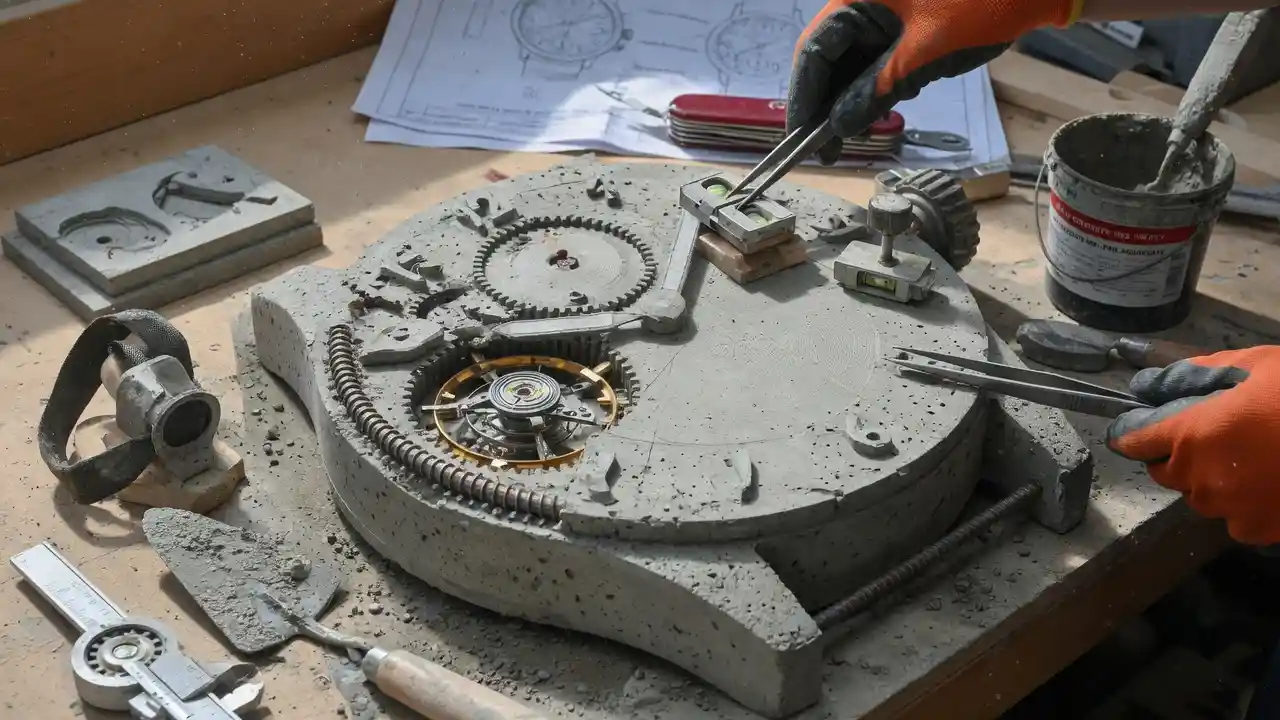
When a 347,500-square-foot museum demands the same precision as fine Swiss horology, every pour, every cable, and every isolator must perform flawlessly.
Building a Swiss watch out of concrete isn’t just a catchy metaphor it’s the exact philosophy that guided the construction of LACMA’s David Geffen Galleries, and it holds powerful takeaways for contractors and builders across every scale.
This concept comes directly from Clark Construction’s perspective as the general contractor responsible for bringing Peter Zumthor’s design to completion.
If you’ve been following architectural precast trends across the Midwest, this won’t come as a surprise: the industry is rapidly moving toward structures where concrete is simultaneously the skeleton and the finished surface.
How Gordie Howe Bridge Aesthetic Lights Are Reshaping Precast
Key Takeaways
- Over 85,000 cubic yards of concrete were poured throughout construction, forming a monumental “concrete sculpture” whose unembellished surfaces let the raw material shine.
- An innovative patterning of post-tensioned cables throughout concrete slabs, ribs, and walls provides lift and support for cantilevers spanning up to 80 feet.
- More than 700,000 labor hours were logged with zero lost-time incidents proof that precision and safety can coexist on the most complex pours.
What Does “Building a Swiss Watch Out of Concrete” Actually Mean?
At LACMA, this meant coordinating a monolithic concrete structure, an extensive post-tensioning system, 56 seismic isolators, unpredictable ground conditions near the La Brea Tar Pits, solid bronze mullions, and mechanical systemsall integrated within a double-deck concrete structure.
Our analysis suggests that the real lesson for Midwest contractors isn’t about replicating a $720-million museum.
It’s about adopting the mindset that architectural concrete deserves watchmaker-level discipline at every step.
Missing one small detail in the architectural concrete process can make the end product look drastically different, which is why the LACMA team developed exact product specifications through 100 samples and two full-size mockups before finalizing critical material decisions like concrete mix design, batch portioning, and form-facing materials.
Katy Roofing Contractor Paramount Roofing Guide
How Was This “Concrete Watch” Engineered?
Here’s where building a Swiss watch out of concrete moves from philosophy to practice.
SOM collaborated as architect of record and structural engineer to achieve Zumthor’s sweeping concrete structure that floats over Wilshire Boulevard, replacing four aging buildings and placing all artwork on a single gallery level elevated 30 feet in the air.
Our contractors note several engineering elements that any team can study and adapt:
- Seismic Base Isolation: The gallery plane is supported by seven pavilions resting on 56 Triple Pendulum Isolators, enabling the structure to float across the site while meeting stringent seismic requirements.
Some pedestals supporting those isolators reach 24 feet in height and were cast in 8,000 PSI concrete. - Post-Tensioning at Scale: After being poured and cured, the concrete was post-tensioned with miles of cables via troughs left open around the perimeter.
- Shrinkage Management: The building shrank from pour to pour, so the over 100 pours were sequenced to accommodate the shrinkage in a planned way and there are no joints in the massive slabs; they move together as one unit.
- Formwork Discipline: To keep finish quality as high as possible, MDO plywood formwork sheets were only used once, and the exposed soffit uses a six-foot equilateral grid with triangular plywood pieces.
- Seismic Movement Capacity: The building can move five feet laterally in any direction thanks to its state-of-the-art seismic protection system.
Ashley Timber Ltd South Shields: Materials Guide
Building a Swiss Watch Out of Concrete
— US News (@Us_news_ways) August 3, 2026
Building a Swiss watch out of concrete isn't just a catchy metaphor it's the exact philosophy that guided the construction…@designboom @ArchDigest @dezeen https://t.co/o3YV7e9IRy
LACMA Geffen Galleries: By the Numbers
| Specification | Detail |
|---|---|
| Total Area | 347,500 sq ft |
| Concrete Volume | 85,000+ cubic yards |
| Project Cost | ~$720 million |
| Seismic Isolators | 56 Triple Pendulum units |
| Maximum Cantilever Span | 80 feet |
| Gallery Elevation | 30 feet above grade |
| Labor Hours | 700,000+ |
| Lost-Time Incidents | Zero |
| Isolator Pedestal Concrete | 8,000 PSI |
| Structure Length | ~900 feet |
What Does Building a Swiss Watch Out of Concrete Mean for Midwest Contractors?
Construction industry insiders are noting that the principles behind this project are scalable.
You don’t need an art museum budget to adopt these practices.
Here’s what we recommend for any team chasing architectural concrete finishes:
- Invest in Mockups Early. The LACMA team built 100 samples and two full-size mockups before committing to final specifications.
Even a single full-scale sample wall can save thousands in rework on a commercial project. - Specify Formwork Reuse Limits. Single-use MDO plywood panels are expensive, but reusing form faces on exposed concrete introduces visible variation.
Define your acceptable tolerances on day one. - Sequence Pours for Shrinkage. LACMA’s team sequenced more than 100 distinct material pours in place, leveraging the seismic systems to accommodate shrinkage as they cured.
On a smaller Midwest project, plan your pour joints around natural break points in the architecture. - Follow PCI Quality Standards. For manufacturing procedures, testing requirements, quality-control recommendations, and dimensional tolerances, comply with PCI MNL 117, the Manual for Quality Control for Plants and Production of Architectural Precast Concrete Products.
PCI certification provides owners, architects, engineers, and general contractors confidence that precast concrete meets rigorous design, production, and installation standards.
How HS2 Danny Sullivan Workers TUPE Transfer Reshapes Labor Law
How Will This Philosophy Impact Your Next Build?
Building a Swiss watch out of concrete is ultimately about zero tolerance for sloppiness a mentality, not a budget line.
Concrete retains moisture for centuries, meaning its appearance will continue to change and evolve over time.
That long lifespan makes getting the initial pour, cure, and finish right even more critical.
Our team observed that projects embracing this watchmaker philosophy rigorous mix design, strict formwork protocols, disciplined shrinkage management consistently outperform on both aesthetics and structural longevity.
Even LACMA’s team used a variety of custom concrete mixes throughout the building, many replacing portland cement with alternative materials to reduce embodied carbon.
Sustainability and precision are not competing goals; they reinforce each other.
Building a Swiss watch out of concrete isn’t reserved for Pritzker Prize architects and nine-figure budgets.
It’s a standard any serious contractor can chase.
As Largo Concrete noted, the LACMA project sets a new standard in architectural execution and collaborative construction for civic and cultural infrastructure.