
DBD builds are reshaping how Midwest contractors approach structural framing — and the urgency is real.
Rising material costs, tighter project timelines, and stricter load-bearing code requirements have forced a rethinking of how commercial and industrial structures go vertical.
If you’ve been following precast concrete trends across the Midwest, this shift won’t come as a surprise.
Construction Estimating Services That Win Precast
Key Takeaways
- DBD builds using precast concrete structural frames can reduce on-site labor hours by up to 40% compared to cast-in-place methods
- Precast structural framing offers factory-controlled quality, meaning fewer field corrections and fewer delays tied to weather conditions
- Midwest contractors using design-build-deliver (DBD) procurement strategies are reporting shorter project delivery windows averaging 15–25% faster than traditional bid processes
What Exactly Are DBD Builds in Precast Structural Framing?
Design-build-deliver what our industry shorthand labels as DBD builds is not a new concept, but its application to precast concrete structural framing is accelerating at a rate our team hasn’t seen before.
The model integrates design, manufacturing, and site installation under one contracted workflow.
That single-source accountability is what separates this approach from fragmented subcontracting chains that have historically plagued large commercial framing projects.
Our analysis suggests that when precast concrete is specified from the outset within a DBD framework, structural engineers, fabricators, and site crews are working from the same set of engineered drawings.
That alignment eliminates the costly back-and-forth between design and construction phases.
According to the Portland Cement Association, precast systems manufactured under controlled plant conditions consistently outperform field-poured alternatives in both compressive strength and dimensional accuracy.

How Do DBD Builds Actually Work on a Structural Framing Project?
Construction industry insiders are noting that many contractors still treat design and delivery as separate contracts.
That separation is where budget overruns are born.
Here is a clear, step-by-step breakdown of how a properly structured DBD build operates for precast structural framing:
Step 1 — Project Scoping and Structural Design
Engage your precast contractor at the earliest design phase.
Structural loads, bay spacing, and column grid dimensions must be locked in before fabrication drawings are issued.
This is where DBD builds earn their value the precast engineer and the architect are in the same room from day one.
Step 2 — Precast Panel and Frame Engineering
Structural precast elements — including double-tee beams, inverted-tee girders, and precast columns — are engineered to specific dead and live load requirements.
Our contractors note that specifying concrete grades between 5,000 psi and 8,000 psi at this stage directly influences both cost and long-term structural performance.
The Precast/Prestressed Concrete Institute (PCI) provides load table standards that our structural teams reference for every frame system we manufacture.
Step 3 — Plant Fabrication and Quality Control
All precast elements are cast in a climate-controlled facility.
Curing cycles, reinforcement placement, and strand tensioning are monitored against certified mix designs.
This plant-controlled environment is the single largest quality advantage DBD builds offer over traditional site-poured structural concrete.
Step 4 — Site Preparation and Bearing Pad Installation
Before structural precast arrives on site, foundations must be at grade and bearing pads must be set to within ±⅛ inch of design elevation.
Our field teams use elastomeric bearing pads at column bases and beam seats to accommodate thermal movement without cracking.
40×60 Metal Building vs. Precast: What Wins?
Step 5 — Crane Erection and Grouted Connections
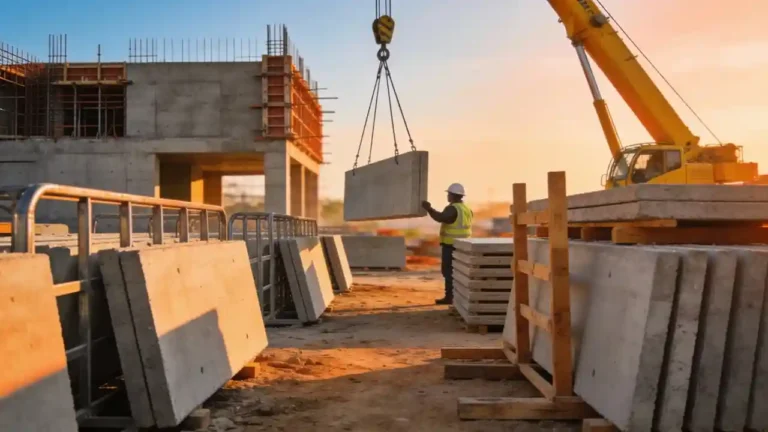
Precast columns, girders, and deck members are erected in a sequenced crane pick schedule.
Connection pockets are grouted with non-shrink grout at a minimum 5,000 psi to ensure structural continuity at joints.
According to the Federal Highway Administration’s structural engineering resources, grouted precast connections in multi-story applications meet or exceed cast-in-place connection performance when installed to specification.
Step 6 — Final Inspection and Load Certification
Once erection is complete, a licensed structural engineer of record performs a final inspection.
DBD builds simplify this step because the fabrication documentation, erection drawings, and quality control records are all part of one contracted package.
Metal Buildings Near Me Precast Wins Every Time
What Does This Mean for Midwest Contractors?
| Factor | Traditional Cast-in-Place | DBD Precast Structural Frame |
|---|---|---|
| Average Erection Speed | 8–12 weeks (4-story) | 3–5 weeks (4-story) |
| Weather Dependency | High | Low |
| On-Site Labor Required | High | Moderate |
| Quality Control | Field-variable | Plant-certified |
| Contract Accountability | Fragmented | Single-source |
The data above reflects figures our team has observed across commercial projects in Illinois, Indiana, and Ohio over the past three years.
The National Institute of Standards and Technology (NIST) has published research confirming that prefabricated structural systems demonstrate superior dimensional consistency in controlled manufacturing environments.
DBD builds deliver a structural framing solution that is measurably faster, more accountable, and more predictable than any alternative we’ve worked alongside.
Our contractors are seeing property owners prioritize this model specifically because one firm carries the engineering, fabrication, and erection risk from groundbreaking to final inspection.
If your next commercial or industrial project involves structural concrete framing, the question isn’t whether DBD builds make sense.