
The Mayo Clinic North Phoenix expansion construction approved for a five-year buildout is a textbook case. Mayo’s $648 million Arizona Forward project nearly doubles its Phoenix campus adding 1.4 million square feet, a six-story patient tower, and raising bed count from 280 to 374. At Midwest Precast Contractor, we study builds like this because the same challenges show up on healthcare jobs across Des Moines, Milwaukee, Ankeny, and West Des Moines.
Here’s what a project this size teaches you about building fast, clean, and safe. And why the delivery method matters more than the price tag.
Key takeaways:
- Phased construction lets hospitals grow without closing — the core of any large healthcare build.
- Precast concrete cuts on-site labor and dust, directly reducing infection-control risk near patients.
- Getting the structure, foundation, and sequencing right early controls up to 60% of total project cost.
Anaheim Regional Transportation Intermodal Center Builders About Durability
The Problem With Traditional Cast-in-Place Healthcare Builds
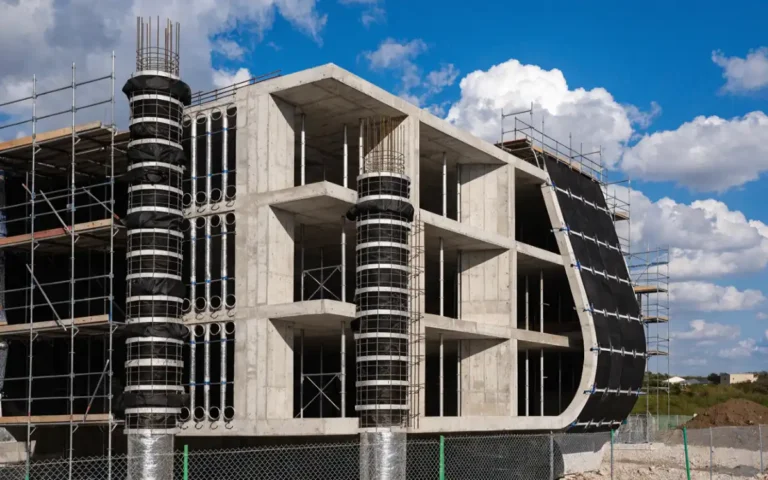
Traditional cast-in-place construction slows healthcare projects down. Pouring concrete on-site means weeks of formwork, curing, and cleanup all generating dust, noise, and traffic next to occupied patient wings.
That’s a real safety issue, not just an inconvenience. Our crews observed on multi-phase medical jobs that most schedule overruns trace back to weather delays and site congestion during on-site pours. Every extra day of open trenching and wet concrete near a hospital wing is another day of exposure.
The stakes are documented. The American Society for Health Care Engineering warns that construction activity near occupied care areas demands strict infection control, because airborne dust from the jobsite can carry pathogens directly to vulnerable patients. When you cut on-site work, you cut that exposure.
How Phased Healthcare Campus Construction Actually Works
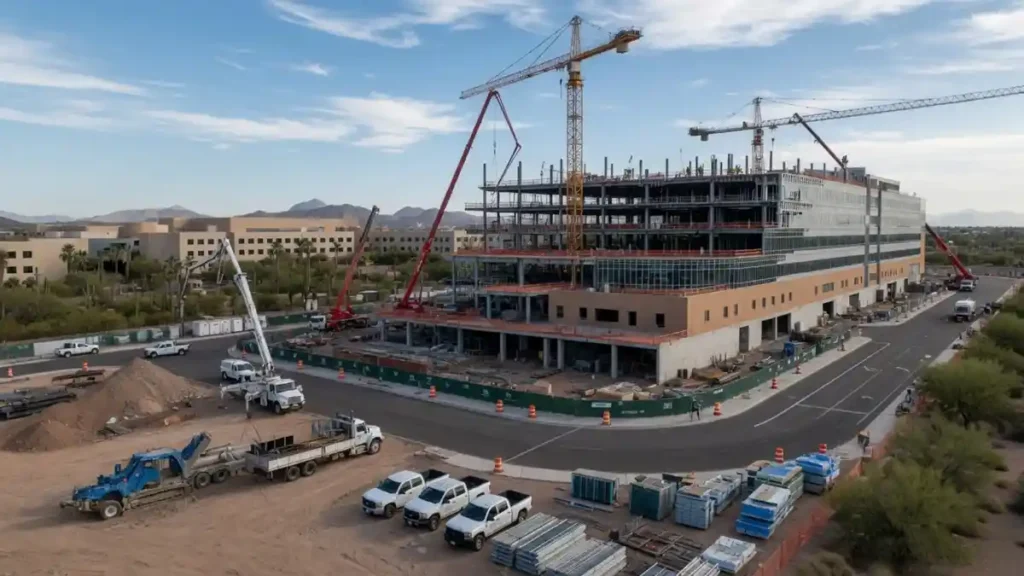
Phased healthcare campus construction builds new capacity in sequence while existing operations keep running. You complete one section, bring it online, then move crews to the next rather than closing the whole facility at once.
Mayo’s Phoenix project shows the model at scale. As Construction Dive reported, the campus adds a six-story patient tower, a three-story addition, and a new emergency facility across a five-year program while the current 1.7-million-square-foot complex stays fully operational.
What the McCormick Place West Building Teaches Builders
Sequencing Around Live Operations
Sequencing is the discipline of ordering work so patients never lose service. You schedule loud or dusty tasks during low-traffic hours, wall off active zones, and route construction traffic away from ambulance bays. Precast elements help here because they arrive finished one crane lift replaces days of messy site work.
Building the Structure Off-Site
Off-site fabrication means manufacturing structural pieces in a controlled plant, then delivering them ready to install. Columns, beams, and wall panels get cast to spec while foundation work continues on-site. The two tracks run in parallel, which is how five-year programs stay on schedule.
| Factor | Traditional Cast-in-Place | Modern Precast + Phased |
|---|---|---|
| Schedule | Longer, weather-dependent | 30–40% faster install |
| On-site dust/noise | High near patients | Sharply reduced |
| Quality control | Variable field conditions | Plant-controlled precision |
| Labor on-site | Large crews for weeks | Smaller, faster crews |
| Weather risk | Significant | Minimal |
| Type | Mechanism | Best Use Case |
|---|---|---|
| Precast structural framing | Factory-cast columns and beams craned into place | Multi-story patient towers |
| Precast wall panels | Finished exterior panels installed as units | Fast building envelope closure |
| Hollow-core planks | Prestressed floor slabs spanning long distances | Parking garages, floor systems |
| Total-precast system | Full structure prefabricated off-site | Tight-schedule campus additions |
2026 Cost Ranges for Large Healthcare Builds
Large healthcare construction in 2026 runs $450 to $900 per square foot, depending on complexity and clinical fit-out. Patient towers with operating rooms land at the higher end.
Typical cost breakdown:
- Foundation and structure: ~55–60%
- Finishing and MEP systems: ~30%
- Design, permits, and approvals: ~10–15%
Getting structure right early controls the majority of the budget.
Step-by-Step: Delivering a Phased Healthcare Expansion
- Assess the site. Map live operations, traffic flow, and infection-control zones before design locks in.
- Design for phasing. Break the build into stages that each deliver usable space.
- Fabricate off-site. Cast structural components in the plant while foundation work runs on-site.
- Sequence installation. Crane precast into place during scheduled low-impact windows.
- Enclose and fit out. Close the envelope fast, then hand over to interior trades.
- Commission and repeat. Bring the phase online, then shift crews to the next stage.
Protect Your Schedule After Geisinger Construction Site Ice Raids
Mayo Clinic North Phoenix Expansion Construction Approved for Large-Scale Healthcare Builds
— US News (@Us_news_ways) September 15, 2026
The Mayo Clinic North Phoenix expansion construction approved for a five-year buildout is…@MayoClinicNeph @MayoClinic @MayoClinic https://t.co/Tj5Br0C5d4
Pros and Cons of Precast for Healthcare
Pros:
- Faster schedules with parallel off-site work
- Lower on-site dust and noise near patients
- Consistent, plant-controlled quality
- Less weather exposure
Cons:
- Higher upfront coordination and design effort
- Requires crane access and staging space
- Transport logistics for large panels
- Less flexibility for late design changes
Case Study: A Phoenix-Scale Model
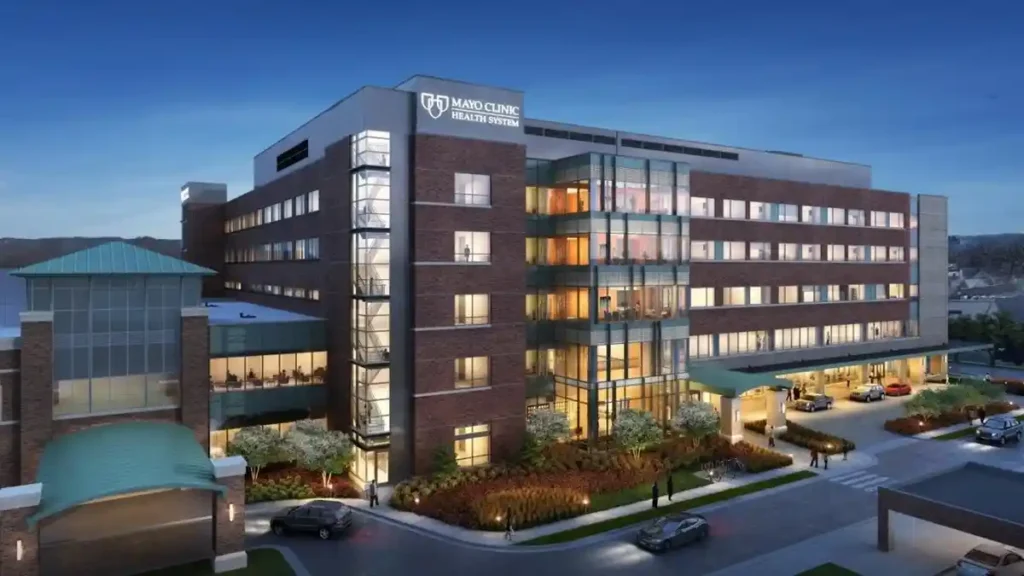
Mayo’s Arizona Forward project is the benchmark. The $648 million program adds 1.4 million square feet to a 1.7-million-square-foot campus, lifting beds from 280 to 374 — a 34% capacity increase — across a five-year phased schedule with zero facility shutdown. That’s how you grow a hospital without turning patients away.
How Midwest Precast Contractor Applies This
We build the same principles into every healthcare job across Iowa and Wisconsin. Our core services — Precast Concrete, Structural Framing, and Formwork Systems — are built for exactly the speed and cleanliness large medical projects demand.
Precast lets us fabricate off-site while your site stays clear. Structural framing goes up fast with crane-set components. Formwork systems keep any on-site pours precise and contained. The result: less disruption near patients, tighter schedules, and predictable costs.
New Construction Communities Complete Guide for Midwest Builders
Common Mistakes to Avoid
- Skipping phasing early. Deciding sequence after design costs you rework.
- Underestimating infection control. Dust barriers and traffic plans belong in the schedule, not the field.
- Ignoring crane logistics. No staging plan means precast can’t be set efficiently.
- Cutting foundation coordination. Structure drives 60% of cost — get it right first.
FAQ
Why was the Mayo Clinic North Phoenix expansion construction approved?
Rising patient demand drove it. The project nearly doubles campus size to add 94 more beds.
How does phased hospital construction avoid shutdowns?
Crews build and commission one section at a time. Existing wings stay open throughout.
Is precast concrete good for healthcare expansions?
Yes. It reduces on-site dust and noise while speeding up install near live patient areas.
What does large-scale healthcare construction cost in 2026?
Expect $450 to $900 per square foot. Structure and foundation account for most of it.
Can Midwest Precast Contractor handle projects like this?
Yes. We deliver precast, framing, and formwork for phased builds across the Midwest.
Coxschepp com leadership Team Names And Titles Drive Precast Tech
Final Thought
The Mayo Clinic North Phoenix expansion construction approved for five years of growth proves one thing: phasing and precast let hospitals expand without stopping care. Faster schedules, cleaner sites, controlled costs.
Midwest Precast Contractor brings Precast Concrete, Structural Framing, and Formwork Systems to healthcare and commercial builds across Des Moines, Milwaukee, Ankeny, and West Des Moines.