
Industrial and commercial builders are hitting a wall with labor shortages and unpredictable weather delays.
Forward-thinking owners are increasingly outsourcing execution risk by hiring specialized structural construction project management companies to manage their off-site fabrications.
Key Takeaways
- Speed to Market: Utilizing precast concrete framing elements reduces overall structural assembly timelines by up to 40% compared to traditional cast-in-place methods (Fortune Business Insights, 2026).
- Cost Certainty: Off-site fabrication in controlled environments eliminates weather-related cost overruns and limits raw material waste by nearly 15%.
- Unmatched Durability: Standardized, high-strength precast structural columns and beams deliver superior structural integrity and precise load-bearing performance.
Construction Worker Lunch Protocols for Precast Projects
What does this mean for Midwest contractors?
Our analysis suggests that the old way of managing structural projects—where concrete mixing, pouring, and curing happen entirely on-site—is becoming a massive financial liability.
Leading construction project management companies are shifting their focus heavily toward modular precast framing systems to guarantee predictable delivery windows (Kaizen Institute, 2026).
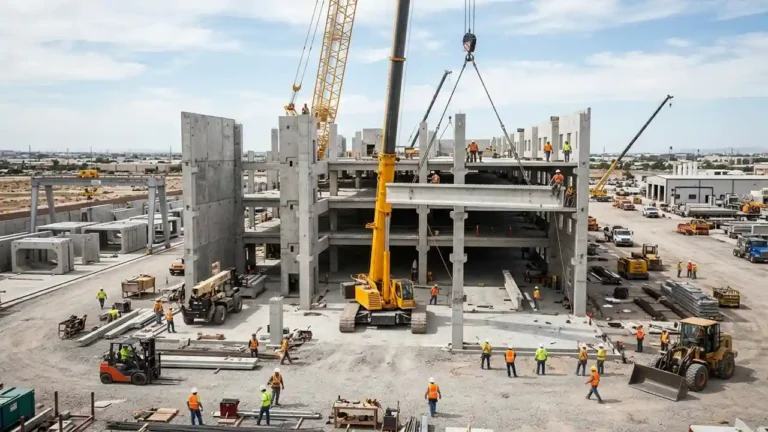
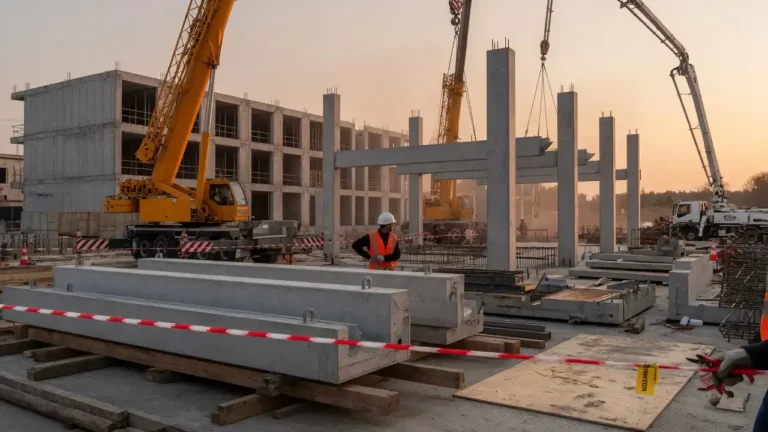
By casting major structural elements like columns, beams, and hollow-core slabs off-site, the jobsite transforms from a chaotic production zone into a streamlined assembly arena.
Construction industry insiders are noting that specialized construction project management companies are uniquely equipped to bridge the gap between architectural intent and industrial engineering.
When working with heavy structural framing, precision is measured in millimeters, not inches.
Without the digital logistics backbone and strict quality control oversight provided by modern construction project management companies, coordinating the transport and crane placement of multi-ton panels can quickly spiral into a logistical nightmare.
New Construction Homes Orlando Structural Framing

How will this impact your next structural build?
The choice of structural materials impacts every single downstream phase of your project, from HVAC rough-ins to interior finishing.
When evaluating structural options, it is essential to look at how precast framing stacks up against alternative structural framing methods like structural steel or traditional cast-in-place concrete.
| Structural Attribute | Precast Concrete Framing | Structural Steel | Cast-In-Place Concrete |
| On-Site Installation Speed | Ultra-Fast (Modular crane assembly) | Moderate (Requires detailing/welding) | Slow (Requires extensive shoring/curing) |
| Weather Dependency | Zero (Components fabricated indoors) | Low (Impacts wind/crane safety) | High (Temperature & rain delays) |
| Inherent Fire Resistance | High (No additional coating needed) | Low (Requires expensive fireproofing) | High (Inherent material benefit) |
| Long-Term Maintenance | Minimal (Highly resistant to degradation) | Moderate (Corrosion risk if exposed) | Low to Moderate (Prone to field cracking) |
Our team observed that projects utilizing construction project management companies alongside precast structural framing consistently bypass the typical scheduling bottlenecks associated with field-cured concrete.
While site excavation and foundation grading are underway, your entire structural skeleton is already being cast under perfect laboratory conditions.
Construction Project Management Companies
— US News (@Us_news_ways) May 29, 2026
Forward-thinking owners are increasingly outsourcing execution risk by hiring specialized structural construction project management companies..@ConstWorldSA @constructdive @EngineeringEX https://t.co/41HK7kmkHD
How do project managers execute precast framing on site?
To successfully execute a precast framing strategy, elite construction project management companies follow a strict, standardized operational pipeline.
Deviating from this sequence can compromise safety and lead to costly field reworks.
Structural Precast Framing Installation Sequence
1.Engineering and Digital Coordination:Phase 1: Pre-Construction.
Our team develops detailed 3D Building Information Modeling (BIM) files to establish exact dimensions for every structural column, spandrel beam, and load-bearing panel.
These files are shared directly with the precast plant to ensure millimetric fabrication accuracy.
2.Off-Site Controlled Fabrication:Phase 2: Plant Production.
High-strength concrete, typically exceeding a self-consolidating concrete grade of 6,000 PSI, is poured into reusable steel forms embedded with tensioned steel rebar.
The components cure in a moisture-controlled environment to maximize strength before being transport-tested.
Construction Injury Attorneys Navigating Precast Concrete Site
3.Just-In-Time Staging and Logistics:Phase 3: Transport.
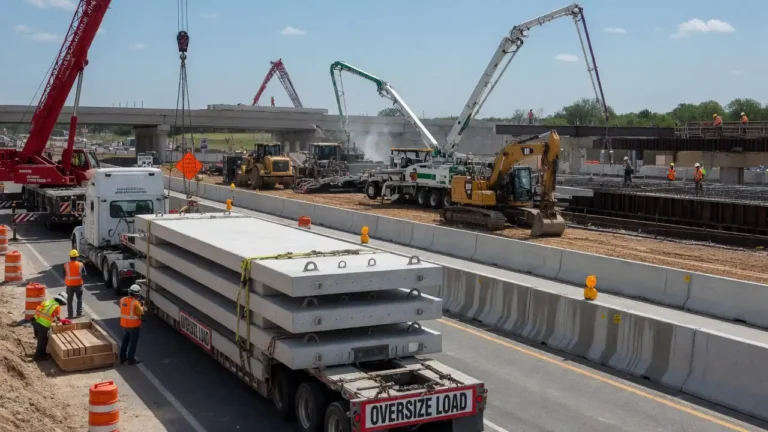
Experienced construction project management companies coordinate flatbed delivery sequences perfectly synchronized with crane operations.
This precise scheduling avoids on-site material stacking and minimizes spatial congestion on tight urban jobsites (PwC, 2026).
4.Rigging, Lifting, and Anchor Placement:Phase 4: Site Erection.
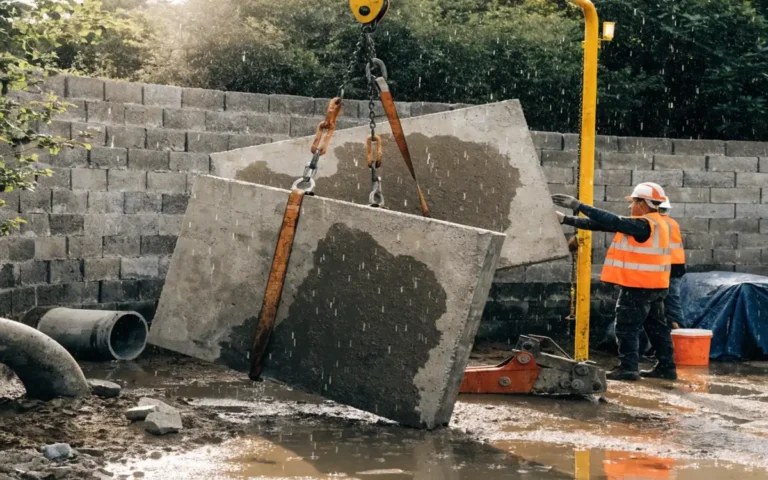
Heavy-duty crawler cranes lift the precast elements into position starting with main columns, followed by connecting beams and floor slabs.
Field crews secure the connections using high-strength steel bolting and localized non-shrink structural grout to lock the framing in place.
Critical Field Note: Structural integrity depends entirely on the precision of the anchor connections. Never allow crane rigging to release a precast column until the engineering team has verified that the baseline anchor bolts are torqued to exact engineering specifications.
New Construction Plumber Strategies for Precast Infrastructure
View on Threads
Why trust specialized management firms over general contractors?
If you are trying to manage a precast build using a standard general contractor who treats precast as an afterthought, you are asking for trouble.
Expert construction project management companies specialize in navigating the incredibly tight tolerances required for successful off-site modular assembly (Fieldwire by Hilti, 2026).
They understand how to mitigate supply chain volatility, manage specialized crane crews, and handle the specialized engineering reviews that traditional builders often overlook.
We found that when professional construction project management companies control the structural workflow, communication gaps between the structural engineer, the precast plant, and the field erection crews disappear.
This integrated approach is the ultimate way to de-risk your commercial investment, protect your budget, and get your structure out of the ground faster than your competition.