
Owners across the Midwest want Old World facades on modern schedules, and many architects use Genoa as their reference city.
That turns the via assarotti construction year ligurian republic french period question into a practical design brief.
It shows how a dense, coastal, mountainous city built to last, and how architectural precast can deliver that look today.
Key Takeaways
- Napoleon’s campaign turned the Genoese state into the Ligurian Republic, a political shift that reshaped how Genoa planned its streets and facades.
- Liguria’s terrain is 65% mountainous, with a 350 km coastline. These conditions demand durable, load-rated envelope systems.
- Modern architectural precast built to ACI 318 and PCI quality standards can match Ligurian detailing with faster installation and lower upkeep.
VHC Yountville Skilled Nursing Facility Construction Cost Estimate Decoded
What does the via assarotti construction year ligurian republic french period refer to?
The phrase ties one Genoa street to a turning point in Ligurian history.
According to the Wikipedia overview of Liguria, Napoleon’s first Italian campaign ended the oligarchic Genoese state and replaced it with the Ligurian Republic, modeled on the French Republic.
Liguria was annexed to the French Empire in 1805. Napoleon then split it into three departments: Montenotte, Gênes, and Apennins.
Via Assarotti honors Ottavio Assarotti, a Genoese priest who began teaching deaf students during these French-period years.
The street itself came later, as part of Genoa’s 19th-century expansion uphill from Piazza Corvetto.
When people search the via assarotti construction year ligurian republic french period, they are usually tracing that link between politics and the city’s built form.
Your next step: pull Genoa facade photos from this era into your project mood board before schematic design.
Why does Ligurian terrain matter for architectural precast?
Ligurian terrain forced builders to work with tight sites, steep grades, and heavy loads.
The Alps and Apennines cross the region, and Genoa and La Spezia can see up to 2,000 mm (80 in) of rain a year.
Dense coastal building has also left a lasting mark. As of 2023, Liguria and Marche held Italy’s record for coastal overbuilding, according to land-consumption data from ISPRA, Italy’s national environmental research institute.
Construction industry insiders are noting the same pressure in Midwest infill projects.
Tight lots and limited staging space favor panels built off-site and set in hours.
The region’s economy shows what lasting infrastructure supports.
The Port of Genoa handles 58.6 million tonnes of trade, and Liguria’s GDP reached €58.9 billion in 2024.
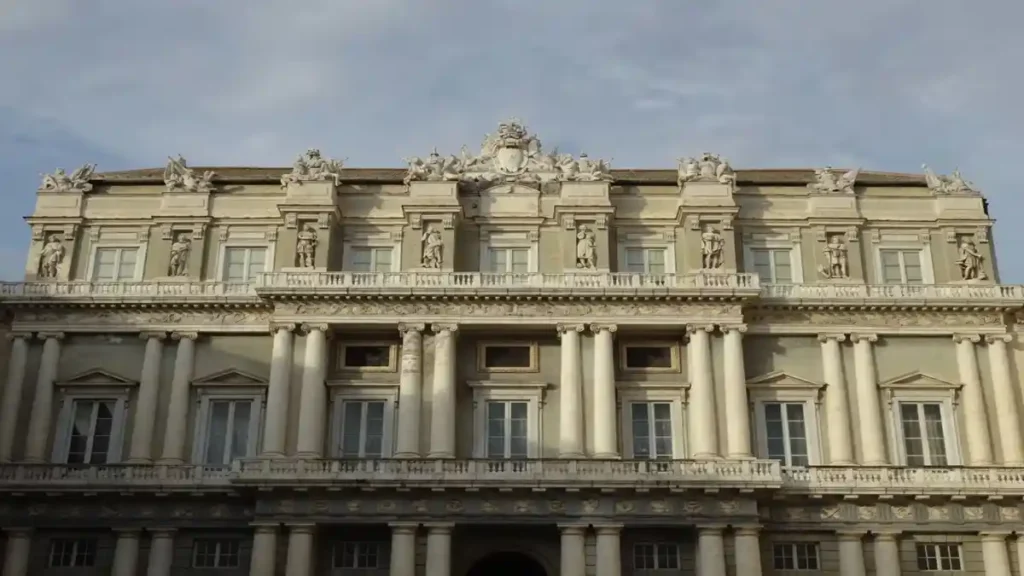
How does Ligurian stonework compare with modern architectural precast?
Modern precast reproduces Ligurian detail with measurable performance.
Our analysis suggests the via assarotti construction year ligurian republic french period aesthetic translates well into precast when you specify for exposure up front.
| Feature | Historic Ligurian Masonry | Standard Architectural Precast | Coastal-Grade Architectural Precast |
|---|---|---|---|
| Wall build method | Hand-laid stone and stucco | Plant-cast panels | Plant-cast panels, dense mix |
| Compressive strength | Varies by stone | 4,000–5,000 psi | 5,000+ psi (ACI 318 C2 minimum) |
| Water-cement ratio | Not controlled | ~0.45 | 0.40 max |
| Quality standard | Craft tradition | PCI MNL-117 | PCI MNL-117 + chloride testing |
| Connection hardware | Iron cramps | Galvanized steel | Stainless or C5-rated coated steel |
| Install speed | Months | Days to weeks | Days to weeks |
The American Concrete Institute sets exposure classes in ACI 318. Class C2 covers concrete exposed to moisture and chlorides, such as salt spray or deicing salts.
C5 is a corrosivity category under ISO 12944, the protective-coating standard for steel. Apply it to embeds and connections near the coast or heavily salted roads.
Tree Seed Processing Centre Delamere Forest Construction Company Raises the Bar
What does this mean for Midwest contractors?
If you’ve been following architectural precast trends across the Midwest, this won’t come as a surprise. Clients want historic character, and precast delivers it without stone-mason lead times.
Our contractors note five steps that keep these projects on track:
- Collect reference images from Genoa’s French-period and 19th-century facades.
- Assign an exposure class under ACI 318 before setting the mix design.
- Specify plant certification through the Precast/Prestressed Concrete Institute, using MNL-117 for architectural units and MNL-116 for structural elements.
- Mock up one full-size panel to approve color, texture, and reveal depth.
- Sequence crane picks with your erection plan to protect finished faces.
What are the pros and cons?
- Pro: Consistent finish quality from controlled plant casting.
- Pro: Faster enclosure, which shortens winter schedules.
- Pro: Lower long-term maintenance than stucco over masonry.
- Con: Higher upfront mold costs for custom profiles.
- Con: Crane access can limit tight urban sites.
Shamir Secret Sharing Reconstruction from Shares Python Code
How will this impact your next build?
The via assarotti construction year ligurian republic french period offers a working model for heritage design on hard sites.
Genoa built dense, climbed steep slopes, and faced the sea. Midwest builders face freeze-thaw cycles, road salt, and crowded infill lots.
Our team sees the same answer in both places: durable envelopes with detail cast in. Reporting from ENR continues to track wider precast adoption in urban and mixed-use work.
Researching the via assarotti construction year ligurian republic french period gives you the design language.
Precast gives you the delivery method.
Book a plant tour with a PCI-certified producer this quarter, and bring your Genoa references to the mock-up meeting.