
Concrete foundation repair using precast systems reduces installation time by up to 50% compared to cast-in-place methods, minimizes site disruption, and delivers consistent structural performance — making it a strong option for Midwest contractors managing tight project timelines and variable soil conditions.
Osrs Construction Calculator for Midwest Builds
Key Takeaways
- Precast concrete panels and wall systems can cut concrete foundation repair timelines from weeks to days, depending on project scope.
- Precast components are manufactured under controlled conditions, which produces more consistent compressive strength than field-poured alternatives.
- Midwest soil conditions — including freeze-thaw cycles and expansive clay — make early foundation repair decisions critical to long-term structural integrity.
Concrete foundation repair is one of the most consequential decisions on any construction or renovation project.
Get it wrong, and you’re looking at recurring structural movement, water intrusion, and cost overruns that compound over time.
Get it right — with the correct system, the right materials, and proper sequencing — and the foundation holds for decades without requiring rework.
Our team at Midwest Precast Contractor has observed a clear shift across the region: more general contractors and structural engineers are turning to precast systems when evaluating concrete foundation repair options, and the data supports that move.
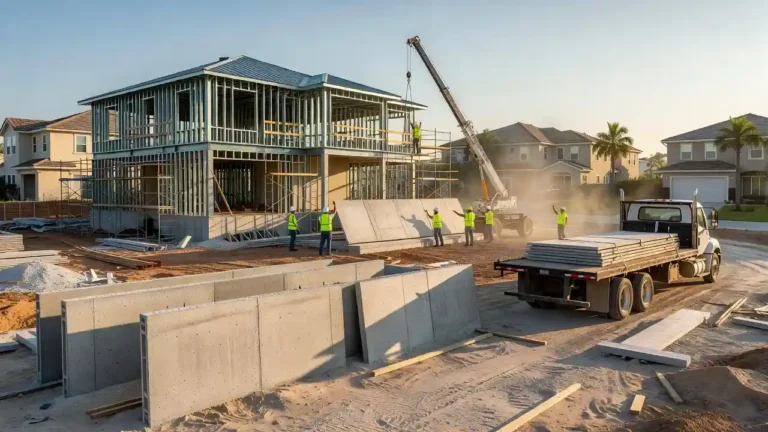
Label Under Construction Practices for Precast Framing
What Makes Concrete Foundation Repair So Complex?
Foundation repair is not a single task.
It’s a sequence of interdependent decisions: soil assessment, structural diagnosis, material selection, sequencing with above-grade framing, and long-term drainage management.
Each variable compounds the others.
Our contractors note that the most common errors they encounter are not in the repair work itself — they’re in the diagnostic phase.
A crack in a foundation wall, for example, can indicate simple shrinkage, differential settlement, or active lateral soil pressure.
Each of those causes requires a different repair strategy.
Misidentifying the cause leads to repairs that stabilize symptoms rather than the underlying problem.
The Bureau of Reclamation’s Guide to Concrete Repair outlines this clearly: effective concrete repair begins with a thorough condition survey, not with material selection.
We follow that principle on every job.
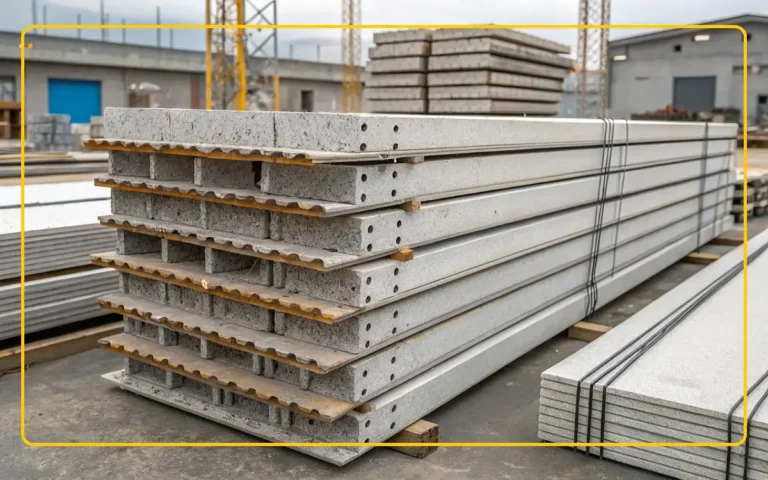
Goodyear Construction Boots Gear for Precast
How Does Precast Compare to Traditional Foundation Repair?
Our analysis suggests that precast systems outperform cast-in-place methods across most residential and light commercial concrete foundation repair scenarios in the Midwest.
Here’s how the two approaches compare across the metrics that matter most to contractors and project owners.
| Factor | Precast Concrete | Cast-in-Place Concrete |
|---|---|---|
| Installation Time | 1–3 days for wall panels | 1–3 weeks including curing |
| Compressive Strength | Controlled, typically 5,000–7,000 psi | Variable, typically 3,000–4,000 psi on site |
| Weather Dependency | Low — panels manufactured off-site | High — temperature and humidity affect cure |
| Quality Control | Plant-controlled, inspected pre-delivery | Field-dependent |
| Cost (materials) | Moderate–high upfront | Lower upfront, higher long-term risk |
| Disruption to Site | Minimal | Significant — forms, curing, staging |
| Freeze-Thaw Resistance | High — dense mix design | Variable |
Construction industry insiders are noting that the total cost of ownership often favors precast when you factor in reduced labor time, fewer weather delays, and lower callback rates.
The Precast/Prestressed Concrete Institute (PCI) sets the manufacturing and quality standards for precast components — and those standards are significantly more rigorous than what’s achievable on a typical job site pour.
What Does Precast Mean for Your Midwest Project?
If you’ve been following precast concrete trends across the Midwest, you already know that regional conditions create specific challenges that national product specs don’t always account for.
Freeze-thaw cycling in Illinois, Indiana, Ohio, and Michigan subjects foundations to repeated stress that accelerates crack propagation in lower-density concrete.
Expansive clay soils in much of the region generate lateral pressure that standard repair patches simply cannot resist over time.
Our team has found that precast panels — manufactured to a minimum 5,000 psi compressive strength with controlled water-cement ratios — hold up measurably better under these conditions than field-poured repairs.
That’s not a marketing claim.
That’s a structural outcome backed by material science.
The Federal Highway Administration’s research on precast concrete systems confirms that precast components demonstrate superior dimensional consistency and durability under repeated load and thermal cycling — findings that translate directly to foundation applications.
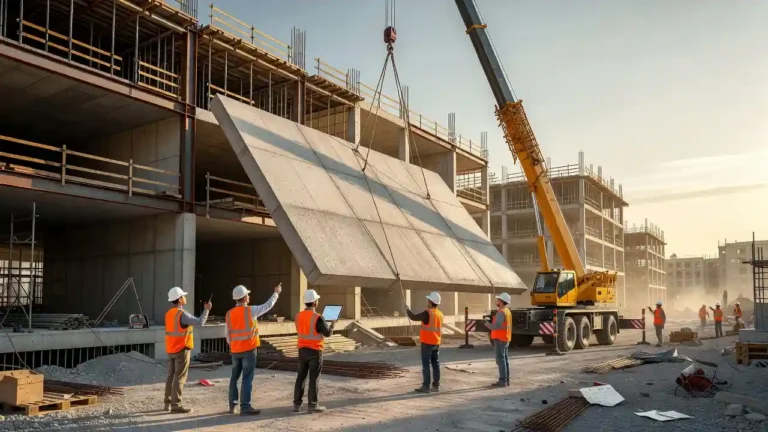
Construction Cleaning Service for Precast Frame Projects

How Do You Plan and Execute a Precast Foundation Repair Project?
Concrete foundation repair with precast components follows a structured sequence.
Skipping steps introduces risk.
Here is the process our contractors follow on-site:
Step 1 — Structural Assessment
Inspect the full foundation perimeter, not just the visible damage.
Document crack width, orientation, and any signs of active movement.
This step determines whether the repair is cosmetic, structural, or both.
Step 2 — Soil and Drainage Evaluation
Check grading, downspout discharge, and subsurface drainage conditions.
Foundation problems in the Midwest are frequently water-driven.
Repairing the structure without correcting drainage is a short-term fix.
Step 3 — Repair Method Selection
For surface-level cracking, epoxy or polyurethane crack injection remains a proven approach.
For compromised wall sections, precast panel replacement or reinforced panel overlay systems are the appropriate solution.
Our team specifies ASTM C150 Type I/II cement for all patch work as a baseline.
Step 4 — Panel Fabrication and Delivery Coordination
Precast panels are ordered to project-specific dimensions.
Lead times typically run 2–4 weeks depending on complexity.
We coordinate delivery with crane positioning and excavation scheduling to eliminate idle time on site.
Step 5 — Installation and Backfill
Panels are set to grade, mechanically connected to the footing and sill plate, and waterproofed at joints.
Backfill is placed in compacted lifts — not dumped — to prevent lateral pressure buildup during initial soil settlement.
Step 6 — Final Inspection and Documentation
Every repair is photographed, load-tested where required, and documented for the project file.
We provide that documentation to the general contractor and structural engineer of record.
Hari Building Precast Is The Future
What Are the Advantages and Limitations of Precast Foundation Repair?
Advantages:
- Consistent quality — every panel leaves the plant at the same spec
- Faster installation reduces exposure to weather and reduces overall project duration
- Higher compressive strength improves performance under freeze-thaw and lateral load
- Less site disruption means neighboring work can continue without interference
- Plant-certified production aligns with PCI quality standards
Limitations:
- Higher upfront material cost compared to poured-in-place repair
- Requires crane access, which may be a constraint on tight urban lots
- Custom panel dimensions require lead time — last-minute changes are costly
- Not every crack or failure mode requires full panel replacement; over-specifying adds unnecessary cost
When Is Concrete Foundation Repair Urgent?
Not every foundation issue demands immediate action.
But some conditions do.
Our contractors flag the following as requiring prompt evaluation:
- Horizontal cracks in basement walls — these indicate active lateral soil pressure and are the most structurally serious type
- Stair-step cracking in block foundations — this typically signals differential settlement
- Bowing or deflection greater than 1 inch in any wall section
- Water infiltration following every rain event — a sign that crack injection alone will not solve the underlying problem
- Gaps between the foundation wall and the floor system above
If you’re seeing any of these conditions, the right move is to get a structural assessment before the problem advances.
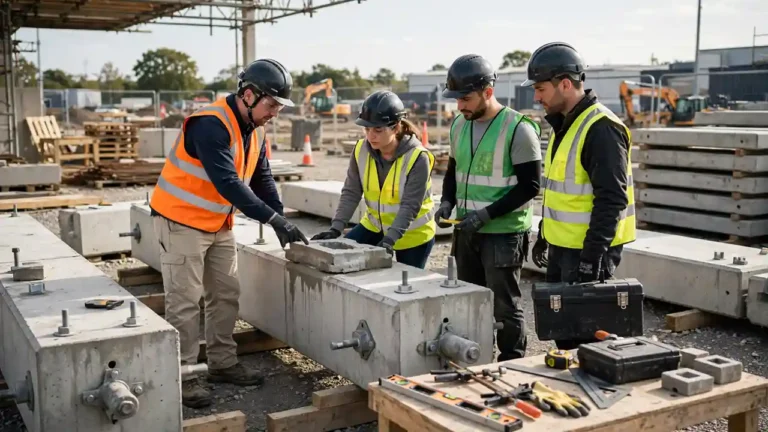
DPR Construction Precast Concrete Precision
Start with the Right Contractor
Concrete foundation repair done correctly the first time is always less expensive than concrete foundation repair done twice.
We’ve built our practice around that principle.
At Midwest Precast Contractor, we bring plant-quality precast components together with field crews who understand the specific demands of Midwest construction.
We assess before we prescribe.
We document every step.
And we stand behind our work after the project closes.
If you have a foundation repair project in planning — or one that needs to happen now — contact our team directly through midwestprecastcontractor.com.
We’ll give you a straight answer on what the project needs and what it will take to get it done right.