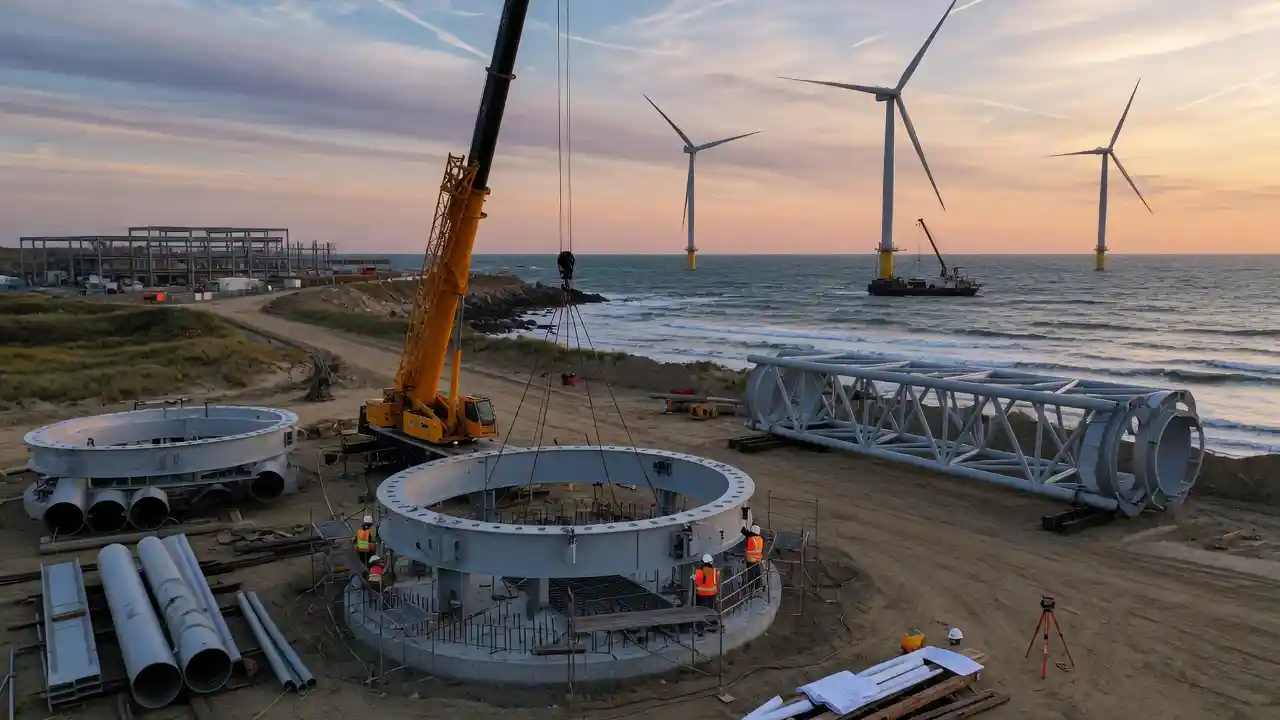
Southcoast wind permit reconsideration is sending real shockwaves through the construction supply chain, and Midwest contractors who work in structural framing need to understand exactly what’s at stake.
The Trump administration’s aggressive review of offshore wind approvals targeting roughly 5 gigawatts of permitted capacity off the Massachusetts coast is already disrupting project pipelines, shifting material demand, and forcing structural teams to rethink long-term planning.
How Leavenworth Federal Penitentiary Shapes Midwest Construction
Key Takeaways
- The federal government is actively reconsidering permits tied to major offshore wind projects, including SouthCoast Wind, representing approximately 2.4 GW of planned generating capacity.
- Structural framing contractors supplying foundations, transition structures, and onshore support infrastructure face direct exposure to timeline and procurement disruptions.
- Diversifying structural framing capacity toward onshore energy projects and industrial builds is emerging as the most practical near-term hedge.
What Is the Southcoast Wind Permit Reconsideration Actually About?
According to reporting from Engineering News-Record (ENR), the Trump administration has moved to target the existing permits of approximately 5 GW of offshore wind projects currently approved off the Massachusetts coastline.
SouthCoast Wind — a joint venture previously permitted and advancing through construction planning represents one of the largest individual projects caught in this federal review.
Our analysis of the ENR reporting suggests this isn’t a routine administrative pause.
The reconsideration involves active federal scrutiny of previously issued Certificates of Public Convenience and Necessity, Construction and Operations Plans (COPs), and related permits the structural backbone of any major energy development’s legal authorization.
Construction industry insiders are noting that the uncertainty created by this southcoast wind permit reconsideration is already cascading into procurement delays for specialty structural steel, high-performance concrete foundations, and prefabricated transition pieces used in offshore-to-onshore connection infrastructure.
How Pembroke Pines FL Projects Build the Future
How Does This Impact Structural Framing Contractors in the Midwest?
If you’ve been following structural framing trends across the Midwest, this won’t come as a surprise energy construction has quietly become one of the strongest demand drivers for heavy structural assemblies over the last six years.
Offshore wind projects like SouthCoast don’t just require ocean platforms.
They require extensive onshore structural framing systems substations, converter stations, operations buildings, and staging facilities all of which draw heavily on Midwest fabricators and erectors.
Our team has observed that contractors currently holding subcontracts tied to SouthCoast Wind’s onshore infrastructure are now operating under significant schedule ambiguity.
The southcoast wind permit reconsideration effectively freezes Notice to Proceed authorizations, which means structural framing scopes cannot be formally mobilized or procured against.
The practical consequence is straightforward: labor commitments made for Q3 and Q4 project windows are now uncertain, and structural steel and precast concrete orders placed speculatively may need to be redirected.
What the Federal Review Means for Material Procurement and Framing Schedules
The ENR source data reflects that the federal review targets permits covering approximately 5 GW of combined offshore capacity along the Massachusetts coastline.
For context, SouthCoast Wind alone had been projected to power over 700,000 homes representing an enormous downstream demand for structural framing components.
Our contractors note that the southcoast wind permit reconsideration introduces three compounding structural risks:
- Schedule compression risk — If permits are eventually reissued, contractors face accelerated timelines with no corresponding labor ramp-up time.
- Material price volatility — Procurement delays concentrated in a short window drive up costs for ASTM A992 structural steel and Class C5 concrete mixes used in corrosive coastal environments.
- Scope creep exposure — Revised permit conditions often introduce new structural requirements mid-project, requiring reengineering of connection details and load paths.
Grey County Builder Lischkoff Fine: A Warning for Buyers
Southcoast Wind Permit Reconsideration Reshapes Structural Demand
— US News (@Us_news_ways) August 4, 2026
Southcoast wind permit reconsideration is sending real shockwaves through the construction supply chain, and Midwest…@southcoasttoday @ENERGY @USWindInc https://t.co/d9Z3k9mzlT
Structural Framing Comparison: Wind Energy vs. Industrial Builds
| Factor | Offshore Wind Onshore Infrastructure | Traditional Industrial Build |
|---|---|---|
| Foundation Type | Deep-drilled caisson foundations, min. f’c 6,000 psi | Spread footings, f’c 4,000–5,000 psi |
| Framing System | Heavy wide-flange steel, seismic + wind load combined | Standard W-series framing, gravity-dominant |
| Timeline Exposure | High — permit-dependent mobilization | Low — no federal permit dependency |
| Material Lead Time | 20–28 weeks for specialty steel sections | 8–14 weeks standard procurement |
| Regulatory Risk | Critical — as the southcoast wind permit reconsideration demonstrates | Minimal for conventional industrial |
What Should Structural Framing Contractors Do Right Now?
Our team recommends a structured response protocol for any contractor with exposure to wind energy project pipelines.
- Audit your current contract language — Identify any force majeure or government action clauses that apply specifically to federal permit revocation or reconsideration events.
- Contact your fabricator immediately — Notify structural steel and precast concrete suppliers about potential schedule holds before formal delay notices arrive.
- Reassess your Q3–Q4 labor commitments — Field crews committed to wind energy scopes should be evaluated for reassignment to industrial or infrastructure projects.
- Document all standby costs now — The southcoast wind permit reconsideration may create compensable delay claims; documentation must begin at the point of impact, not after.
- Explore demand-side pivots — According to the Precast/Prestressed Concrete Institute (PCI), industrial and data center construction remain among the strongest structural framing growth sectors in 2024–2025.
- Consult your surety and bonding team — Extended permit uncertainty may trigger performance bond review clauses on active or pending energy project commitments.
How Gordie Howe Bridge Aesthetic Lights Are Reshaping Precast
Where Does the Industry Go From Here?
The broader implications of the southcoast wind permit reconsideration are still developing.
The Bureau of Ocean Energy Management (BOEM), which oversees offshore wind permitting at the federal level, has not yet issued definitive revised guidance meaning structural contractors remain in a holding pattern that could extend through multiple quarters.
Our analysis suggests the most resilient structural framing operations will be those that treat energy construction as one segment of a diversified portfolio not a primary revenue anchor.