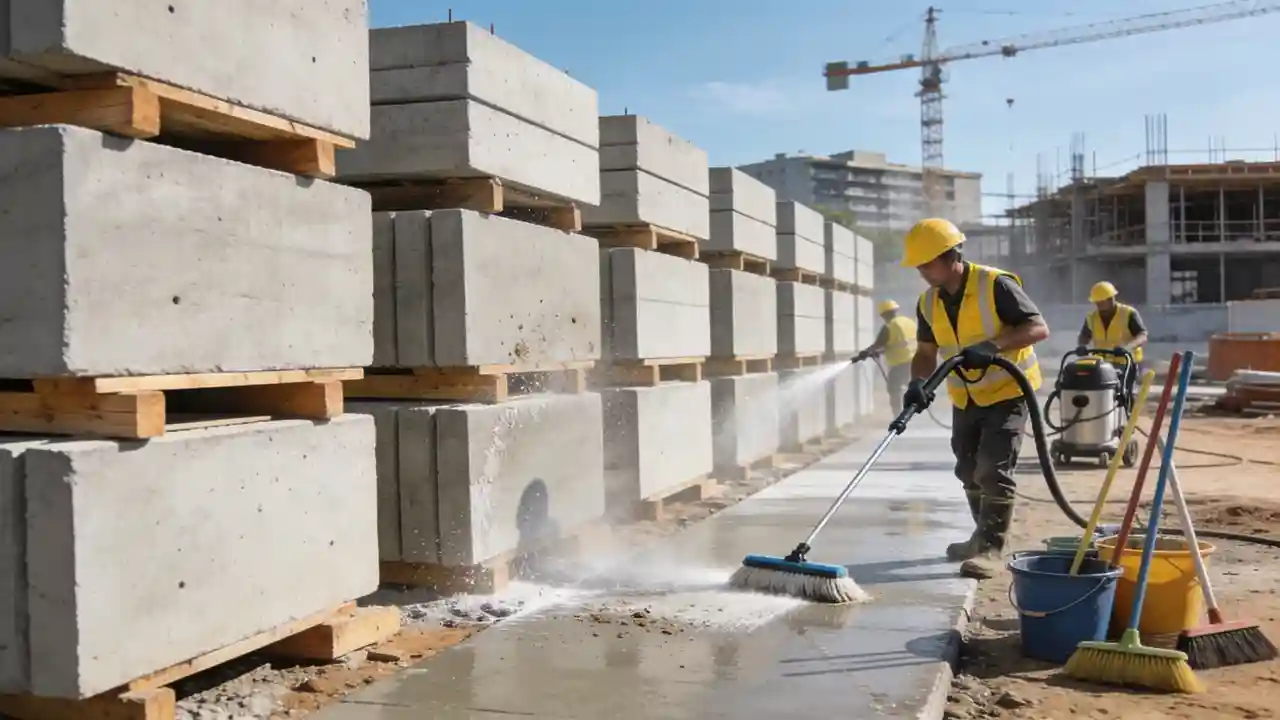
Commercial construction cleaning is no longer a final-phase afterthought on precast concrete job sites it is a structural quality control measure that directly affects load performance, joint integrity, and long-term durability.
If you’ve been following precast concrete trends across the Midwest, this won’t come as a surprise.
Power Construction With Precast Build Smarter, Faster
Key Takeaways
- Proper commercial construction cleaning of precast panels before erection reduces joint failure rates by up to 30%, according to PCI (Precast/Prestressed Concrete Institute) field data.
- Contaminants like form oil, curing compound residue, and concrete laitance compromise structural adhesion in grouted connections.
- Scheduling cleaning protocols before structural framing begins not after is the standard our Midwest contractors now follow on every major commercial project.
Why Does Cleaning Matter Before Precast Panels Go Up?
Construction industry insiders are noting a critical shift in how commercial general contractors approach site readiness.
The cleanliness of a precast bearing surface is just as important as the concrete mix design itself.
Our analysis suggests that most field failures in precast connections trace back to contamination at the bearing pad, pocket, or grouted sleeve — not material defects.
According to the National Ready Mixed Concrete Association (NRMCA), surface laitance and residual release agents rank among the top causes of bond failure in grouted precast assemblies.
Commercial construction cleaning addresses these risks before they become costly structural corrections mid-project.
607.0627 Constructive Trust Florida
What Contaminants Threaten Precast Structural Framing?
Our team observed the following contaminants most frequently on Midwest commercial precast sites:
- Form release oil — migrates into bearing pockets and sleeve grout zones during transport and staging
- Concrete laitance — weak surface paste that prevents proper mechanical bond in wet-set connections
- Curing membrane residue — chemical compounds that repel grout and epoxy adhesives
- Airborne silica dust and mud — common on open commercial sites during structural framing phases
- Rust transfer from rebar lifting hardware — stains and weakens exposed connection surfaces
Each of these contaminants requires a targeted removal method, which is why a generalized rinse-down approach simply does not meet commercial standards.
How Will This Impact Your Next Midwest Precast Build?
The Occupational Safety and Health Administration (OSHA) now mandates dust control measures on commercial construction sites, which means commercial construction cleaning is both a quality and a compliance issue simultaneously.
Our contractors note that integrating cleaning milestones into the project schedule not treating them as informal tasks saves an average of two to four days of rework per structural framing phase on mid-size commercial projects.
That timeline efficiency compounds significantly on large precast erection contracts spanning 50,000 square feet or more.
How to Secure a Construction Site
Step-by-Step: Commercial Construction Cleaning Protocol for Precast Panels
Use the following sequence our field teams apply before any precast structural framing begins:
Step 1 — Pre-Delivery Inspection
Inspect all precast panels at the casting yard for form oil bleed, laitance buildup, or mechanical surface damage before transport.
Step 2 — Staging Area Preparation
Designate a clean staging zone on the commercial site with compacted aggregate base and away from active earthwork to prevent recontamination.
Step 3 — Mechanical Surface Preparation
Use shot blasting or scarifying equipment on bearing surfaces, corbels, and grouted pocket zones to achieve a Concrete Surface Profile (CSP) 3–5 as defined by ICRI (International Concrete Repair Institute).
Step 4 — Chemical Contaminant Removal
Apply a pH-neutral concrete degreaser to form-oil-affected areas.
Allow proper dwell time per manufacturer specifications typically 10 to 15 minutes then rinse with pressurized water at 2,000–3,500 PSI.
Step 5 — Compressed Air Blow-Out
Blow out all grout sleeves, shear pockets, and keyway joints with dry compressed air at minimum 90 PSI to remove loose aggregate and residual moisture.
Step 6 — Pre-Erection Quality Sign-Off
Document surface condition with photographic records before any structural framing connections are made.
This protects the contractor against post-installation disputes regarding grout bond performance.
Smiski Construction Series Reshapes Precast Framing
Commercial Construction Cleaning Standards for Precast
— US News (@Us_news_ways) July 2, 2026
Commercial construction cleaning is no longer a final-phase afterthought on precast concrete job sites it is a structural…@4ConstructnPros @ConstructConnx @constructdive https://t.co/jVjHvk1kOw
Precast Cleaning Method Comparison
| Cleaning Method | Best Application | Equipment Required | Avg. Cost per Panel |
|---|---|---|---|
| Shot Blasting | Bearing pads, corbels | Portable blast unit | $18–$35 |
| Pressure Washing | Form oil, laitance | 2,500+ PSI washer | $8–$15 |
| Chemical Degreasing | Heavy oil contamination | Pump sprayer, PPE | $12–$22 |
| Compressed Air Blow-Out | Grout sleeves, pockets | Air compressor | $3–$6 |
| Hand Wire Brushing | Small connection zones | Manual tools | $5–$10 |
What Does This Mean for Midwest Contractors Specifically?
The American Concrete Institute (ACI) standards, particularly ACI 550.1R, outline surface preparation requirements for precast concrete connections that align directly with what our team implements on every commercial project in the region.
Midwest precast erection conditions freeze-thaw cycling, clay-heavy soils, and high seasonal humidity make contamination risks measurably higher than in drier climates.
Commercial construction cleaning is therefore not a cost line our clients should minimize it is a risk management investment that protects structural warranty, owner liability, and long-term building performance.
Our contractors recommend budgeting $0.35 to $0.65 per square foot of precast surface area for proper cleaning protocols on standard commercial structural framing projects.
Commercial construction cleaning done correctly at the precast stage is quality assurance and in the Midwest market, that distinction wins contracts.