
Tight deadlines and rising labor costs are pushing Midwest contractors to rethink their kits.
The right concrete tools now decide whether a precast job finishes on schedule or bleeds margin.
Our team has watched this shift firsthand on framing sites from Ohio to Iowa.
So the question is no longer if you upgrade your gear, but which tools earn their keep.
Key Takeaways
- The right concrete tools can cut precast panel setting time by up to 40% versus poured-in-place methods.
- Precast framing reduces on-site labor crews, trimming payroll on tight builds.
- Quality tools paired with 5,000 PSI panels deliver stronger, faster, weather-independent structures.
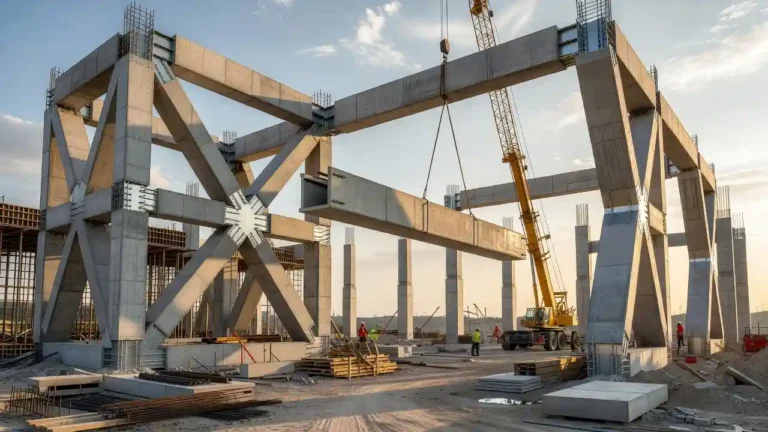
Shreeji Construction Precast Structural Framing
Why do concrete tools matter more in precast work?
Precast concrete is a different animal from cast-in-place.
You are not pouring and waiting.
You are setting cured, engineered panels with precision and speed.
That means your concrete tools must support lifting, aligning, and securing heavy structural elements.
Our contractors note that a mismatched tool kit is the fastest way to stall a precast schedule.
If you’ve been following precast concrete trends across the Midwest, this won’t come as a surprise.
The Precast/Prestressed Concrete Institute (PCI) has long documented how proper handling equipment protects panel integrity.
Drop a connection point, and you compromise the entire structural frame.
JP Construction Precast Concrete Results
Which concrete tools belong on a precast site?
Our team observed that most successful precast crews carry a tight, purpose-built set.
You don’t need a hundred items. You need the right ones.
Here are the core concrete tools we recommend for structural framing:
- Spreader beams and rigging — for safe, balanced panel lifts
- Lifting clutches and anchors — matched to embedded panel inserts
- Plumb bars and turnbuckle braces — to align panels true and vertical
- Laser levels — for fast, accurate elevation checks
- Grout pumps and dry-pack tools — to seal connections and bearing points
- Torque wrenches — for welded and bolted plate connections
Each tool maps to a specific phase of the set. Skip one, and you create a bottleneck.
OSHA’s crane and rigging standards make clear that lifting gear is not optional.
It is a safety requirement on any structural lift.

How do precast tools compare to traditional framing tools?
Our analysis suggests the gap is widest on labor and timeline.
Traditional cast-in-place work demands formwork, rebar tying, and long cure windows. Precast shifts most of that into the plant.
| Factor | Precast Concrete Tools | Traditional Cast-in-Place |
|---|---|---|
| Primary gear | Rigging, lifting clutches, braces | Formwork, vibrators, finishing trowels |
| Crew size | Smaller, specialized | Larger, multi-trade |
| Weather delays | Minimal | Frequent |
| Cure time on-site | None (panels arrive cured) | 7–28 days |
| Setting speed | Fast (panels per day) | Slow (pour, cure, strip) |
The takeaway is simple.
Precast concrete tools front-load precision and back-load speed.
ASTM International maintains the material standards that make this consistency possible. Engineered panels meet spec before they ever reach your site.
Suffolk Construction Precast Concrete Projects
What’s the right way to set precast panels?
Here is the process our crews follow on a typical structural framing set.
Follow it in order.
- Plan the lift.
Confirm panel weights, pick points, and crane capacity against the shop drawings.
Match every lifting clutch to the embedded anchor rating. - Prep the bearing surface.
Clean and level the foundation or supporting element.
Set shims to the exact elevation marked on your plans. - Rig and lift.
Attach the spreader beam and clutches.
Lift slowly and keep the panel balanced. - Position and brace.
Guide the panel into place with tag lines.
Set turnbuckle braces immediately and check plumb with a laser level. - Connect.
Weld or bolt the plate connections per the engineer’s spec.
Torque every bolt to the required value. - Grout the joints.
Dry-pack or pump grout into bearing points and panel seams.
Verify the mix meets your project’s strength requirement.
The American Concrete Institute publishes detailed connection guidance through ACI.
We lean on those standards for every structural joint.
What does this mean for your next Midwest build?
Construction industry insiders are noting a steady move toward precast across commercial and multi-family projects.
The reason is plain. Speed and predictability win bids.
We found that crews equipped with proper concrete tools consistently beat poured-in-place timelines.
That advantage compounds across a tight Midwest building season. Fewer weather delays means more projects closed before winter.
Construction Heater Rental Up Your Winter Project
The pros of a precast-ready tool kit:
- Faster panel setting and shorter overall schedules
- Reduced on-site labor and lower payroll exposure
- Stronger, factory-controlled structural quality
- Year-round work, even in cold months
The cons to plan around:
- Higher upfront equipment investment
- A learning curve for crews new to rigging
- Coordination required between plant and site
Our team’s view is that the upfront cost pays back quickly.
The U.S. Bureau of Labor Statistics tracks rising construction labor costs every year.
Tools that cut crew hours directly protect your margin.
How should you build your concrete tools strategy?
Start with the lift.
Get your rigging and bracing right before anything else. Everything downstream depends on safe, accurate panel placement.
Then standardize.
Train your crew on one consistent set of concrete tools so every job runs the same way.
Repetition builds speed, and speed builds profit.
As Construction Evolves, Precast Concrete Leads
Here is your quick checklist before the next precast set:
- Rigging and lifting clutches rated to panel weight
- Bracing and plumb tools staged on-site
- Laser level calibrated
- Grout and connection gear ready
- Crew briefed on the setting sequence
The bottom line is straightforward. Better concrete tools mean faster, safer, stronger precast builds.
Which tool upgrade would make the biggest difference on your next project?