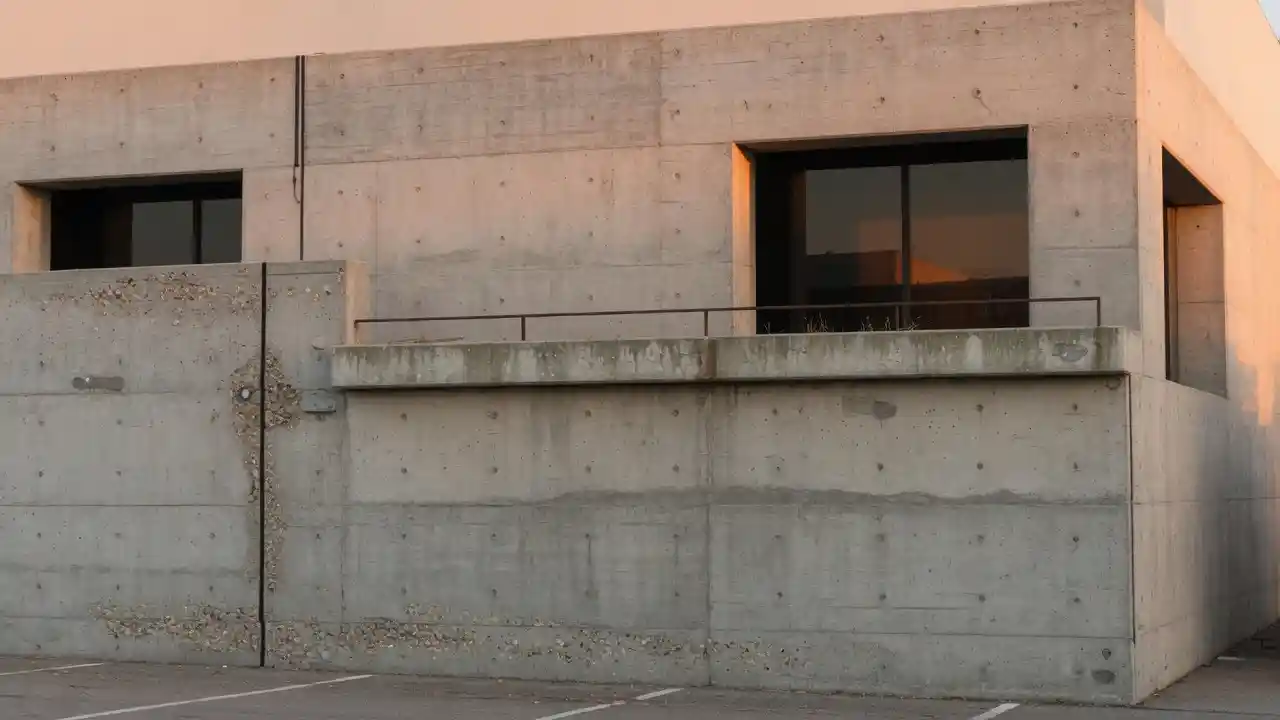
Energy codes are tightening, and repair budgets are not getting any bigger. That combination puts real pressure on the building envelope of concrete wall systems you specify today.
Get the design right early, and you can reduce moisture problems, energy loss, and callbacks for years. Get it wrong, and the fixes tend to be slow and expensive.
Border Construction Big Bend Texas to Know
Key Takeaways
- A well-detailed building envelope of concrete wall controls air, water, and heat movement across one continuous system, not separate parts.
- Architectural precast panels are cast off-site, which supports tighter tolerances and faster installation once panels reach the job.
- Standards like ACI 562 and PCI MNL-122 guide durability, thermal performance, and long-term maintenance decisions.
What is a building envelope of concrete wall, really?
The envelope is every layer that separates the inside of a structure from the outside.
For concrete construction, that means the panel itself, the insulation, the air and vapor control layers, the joints, and the sealants.
Our contractors note that most envelope failures start at transitions joints, connections, and window openings — rather than in the middle of a panel.
When those details are planned as one system, the wall performs closer to its design intent.
According to guidance from IIBEC, properly designed concrete facade elements can deliver a long service life with a reasonable level of maintenance.
That word reasonable matters, because no concrete envelope is maintenance-free.
How to Conduct a Construction Site Risk Assessment
Why does architectural precast change the equation?
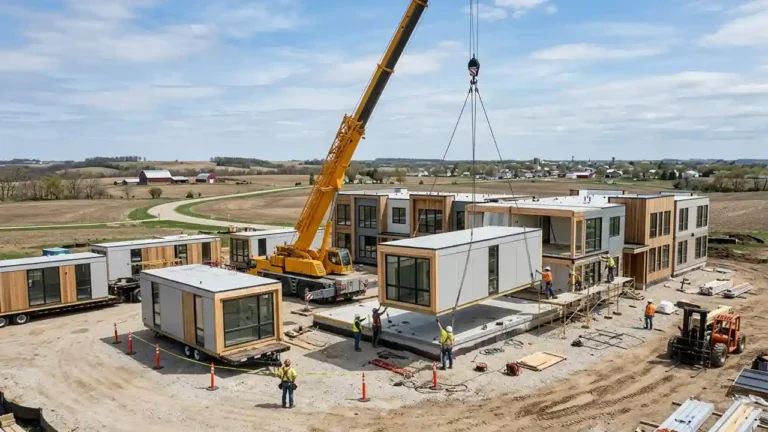
Architectural precast panels are cast in a controlled plant, not poured in place on a windy site.
That off-site process, described by RestoreWorks, supports meticulous detailing and expedited installation once panels arrive.
We found that plant casting also helps with color, texture, and finish consistency across a facade.
The PCI MNL-122 manual covers these finishes in depth, along with the split between loadbearing and non-loadbearing panels.
The building envelope of concrete wall built from precast can also carry insulation inside the panel itself.
These sandwich panels place a rigid insulation layer between two concrete wythes, which can improve R-value while using concrete’s thermal mass to steady indoor temperatures.
A concrete envelope acts as a natural insulator, which may reduce heating and cooling loads over the building’s life.
That benefit only holds when air barriers, vapor retarders, and joints are detailed correctly.
Building Envelope of Concrete Wall Builder’s Guide
— US News (@Us_news_ways) August 17, 2026
Energy codes are tightening, and repair budgets are not getting combination puts real pressure on the building envelope of concrete wall…@Engineering @companyconcrete @CNplus https://t.co/16u53Dqx01
How does precast compare to cast-in-place?
Both methods can produce a sound building envelope of concrete wall.
The differences show up in schedule, quality control, and site conditions.
| Factor | Architectural Precast | Cast-in-Place |
|---|---|---|
| Where it’s made | Controlled plant | On the job site |
| Quality control | High, repeatable | Depends on site conditions |
| Weather sensitivity | Lower during casting | Higher during placement |
| Finish consistency | Strong across panels | Varies by pour |
| Install speed on site | Faster once erected | Slower, cure time on site |
| Insulation integration | Built into sandwich panels | Added as separate layers |
Our team observed that precast tends to win on schedule and consistency, while cast-in-place can suit complex, continuous forms.
Neither choice removes the need for careful joint and sealant work.
How should you plan an envelope inspection?
A structured walk-through catches small problems before they reach the reinforcing steel.
Here is the process we use.
- Review the design intent. Pull the drawings and confirm which layers control air, water, and vapor.
- Inspect joints and sealants. Check for splits, gaps, or hardening in the sealant lines, since these are common first failure points.
- Look for cracks. Note width, length, and pattern, because volume-change cracking behaves differently than structural cracking.
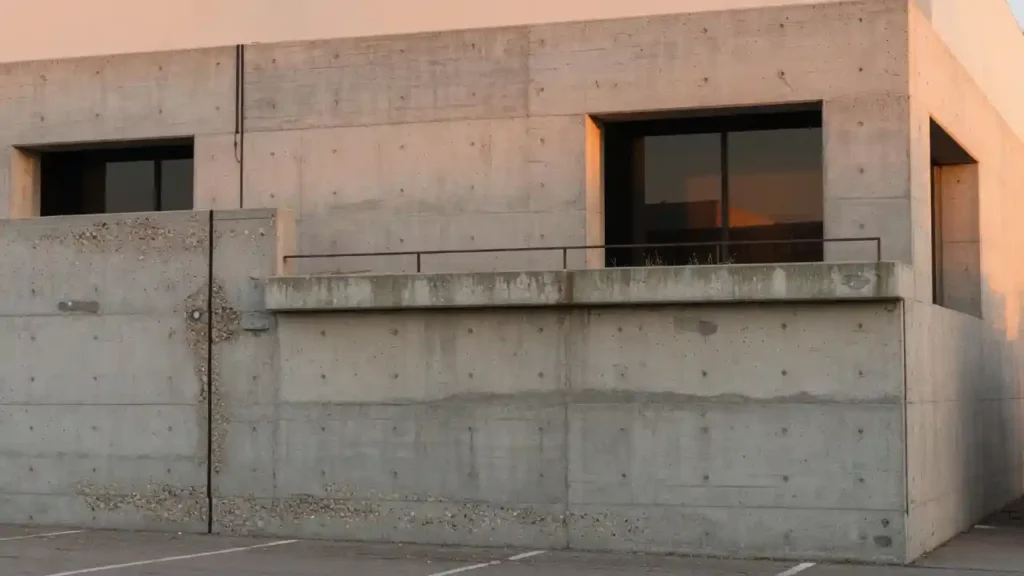
- Check for moisture signs. Watch for staining, efflorescence, or scaling that suggests water is getting in.
- Evaluate corrosion risk. Inspect exposed connections and any spot where cover concrete may be thin over reinforcement.
- Assess coatings and sealers. Confirm surface treatments are still bonded and continuous.
- Document and prioritize. Rank findings by risk to the building envelope of concrete wall and by cost to correct.
The durability chapter of ACI 562, available through ICRI, lists freeze-thaw exposure, scaling, chemical attack, and corrosion as the main threats to watch.
Match your inspection to the exposures your building actually faces.
PhET Circuit Construction Kit for Builders
What durability details deserve the most attention?
Sealant selection carries real weight.
ACI 562 guidance discusses silicone, polyurethane, and epoxy options, and the wrong choice for a moving joint can undo an otherwise sound wall.
Surface coatings, sealers, and membranes can help extend service life when specified for the right exposure.
They can also trap moisture if applied over a wall that is already wet, so timing matters.
We treat these as points to verify:
- Freeze-thaw protection for climates with hard winters.
- Adequate concrete cover over reinforcement to slow corrosion.
- Crack sealants matched to expected joint movement.
- Coatings selected for the specific chemical and moisture load.
Reference material from the American Concrete Institute supports these decisions with tested standards.
Where is the concrete envelope heading next?
Sustainability is reshaping mix design.
Fly ash, slag, and recycled aggregates can reduce the carbon footprint of a building envelope of concrete wall while cutting demand for fresh material.
These same ingredients often support LEED credits under the sustainability sections of PCI MNL-122.
Installation is shifting too. Modular and prefabrication methods are speeding erection, and 3D printing is being tested for precise facade shapes.
Emerging work includes self-healing concrete and sensor-embedded facades that respond to conditions.
These are promising, but we advise treating them as developing options rather than proven standards for your next build.
Spandrel Glass Cleaner Precast Facades
Putting it into practice
A durable building envelope of concrete wall comes from three habits. First, design air, water, vapor, and thermal layers as one connected system.
Second, choose precast when schedule and finish consistency matter, and detail every joint with care.
Third, inspect on a set schedule and match repairs to the standards in ACI 562, ICRI 310.2R-2013, and PCI MNL-122.
If you’re planning a project, start by mapping your envelope layers and exposures before you finalize panel selection.
That single step tends to prevent the most costly surprises later.