

Campus buildings now carry more people, more technology, and more scrutiny than at any point in the last generation.
The Edward St John Learning and Teaching Center shows what that load looks like in real numbers.
For contractors bidding the next envelope package, those numbers set the standard owners will expect.
Key Takeaways
- The facility covers 95,800 square feet, seats 2,000 students at once, and serves roughly 10,000 students every day.
- High-traffic academic buildings demand envelope systems built for decades of hard use, which is where architectural precast competes well.
- Plant-cast panels move fabrication off-site, so crews can compress enclosure schedules on tight campus sites.
California Railroad Infrastructure Failure Emergency Repair
What Makes This Building a Benchmark?
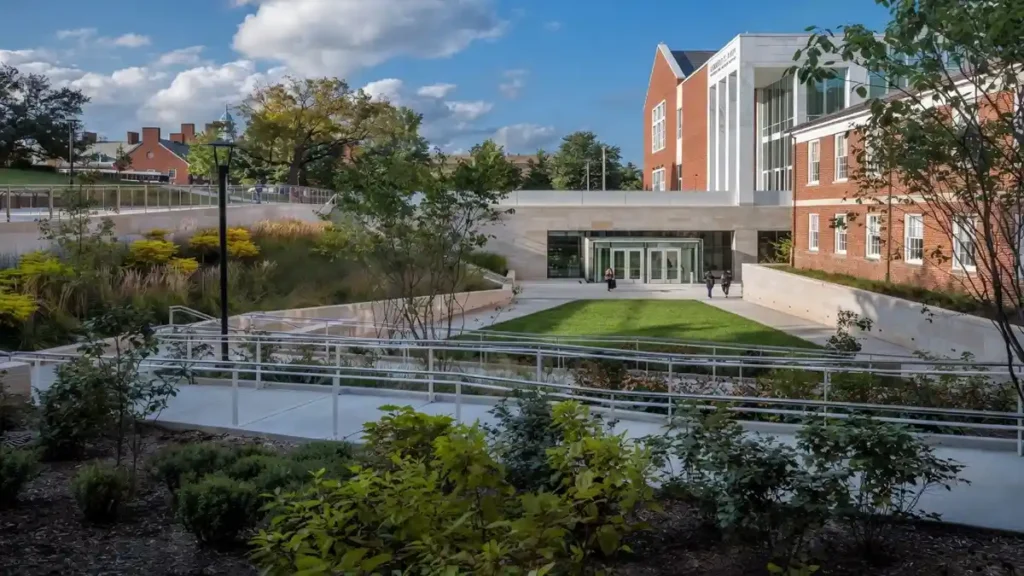
According to Clark Construction’s project overview, the Edward St John Learning and Teaching Center opened in 2016 at the University of Maryland in College Park.
Ayers Saint Gross designed it, and Clark delivered it under a General Contracting model.
Classrooms range from 80 to 320 seats.
A centralized technology service unit manages every room’s classroom tech.
Our analysis suggests the daily headcount is the real story.
When 10,000 students pass through one building each day, every door, wall, and joint gets tested constantly.
Why Does Daily Traffic Matter for Architectural Precast?
The Edward St John Learning and Teaching Center packs heavy use into a single footprint.
That kind of use punishes weak envelope details within a few seasons.
Construction industry insiders are noting a steady shift toward factory-controlled cladding on academic projects.
Coverage of MidAtlantic higher education construction trends from ENR highlights total precast structures as an efficient, durable option for school buildings.
If you’ve been following architectural precast trends across the Midwest, this won’t come as a surprise.
Our freeze-thaw cycles are harsher than Maryland’s, which makes plant-controlled curing even more valuable here.
How Does Architectural Precast Compare to Field-Built Cladding?
A building on the scale of the Edward St John Learning and Teaching Center invites a closer look at envelope options.
Our contractors use the following comparison when advising owners on campus work.
| Factor | Architectural Precast | Traditional Field-Built Cladding |
|---|---|---|
| Quality control | Plant-cast under PCI MNL-117 procedures | Varies with crew, weather, and site conditions |
| Typical concrete strength | 5,000 psi minimum 28-day strength is common | Depends on unit masonry and mortar type |
| Weather sensitivity | Panels cast indoors year-round | Cold-weather masonry slows or halts work |
| On-site labor | Crane-set panels, smaller field crews | Large crews over longer durations |
| Finish options | Form liners, acid etch, embedded thin brick | Limited to the selected unit material |
| Campus disruption | Shorter enclosure window | Extended scaffolding and staging |
The Precast/Prestressed Concrete Institute (PCI) certifies plants that produce architectural panels.
We always recommend specifying a PCI-certified producer on institutional work.
How Will This Impact Your Next Campus Build?
Owners now point to projects like the Edward St John Learning and Teaching Center when they define what “durable” means.
Your bid needs to show a clear plan for performance, not just a number.
Here is the process our team follows on high-occupancy academic envelopes:
- Confirm design loads early.
Coordinate panel connections with the structural engineer under ACI 318 requirements. - Select a certified producer.
Require PCI plant certification in the specifications, not just in the bid documents. - Approve mockups and finish samples.
Lock in color, texture, and joint layout before production starts. - Sequence crane picks around campus activity.
Plan deliveries for early mornings or academic breaks to protect student routes. - Seal and test joints.
Verify sealant compatibility and run water testing on the first completed bays. - Coordinate with mechanical trades.
Tight envelopes affect how designers meet ASHRAE 62.1 ventilation rates for crowded classrooms.
Hayco Construction Leadership Team Members and Job Titles
Edward St John Learning and Teaching Center Raises The Bar The Edward St John Learning and Teaching Center shows what that load looks like in real numbers. @highereduminmp @EduMinOfIndia @UMDuluthEduc https://t.co/AfA8An4VdD
— US News (@Us_news_ways) October 13, 2026
What Standards Should Contractors Keep Front and Center?
Three standards bodies shape most of our architectural precast decisions on academic jobs.
Each one covers a different piece of the performance puzzle.
- ACI: The American Concrete Institute publishes ACI 318 for structural concrete and ACI 533R guidance on precast wall panels.
- PCI: Plant certification and MNL-117 govern tolerances, finishes, and quality control for architectural units.
- ASHRAE: ASHRAE sets Standard 62.1, which drives ventilation design for spaces holding up to 320 students.
Our team observed that envelope and mechanical teams often work in isolation.
On a building with the occupancy of the Edward St John Learning and Teaching Center, that gap creates expensive rework.
Leon L Bean Home and Archives Restoration Completed 2016
What Does This Mean for Midwest Contractors?
University owners across Ohio, Illinois, Michigan, and Wisconsin are planning similar consolidated learning hubs.
They want fewer, larger, tech-rich buildings instead of scattered aging halls.
That shift favors contractors who can enclose buildings fast and hand over envelopes that hold up for 50 years or more.
Architectural precast checks both boxes when you partner with the right plant and plan connections early.
The Edward St John Learning and Teaching Center proves that heavy daily use is now the baseline, not the exception.
We suggest treating its numbers as your design brief for the next campus pursuit.


