
Utility crews working near energized conductors face a simple truth: the wrong lift can kill. That is why insulated aerial work platform technical specifications ansi isea standards matter to every project manager, developer, and property owner planning high-voltage work near our precast structures across the Midwest.
Key Takeaways
- Dielectric boom testing under ANSI/ISEA references confirms an insulated boom can resist voltage before it ever leaves the factory.
- The ANSI/SAIA A92 suite governs design (A92.20), safe use (A92.22), and training (A92.24) for every mobile elevating work platform.
- Voltage categories (Type A, B, and C) match platform insulation to job site line voltage, from 46kV up to 138kV and beyond.
What an Insulated Aerial Work Platform Actually Is
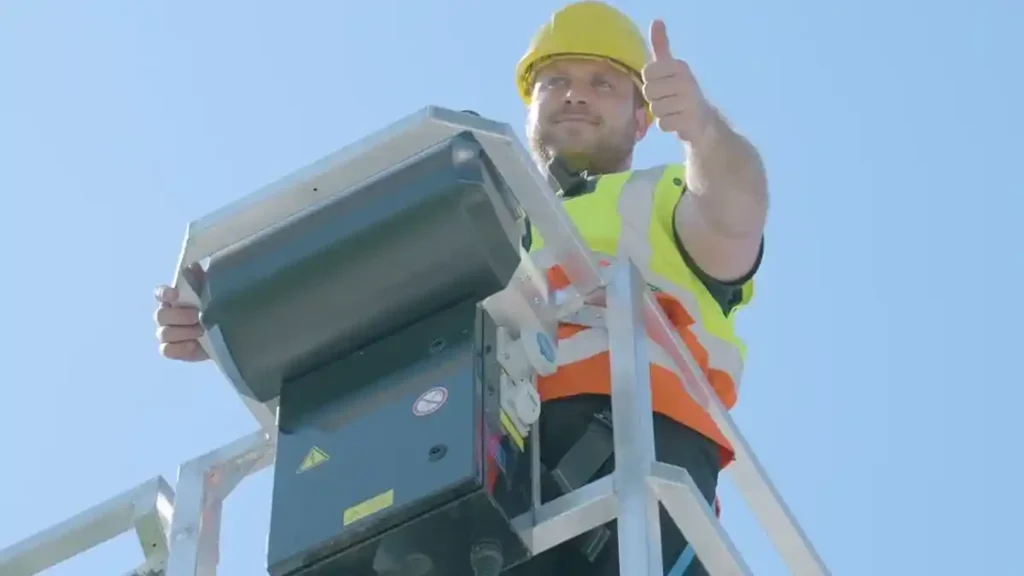
An insulated aerial work platform is a mobile elevating unit built with a fiberglass boom section and an insulated platform liner that break the electrical path to ground. Our crews see these on telecom towers, substations, and live-line repairs. The chassis, hydraulics, and guardrails match a standard boom, but the dielectric materials set it apart.
If you have tracked utility construction standards, this specification won’t surprise you. The insulation is the reason a lineman can work near a charged conductor without becoming part of the circuit.
AWP Types and Chassis Families
Aerial work platforms ship in several chassis families, each matched to reach, footprint, and floor loading. Our engineering team picks the right one during the specification stage, before scheduling any precast lift work.
| Chassis Family | Lifting Motion | Best Use | Insulated Option |
|---|---|---|---|
| Scissor | Vertical only | Flat indoor floors, wide platform | Rare |
| Articulating Boom | Up-and-over reach | Around obstacles, tight positioning | Yes |
| Telescopic Boom | Straight extension | Long horizontal outreach, bridges | Yes |
| Vertical Mast | Narrow vertical | Corridors, doorways, low weight | Rare |
| Trailer-Mounted | Folding boom | Road-legal, municipal reach | Yes |
For live-line work, the articulating and telescopic boom lines carry the insulation package. Scissor and mast units stay on non-energized tasks.
The ANSI/SAIA A92 Standards Suite
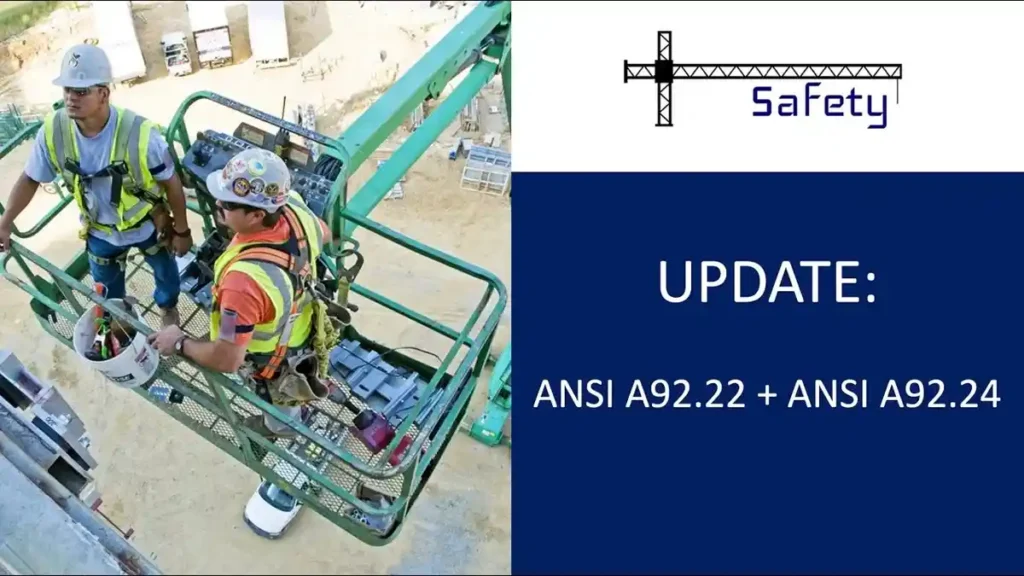
The ANSI/SAIA A92 standards define how every mobile elevating work platform is designed, used, and inspected. Developed with the Scaffold and Access Industry Association, they protect workers and reduce project delays.
| Standard | Title Focus | What It Covers |
|---|---|---|
| A92.2-2021 | Vehicle-mounted devices | Rotating and elevating aerial devices |
| A92.20-2021 | Design & calculations | MEWP safety requirements, test methods |
| A92.22-2021 | Safe use | Planning, supervision, rescue |
| A92.24 (R2026) | Training | Operation, inspection, maintenance training |
The A92.24 standard was reaffirmed in 2026, so training requirements remain current. Review the ANSI/SAIA A92 family before any bid involving elevated access.
Insulated Boom Dielectric Test Parameters
Here is where insulated aerial work platform technical specifications ansi isea standards drive nearly every material decision. Each fiberglass boom arrives with a certified dielectric test report, and every finished unit gets a proof test before shipment.
| Test Parameter | Method / Reference | Result Format |
|---|---|---|
| Boom dielectric withstand | AC proof voltage per ANSI/ISEA category | Pass/Fail, leakage current logged |
| Platform liner insulation | Visual + electrical continuity check | Pass/Fail with photo record |
| Surface contamination | Cleaning + moisture check | Logged pre-test |
| Outrigger interlock | Mechanical + electrical verification | Pass/Fail |
| Retest interval label | Stamped date near turntable | Date code filed |
The AC proof voltage test and recorded leakage current are the two numbers utility buyers check first. Our teams keep raw material certificates archived so a dielectric retest years later traces back to the original fiberglass batch.
Insulated Aerial Work Platform Technical Specifications Ansi Isea Standards
— US News (@Us_news_ways) September 1, 2026
That is why insulated aerial work platform technical specifications ansi isea standards matter to every project…@SaifOnline @OSHA_DOL @ANS_Online https://t.co/S7CAWHa1C5
Voltage Categories: Type A, B, and C
Insulation categories match the platform to line voltage. Get this wrong, and the boom offers no meaningful protection. Manufacturers align these ratings with ANSI and IEC standards for live-line maintenance.
| Category | Voltage Rating | Typical Application |
|---|---|---|
| Type A | 138 kV & above | Transmission, live-line maintenance |
| Type B | 69 kV & below | Distribution feeders |
| Type C | 46 kV & below | Lower-voltage distribution work |
Platforms cover working heights from 9 meters to 65 meters at ratings reaching 765 kV on the largest transmission jobs. We always confirm the category against the site’s line voltage first.
Why Midwest Weather Resistance Matters
At Midwest Precast Contractor, we know Iowa winters and summer storms punish equipment. Fiberglass booms need dry, clean surfaces to hold their dielectric rating, and moisture is the enemy of insulation integrity.
Pros of insulated platforms in Midwest conditions:
- Corrosion-resistant finishes survive freeze-thaw cycles
- Fiberglass resists rust that plagues steel booms
- Sealed liners keep moisture off critical surfaces
Cons to manage:
- Surface contamination lowers dielectric performance
- Ice and rain demand pre-use inspection
- Cold hydraulics need warm-up before full range use
Our commitment to weather-resistant builds and on-time delivery carries straight into how we spec elevated access.
Operator Certification: The 5-Step Process
Under OSHA 1926.453 and A92.24, operators need documented training before touching the controls. Our crews follow a five-step path on the actual delivered model, not a generic classroom unit.
- Classroom session covering platform structure, controls, and load charts
- Inspection practice completing a written daily checklist
- Supervised lift practice for raise, lower, drive, and steer
- Emergency drill using ground-level lowering controls
- Assessment and certificate recording model and serial number
The OSHA aerial lift rule also bars moving a truck with the boom elevated and workers in the basket, except on approved equipment.
Maintenance Schedules and Retest Intervals
Preventive maintenance runs on operating hours, not just the calendar. Fire-related electrical safety also ties back to NFPA guidance for utility work environments. Our service approach keeps units field-ready year-round.
| Interval | Tasks |
|---|---|
| Daily / Pre-shift | Hose, tire, guardrail, and control function checks |
| Scheduled hours | Hydraulic fluid, filters, fastener torque, lubrication |
| Dielectric retest | AC proof test per stamped label date |
| Annual | Structural inspection, decal review, records update |
Never skip the daily dielectric surface check on an insulated unit. A clean, dry boom is the difference between a safe lift and a fatal one.
Installation and Setup Steps
Setting up a truck-mounted insulated platform on firm ground is non-negotiable. Our crews follow a repeatable sequence tied to A92.22 safe-use planning.
- Survey the ground for grade, stability, and overhead lines
- Chock the wheels before disconnecting any towable unit
- Deploy all outriggers with correctly sized pads
- Confirm the bubble level on the base frame
- Verify interlocks and dielectric surface condition
- Test controls at ground level before raising
Oversized mats spread the load and reduce point loadings on soft Midwest soil.
AWP vs EWP: The Terminology Question
Buyers often ask about AWP versus EWP. From an engineering view, the design is identical. The difference is regional labeling on the nameplate and manual.
| Item | AWP Order | EWP Order |
|---|---|---|
| Common region | North America | Australia, New Zealand, Europe |
| Chassis design | Identical | Identical |
| Nameplate wording | Aerial Work Platform | Elevated Work Platform |
So a purchasing manager comparing quotes should not read a spec difference into the two acronyms. The load charts stay the same.
Real-World Job Site Applications
Industry contractors are noting rising demand for elevated access on grid and precast projects. Our hands-on engineering experience shows these units earning their keep across several categories.
- Utility and transmission: live-line repair near energized conductors
- Telecommunication towers: antenna installation and line maintenance
- Precast construction: panel joint sealing and facade inspection at height
- Bridge inspection: telescopic booms for long horizontal outreach
- Municipal work: trailer-mounted booms for street-side reach
When our precast crews work alongside utility lines, the insulated platform keeps everyone clear of the circuit while we finish the structure.
Frequently Asked Questions
What standard covers insulated aerial platform dielectric testing?
ANSI/ISEA references guide the AC proof voltage and leakage current tests, while the ANSI/SAIA A92 suite covers design, use, and training.
How often does an insulated boom need retesting?
Follow the stamped retest label near the turntable. Intervals vary by manufacturer and duty cycle, and each date is filed against the serial number.
Does OSHA require aerial lift training?
Yes. OSHA 1926.453 and ANSI A92.24 both require documented operator training before use.
Can these platforms handle Midwest weather?
They can, with proper pre-use inspection. Moisture and contamination must be cleared to protect the dielectric rating.