
Two federal builds in the capital are moving enough concrete and rebar to rewrite what contractors expect from high-visibility projects.
The washington dc trump construction projects now underway at the White House and Kennedy Center offer a rare, court-documented look at how nuclear-grade concrete and heavy structural work get specified at scale.
If you pour foundations or bid public work, the numbers matter to you.
Key Takeaways
- The White House ballroom has already used 18,000 cubic yards of concrete and 6.4 million pounds of rebar, per court filings.
- Crews are pouring what officials call nuclear-plant-grade concrete impermeable and built to resist deconstruction.
- The Kennedy Center overhaul adds a $257 million full-systems rebuild, showing how federal specs drive material demand.
Teleos RV Construction and Features Redefine Builds
Why are these projects such a big deal for concrete?
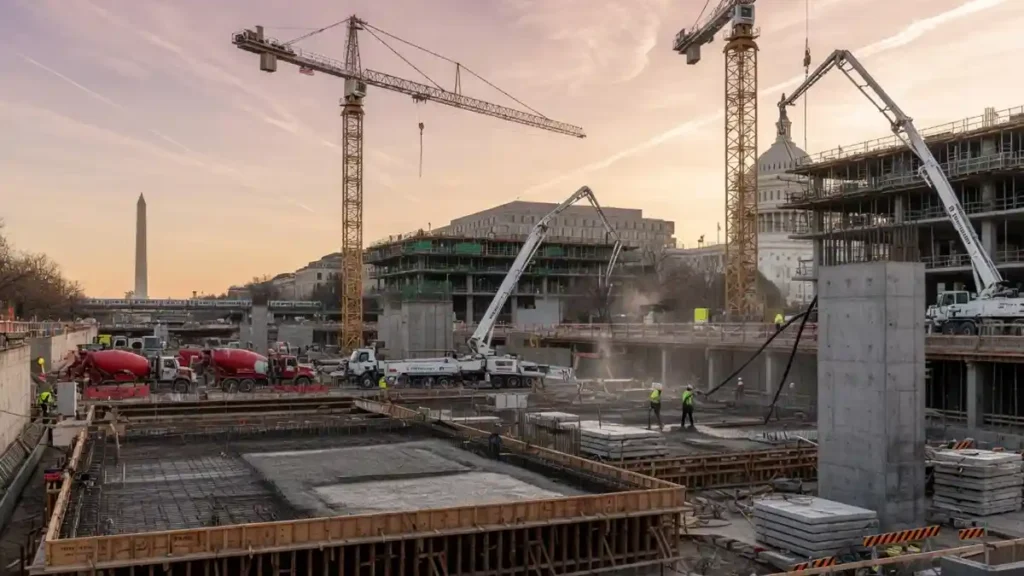
The scale here is not typical. According to CBS News reporting on court filings, the White House ballroom superstructure rises 70 feet in places, with a foundation reaching 50 feet below grade across a 50,000-square-foot footprint.
That kind of depth and mass demands tight mix design control and disciplined placement.
Construction industry insiders are noting the material volumes.
A 250-person crew has worked roughly 20 hours a day, seven days a week, pushing the project to about 65% complete.
Before an injunction deadline, the team planned another 3,000 cubic yards of concrete and 1 million pounds of rebar.
Our contractors note that the described concrete matches high-performance specifications.
Officials called it “the hardest and strongest concrete there is,” the type used in nuclear plants — impermeable and virtually impossible to deconstruct.
For durability standards behind that language, the American Concrete Institute publishes guidance like ACI 318 and ACI 301 at concrete.org.
Washington DC Trump Construction Projects Show Concrete Power
— US News (@Us_news_ways) August 21, 2026
The washington dc trump construction projects now underway at the White House and Kennedy Center offer a rare, court-documented@USDOT @POTUS @WhiteHouse https://t.co/Ikst0QfHst
How does nuclear-grade concrete compare to standard structural mixes?
The gap between everyday structural concrete and the mixes on these washington dc trump construction projects is wide.
Our analysis suggests the difference shows up in strength, permeability, and long-term durability.
| Spec | Standard Structural Concrete | Nuclear-Grade High-Performance |
|---|---|---|
| Compressive strength | 3,000–5,000 psi | 8,000+ psi |
| Permeability | Moderate | Very low (near impermeable) |
| Water-cement ratio | ~0.45–0.55 | ≤ 0.40 |
| Rebar density | Standard | High (heavy reinforcement) |
| Design life | 50–75 years | 100+ years |
| Governing standard | ACI 318 | ACI 349 (nuclear structures) |
Lower water-cement ratio is the quiet workhorse here. It cuts permeability, which protects the rebar and extends service life.
That is why the ballroom’s 6.4 million pounds of steel pairs with such a dense, low-porosity pour.
How to Remove a Stripped Screw on Job Sites
What does the material list tell you about federal build demand?
The steel and finish figures reinforce the scale. Fisher’s declaration cited 3 million pounds of steel readied for installation, plus 1 million pounds of facade steel and 60,000 pounds of aluminum finishes.
The Corinthian columns use Indiana limestone carved in Italy.
Funding and timeline details come from the same filings and official sources. Private donors raised $355 million of a $400 million goal, with structural completion projected for November and the full project by August 2028.
The White House lists Clark Construction as builder, AECOM on engineering, and McCrery Architects as lead, with work started in September 2025.
The Kennedy Center adds a second demand signal. As ENR reported, its board approved a $257 million overhaul covering HVAC, structural elements, waterproofing, and life-safety systems.
Federally funded work like this often triggers Section 106 review under the National Historic Preservation Act, detailed by the GSA.
Building Envelope of Concrete Wall Builder’s Guide
How do you specify and pour high-performance concrete on a large federal build?
If you want to apply lessons from these washington dc trump construction projects, follow a disciplined sequence.
The steps below mirror standard practice for mass concrete placements.
- Define performance targets.
Set compressive strength, permeability limits, and design life against the correct standard — ACI 318 for general structures or ACI 349 for nuclear-grade specs. - Design the mix.
Lock a low water-cement ratio, select supplementary cementitious materials, and confirm workability for deep placements. - Detail reinforcement.
Match rebar density to load and durability needs, then verify cover and spacing before the pour. - Plan thermal control.
For mass pours, manage heat of hydration with cooling and staged placement to prevent cracking. - Batch and test.
Sample each load, run slump and air tests, and cast cylinders for strength verification. - Place and consolidate.
Deposit in controlled lifts, vibrate to remove voids, and protect fresh concrete from weather. - Cure and verify.
Hold moisture and temperature through the curing window, then confirm break results before loading.
Border Construction Big Bend Texas to Know
What should Midwest contractors take from all this?
If you have followed structural concrete trends across the Midwest, this won’t come as a surprise. Large public builds keep pushing toward denser reinforcement, lower permeability, and longer design life.
The washington dc trump construction projects simply put those trends on public record.
Our team observed three practical signals worth tracking. Material demand for high-strength mixes and heavy rebar is rising, which affects your supply planning.
Precast and prestressed methods can shorten schedules on tight timelines — the Precast/Prestressed Concrete Institute covers standards at pci.org.
These washington dc trump construction projects also show how court oversight and federal review shape sequencing.
For contractors, the takeaway is clear.
Tighten your specs, document your testing, and build durability in from the first pour.