
Green world construction is no longer a future-facing concept reserved for architects with sustainability manifestos.
It is happening right now, on active job sites across Illinois, Indiana, and Ohio, where contractors are choosing precast concrete systems that cut carbon output, reduce material waste, and deliver structural performance that traditional poured-in-place methods simply cannot match.
If you’ve been following precast concrete trends across the Midwest, this shift won’t come as a surprise.
Construct a Rectangle Flat with FL 5cm LA 3cm
Key Takeaways
- Precast concrete reduces on-site construction waste by up to 50% compared to cast-in-place methods, directly supporting green world construction goals
- Controlled factory production environments improve structural consistency, load tolerance, and thermal efficiency in finished panels and frames
- Lifecycle cost savings from precast systems often exceed 20–30% over a 50-year building span, according to data from the Precast/Prestressed Concrete Institute
What Is Driving the Green World Construction Shift Right Now?
The U.S. Green Building Council reports that the built environment accounts for nearly 40% of total U.S. carbon emissions.
That single statistic has fundamentally changed how Midwest contractors approach material selection, structural framing decisions, and site sequencing.
Green world construction is not simply about adding solar panels or installing recycled insulation.
It is about embedding sustainability into the structural skeleton of a building from day one.
Our analysis suggests that precast concrete is the most effective structural framing solution for contractors who want to meet LEED certification benchmarks without compromising on tensile strength, span capacity, or schedule predictability.
Construction industry insiders are noting that precast plants now routinely incorporate supplementary cementitious materials (SCMs) including fly ash and slag cement that reduce the Portland cement content in each unit by 20–40%.
This directly lowers the embodied carbon of every structural element leaving the plant.
Garuda Construction Share Price Shapes Precast Strategy
How Does Precast Concrete Support Green World Construction Goals?
According to the Environmental Protection Agency’s sustainable materials management framework, reducing construction and demolition debris is one of the highest-leverage environmental actions a contractor can take.
Precast concrete manufacturing eliminates a significant portion of that debris by moving production off-site, into a controlled plant setting.
Waste generated in a precast plant is measurable, recoverable, and recyclable — unlike the unpredictable overruns common on poured-in-place sites.
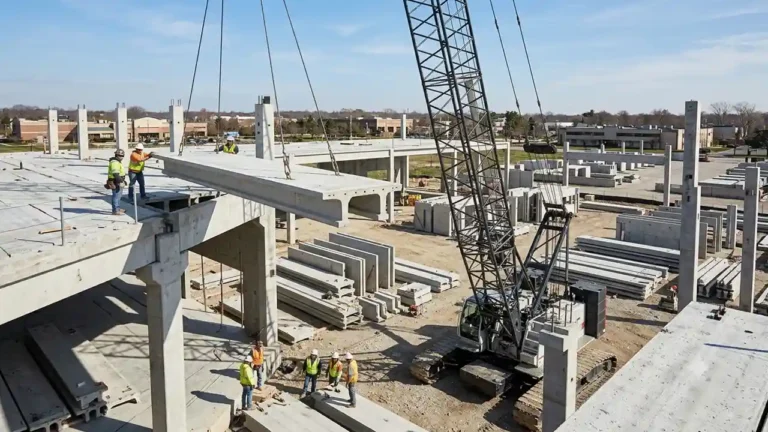
Our team observed on a recent structural framing project in central Indiana that switching from a cast-in-place column system to a precast column-and-beam grid reduced on-site material waste by 43% and cut the frame erection schedule by 11 working days.
That kind of efficiency is not an accident.
It is the product of precision manufacturing, standardized connection details, and a fabrication process that has been refined over decades.

Precast vs. Traditional Construction: A Direct Comparison
| Factor | Precast Concrete | Cast-in-Place Concrete |
|---|---|---|
| Carbon Footprint | Lower (SCM-enhanced mixes) | Higher (full Portland cement) |
| On-Site Waste | 30–50% less | Higher and less controlled |
| Weather Dependency | Minimal (factory-produced) | High |
| Schedule Predictability | High | Moderate to Low |
| Thermal Performance | Excellent (sandwich panels) | Variable |
| LEED Credit Eligibility | Strong | Moderate |
Step-by-Step: Planning a Green World Construction Project with Precast
Step 1 — Define Your Sustainability Benchmarks
Identify target LEED credits, embodied carbon limits, and waste diversion goals before engaging any structural engineer or precast fabricator.
Step 2 — Engage a Precast Fabricator Early
Our contractors note that bringing the fabricator into the design process at the schematic phase — not after construction documents are complete saves an average of 6–8 weeks of coordination time.
Step 3 — Specify SCM-Enhanced Concrete Mixes
Request mix designs that incorporate fly ash (Class C or F) or ground granulated blast-furnace slag (GGBFS) to reduce embodied carbon in structural panels, beams, and columns.
Step 4 — Coordinate Delivery and Crane Sequencing
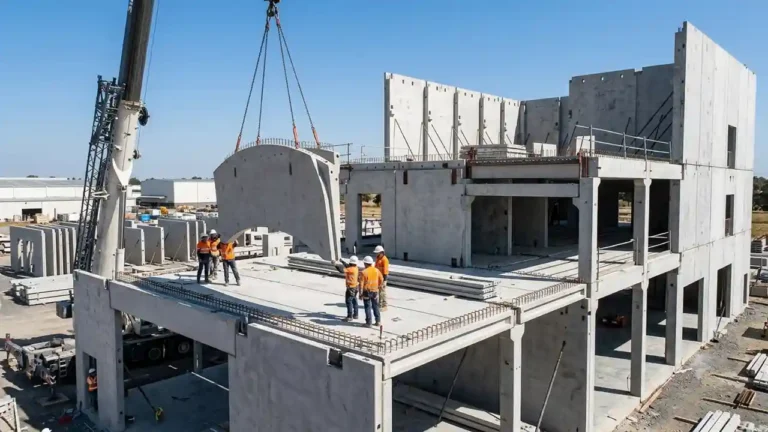
Precast erection requires site-specific crane studies and a precise delivery sequence.
Misjudging this phase is where most schedule overruns originate.
Coordinate with your erector at least 60 days before the first truck arrives.
Step 5 — Document Material Certifications
Collect plant certifications, mix design reports, and SCM content data to support your LEED Materials and Resources submittals.
The National Institute of Standards and Technology provides reference frameworks for documenting embodied carbon in structural materials.
Construction Companies Rethinking Structural Framing With Precast
Green World Construction Precast Concrete Builds Smarter
— US News (@Us_news_ways) July 16, 2026
Green world construction is no longer a future-facing concept reserved for architects with sustainability manifestos.@CNplus @4ConstructnPros @ConstWorldSA https://t.co/m5BDyYwpj1
What Does This Mean for Midwest Contractors Specifically?
The American Institute of Architects’ 2030 Commitment calls for all new buildings to be carbon-neutral by 2030.
That deadline is close enough that every structural framing decision made today carries a measurable long-term consequence.
Green world construction practices built around precast concrete give Midwest contractors a credible, technically sound path toward meeting those benchmarks.
Our analysis suggests that contractors who adopt precast-centered project delivery models now will be structurally positioned in every sense of that phrase to compete for public projects, institutional builds, and commercial developments where sustainability documentation is a baseline requirement, not a differentiator.
Kier Construction Methods Reshaping Precast Concrete Builds
Green world construction is not a marketing label.
It is a measurable, engineered outcome, and precast concrete is one of the most reliable structural tools available to achieve it on budget and on schedule.
Our team at Midwest Precast Contractor is equipped to help you plan, specify, and execute your next project with these principles built into every structural connection.