
The iconic style seen in Hyatt Regency architecture sets a high bar for modern structural design and commercial efficiency.
By blending aesthetic appeal with high-performance precast concrete components, these buildings define the intersection of luxury and structural reliability.
Our team observes that the methodology behind these structures is shifting the standard for regional Midwest developments.
Commercial Floor Cleaning Services
Key Takeaways
- Hyatt Regency architecture frequently utilizes modular precast concrete panels to achieve a clean, modern aesthetic while significantly shortening project timelines.
- The use of off-site manufactured structural components reduces site congestion, allowing for faster assembly in dense urban environments.
- Enhanced structural integrity and fire resistance are standard benefits, providing long-term value for commercial property owners and investors.
What does this mean for Midwest contractors?
If you have been following precast concrete trends across the Midwest, this focus on modularity will not come as a surprise.
We find that the precision engineered nature of Hyatt Regency architecture serves as a blueprint for how contractors can optimize their own builds.
Industry insiders are noting that the move away from traditional on-site pouring is not just a trend but a necessity for meeting tight occupancy deadlines.
According to the latest data from the Precast/Prestressed Concrete Institute, the shift toward off-site structural solutions is accelerating because it minimizes weather-related delays.
When we examine the structural framing of these buildings, the efficiency becomes apparent.
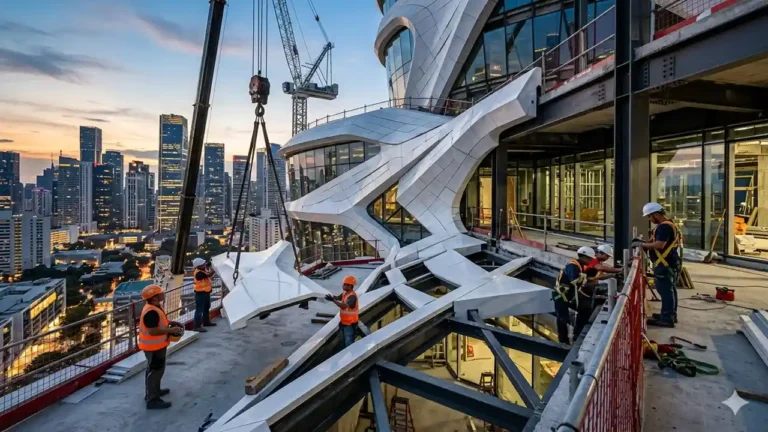
These projects often rely on high-strength, acid-etched panels that act as both the aesthetic skin and a primary load-bearing element.
Commercial Floor Care Services

How will this impact your next build?
Integrating principles inspired by Hyatt Regency architecture requires a shift in how your team approaches the initial project planning phase.
Our contractors note that coordination is the most critical factor when transitioning to a precast-heavy design.
You must engage your precaster early, often during the schematic design phase, to ensure that the structural framing can accommodate the specific panel weights and connection details required.
| Feature | Traditional Poured Concrete | Architectural Precast Concrete |
| Curing Time | Days (Weather dependent) | Factory-Controlled (Immediate) |
| Finish Quality | Variable (Field finished) | High-Precision (Factory finished) |
| Site Impact | High congestion | Low site impact |
| Sustainability | Higher waste | Reduced waste/LEED potential |
Step-by-Step: Implementing Precast for Large-Scale Projects
Follow these instructions to mirror the efficiency found in landmark hotel developments:
- Engage Early with Engineers: Collaborate with a structural engineer and your precast supplier to finalize the load-bearing capacity needs before the foundation is poured.
- Optimize Panel Geometry: Design panels—such as E-shaped or spandrel units—to maximize coverage while minimizing the total number of joints, which reduces seal failure points.
- Coordinate Just-in-Time Delivery: Plan your site logistics to allow for direct-from-truck-to-structure installation, ensuring the structural framing is ready to accept panels immediately.
- Rigorous Quality Verification: Perform a 360-degree inspection of all precast concrete components upon arrival to ensure that the acid-etched surfaces and textures meet the exact architectural specifications before rigging.
- Utilize Specialized Rigging: Ensure your crane operators are trained specifically for precast panel placement, as these elements require precise stabilization to prevent corner chipping.
Commercial Floor Cleaning Services
Is durability compromised for aesthetics?
Our analysis suggests that Hyatt Regency architecture proves that structural elegance does not require sacrificing performance.
By choosing high-density concrete grades that are reinforced for seismic and environmental loads, you are making a long-term investment.
These structures offer exceptional thermal mass, which helps maintain stable indoor temperatures—a key goal in modern energy-efficient design.
As noted in reports from the National Institute of Building Sciences, the use of high-performance materials in urban centers significantly reduces long-term maintenance costs.
Builders in the Midwest are finding that when they adopt these methods, they satisfy both the architect’s vision and the developer’s bottom line.
It is a strategic advantage that we recommend for any high-authority commercial project.
When you look at the structural framing of a modern hotel, you are seeing a masterclass in modern engineering.
Hyatt Regency architecture continues to inspire our own local projects by demonstrating that scale and speed do not have to come at the expense of quality.
We encourage our peers to continue pushing these boundaries in every build.