


shuttering and shuttering methods are a key feature of building with precast concrete. They make parts for buildings off-site, which speeds up and makes construction more accurate. New materials and automation have made building even more dependable.
What does “shuttering” mean in precast concrete?
Formwork, or shuttering, is what holds the new concrete until it hardens and takes the shape it needs to. The panels, beams, and slabs for precast concrete are built in a factory, so they don’t get delayed by bad weather.
People build the shuttering around the casting beds or tables, pour the concrete, let it set, and then take the forms away. This managed approach allows for the creation of pieces with smooth finishes and high strength. Precast works with rigid setups to create identical pieces in repetition.
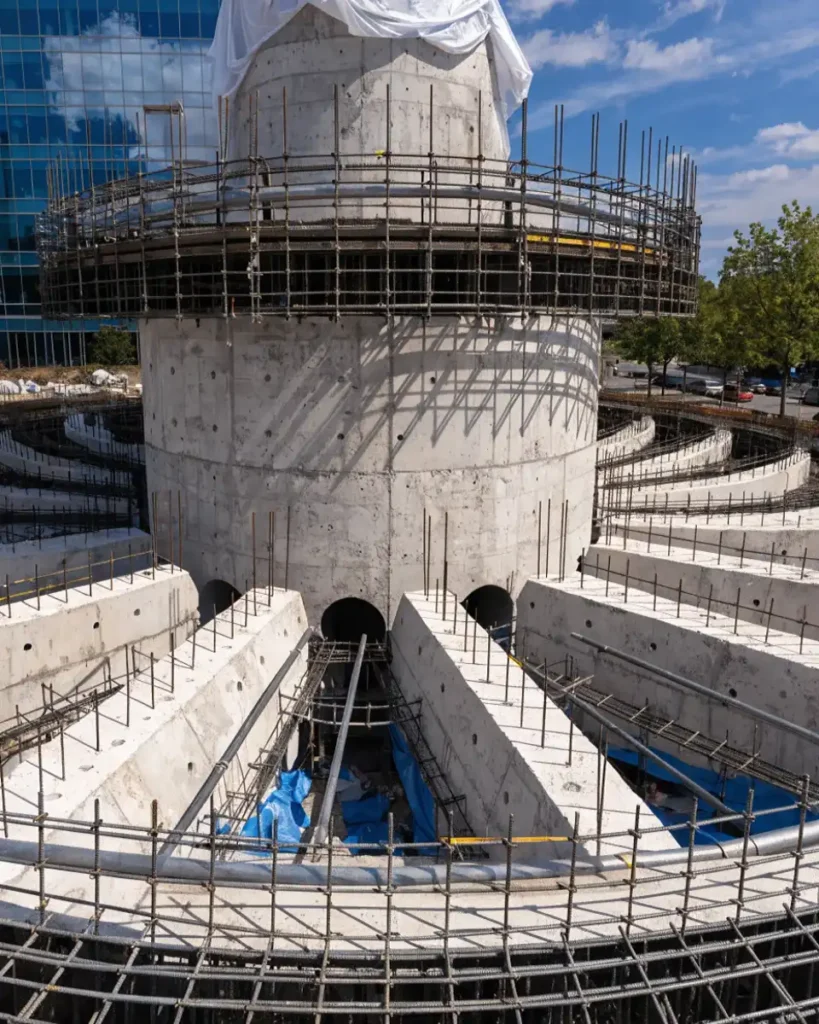
Modern precast concrete plants aim for the greatest cost efficiency and greatest flexibility through the use of modular, reusable shuttering systems. Basic modular parts are made to stack on top of one other to modify the height of the formations. For example, Sommer’s modular system comes with base units in height increments of 100mm, with top units available for wall thicknesses of 160mm to 340mm.
Important Materials for Shuttering and Shuttering
The most popular materials for shuttering are steel, aluminum, plywood, and composite materials.
Steel is the most durable alternative, but it is also the heaviest. Aluminum, on the other hand, is 70% lighter than steel, allowing a single worker to lift panels up to 40cm in height.
Plywood gives custom work a smooth surface, and you may use flexible, reusable plastic forms to make curves. These forms stick to the tables with magnets, so there is no need for bolts.
| Material | Pros | Cons | Best For Precast Use |
| Steel | High strength, long life | Heavy, costly | High-volume slabs, walls |
| Aluminum | Lightweight (70% less than steel), reusable | Higher upfront cost | Panels, quick setups |
| Plywood | Smooth finish, affordable | Less durable, absorbs water | Custom forms, low volume |
| Plastic/Composite | Flexible, eco-friendly | Limited load capacity | Curved elements, sustainability |
The chart lists the materials used in precast work based on how easy they are to use and how strong they are.
Old-fashioned ways of shuttering and shuttering
Shuttering and shuttering techniques that have been around for a long time depend on putting things together by hand. Workers have to bolt and clamp the panels to the tables, then add spacacers to create voids, and seal the joints.
Plywood-faced timber shutters work well for small runs, whereas steel profiles make sharp edges that are either chamfered or machined in a cone shape.
After curing, tiltable systems open the design, which means that conventional parts don’t need to be handled as much.
Modern Automation in Shuttering and Shuttering
Modern robots are used for shuttering and shuttering, so processes are faster. In the case of storage, robots pull profiles from magazines and position them according to CAD.
Shuttering robots use magnets to hold the forms, meaning fewer mistakes. The robot speedily takes off the shutters during the deshuttering procedure.
BT’s MagFly makes systems better by making it easy for forms to move and only needing a little tweak to get them in the appropriate place. Using PE strips, they can be sealed to prevent leakage at the joints.
The most important thing is to lower the number of man-hours needed per square meter for high-output plants.
Changes and new ideas for 2025
Smart technology and a focus on sustainability will come to shuttering and shuttering in 2025. Sensors embedded in the precast will monitor curing and connect to the IoT to provide real-time data.
Magnetic systems speed up assembly by a lot, making it faster than welding.

Modular repeatable systems also create less waste by using lightweight plastics and aluminum, making them great for green builds.
3D printing makes custom inserts, and for all the complex shapes, we use robots. A trend towards automation offers greater safety and speed.
While there are no major product launches planned for 2025, there are smaller developments. Almost 2000 daN of stronger neodymium magnets are being developed, which will enhance the hold even more.
Advanced Shuttering and Shuttering Techniques
There are multiple advantages, and great time and cost savings are only the fundamentals. With these techniques, robots are even able to run 24/7, which allows them to hit even the tightest deadlines.
Less manual handling means more safety, and the lightweight forms will contribute to injury prevention.
There is an issue of site fitting and the placement of precast concrete forms‘ property lines. Controlling the factory to prevent on-site issues is more important than avoiding them on-site.
High volume and quick return on investment makes high first-time costs less of an issue. Especially, since skilled operators are more likely to be trained.
Training is needed for maintaining robots, and magnets require maintenance to be clean.
Using CAD for planning, sealing joints, even curing, and even sealing are all maintenance tasks to ensure the best functioning of the robots.
On precast modular profiles, lengths are adjustable without taking away storage space.
Shuttering Steps in Precast Plants
- Prepare table: Clean and apply the release agent.
- Setting base profiles: The magnets will hold them in place.
- Add top modules: Stack more to increase height.
- Put inserts: rebar, voids.
- Pour concrete: Use a vibrator to settle the concrete.
- Cure the concrete: This will take 12 to 24 hours and you can use steam or air.
- Demolding: remove the molds with a robot or tilt the molds.
- Store the Precast elements: move them to the yard.
This flow provides quality precast concrete.
Industry Case Examples
BT Innovation’s MultiForm Alu produces panels quicker thanks to the easy-magnet system.
Sommer’s APIS provides precise slab edge profiles and is used in European plants.
Progress Group’s Infinity Line shutters can be made in 4 pieces to shutters of any length.
These examples show efficient operations.

Looking Ahead: Shuttering and Shuttering
Digital twins and AI will predict stresses in the forms. Hybrid technologies will combine the lightness of steel with the strength.
Sustainability will push the use of recycled composites. Full automation is expected by 2030.
Precast concrete will be the first choice for construction in urban areas, and shuttering will be key to scaling.
Shuttering and shuttering techniques take precast concrete construction to the next level by integrating old and new technology for the most efficient and effective concrete structures. It promises fast and quality finishes on structures.
For Repair and Services
1924 W Edward Ln, Milwaukee, WI 53209, United States
Phone: +14142855933
Email: [email protected]
Leave a Reply