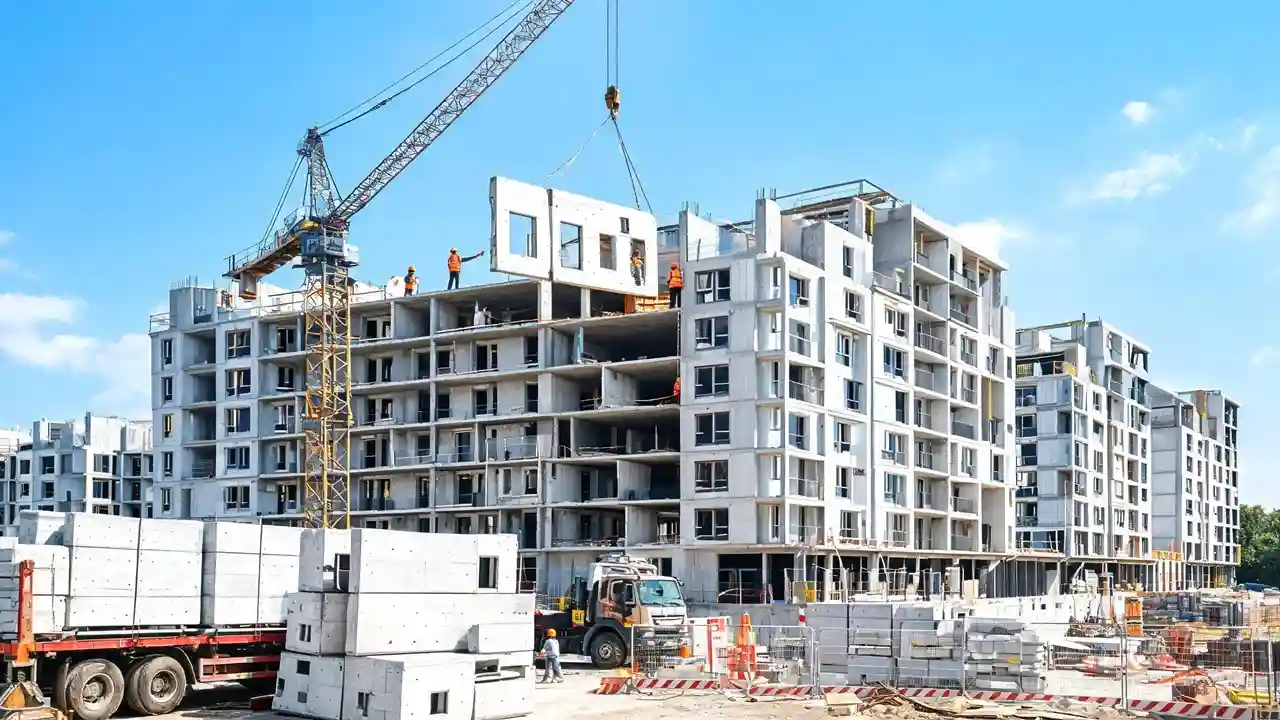
Multifamily construction is moving faster, leaner, and smarter than it has in decades and the structural system driving that shift isn’t new technology, it’s precast concrete done right.
Developers and general contractors across the Midwest are under real pressure: rising labor costs, tightening timelines, and a housing shortage that demands speed without sacrificing structural integrity.
The answer our team keeps returning to is a precast-based structural framing approach that changes how multifamily projects are designed, scheduled, and delivered.
Construction Scheduling Software Transforms Precast Framing
Key Takeaways
- Precast concrete structural framing can reduce on-site construction time by 30–50% compared to cast-in-place methods.
- Load-bearing precast panels and hollow-core planks are among the most cost-efficient structural framing systems available for mid-rise multifamily buildings.
- Precast systems offer superior fire resistance, acoustic separation between units, and long-term durability — three critical performance factors in multifamily construction.
Why Is Precast Concrete Reshaping Multifamily Construction Right Now?
If you’ve been following precast concrete trends across the Midwest, this won’t come as a surprise.
The National Multifamily Housing Council has documented a sustained demand gap for housing units in urban and suburban markets alike.
That gap is pushing developers to rethink every phase of project delivery, from site prep to topping out.
Our analysis suggests that the single biggest inefficiency in traditional multifamily construction is the time spent waiting — waiting for forms to cure, waiting for weather windows, waiting for trades to sequence properly.
Precast eliminates much of that waiting.
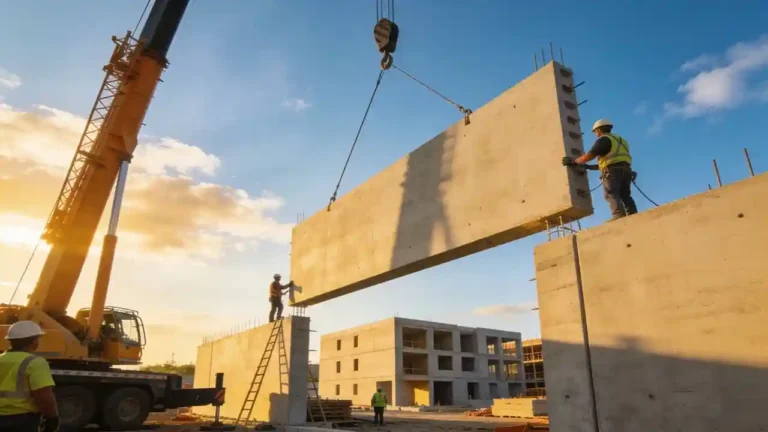
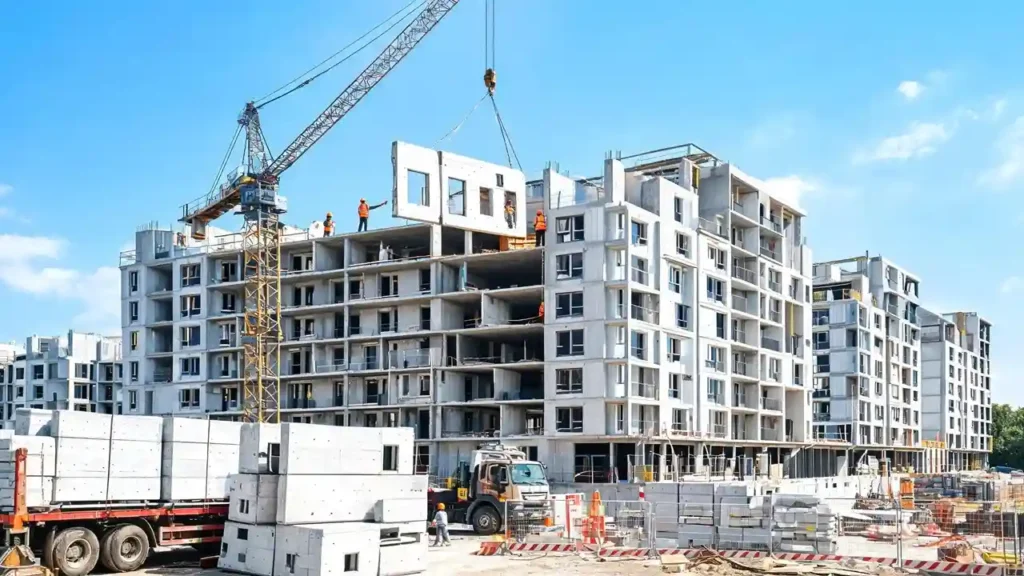
Because structural components are manufactured off-site in climate-controlled facilities, the critical path on a multifamily build compresses significantly.
According to data published by the Portland Cement Association, precast and prestressed concrete systems account for a growing share of mid-rise residential structural frames precisely because of their schedule reliability.
Our contractors note that when panels and planks arrive on-site pre-engineered to spec, the margin for costly field errors drops sharply.
Construction Estimating Services That Win Precast
How Does Precast Structural Framing Actually Work on a Multifamily Project?
The process is more systematic than most owners realize.
Here is the step-by-step sequence our team follows on a typical multifamily construction project using precast structural framing:
Step 1 — Structural Design Coordination
Work with a licensed structural engineer to determine load requirements, floor-to-floor heights, and bearing wall placement.
Precast component geometry must be finalized before production begins changes after this stage are costly.
Step 2 — Shop Drawing Review
The precast manufacturer submits detailed shop drawings for every panel, column, beam, and hollow-core plank.
Review these drawings against architectural and MEP coordination models before approving production.
Step 3 — Plant Production
Structural components are cast in a certified precast plant under controlled conditions.
High-strength concrete mixes — typically 5,000 to 7,000 psi compressive strength — are used for load-bearing members in multifamily applications.
Step 4 — Site Preparation and Foundation Work
While plant production is underway, foundation work and site utilities progress simultaneously.
This parallel scheduling is one of the most powerful schedule advantages precast offers in multifamily construction.
Step 5 — Delivery and Erection Sequencing
Components are delivered in erection order to minimize crane picks and laydown area requirements.
A precast erector coordinates with the GC to establish a daily pick schedule.
Step 6 — Connection and Grouting
Structural connections are welded or bolted at designated embed plates, then grouted per the engineer’s specifications.
Do not rush this phase — connection integrity is what makes the system perform as designed.
Step 7 — MEP Rough-In and Interior Build-Out
Once the structural frame is complete and verified, interior trades follow a clean, unobstructed sequence.
Hollow-core plank floors provide an immediate working surface for the next level.
What Do the Numbers Say? Precast vs. Traditional Cast-in-Place
| Factor | Precast Concrete Framing | Cast-in-Place Concrete |
|---|---|---|
| Typical Frame Schedule (5-story) | 8–12 weeks | 18–26 weeks |
| On-Site Labor Requirement | Low to Moderate | High |
| Weather Dependency | Minimal | Significant |
| Quality Control | Plant-Controlled | Field-Dependent |
| Fire Rating | 2–4 Hour Rated | Varies by design |
| Sound Transmission Class (STC) | 50–55+ | 45–52 |
| Long-Term Maintenance | Low | Moderate |
Our team observed consistent schedule compression in the 35–45% range on multifamily construction projects where precast framing replaced conventional cast-in-place systems.
That timeline recovery translates directly into reduced carrying costs and earlier lease-up.
What Should Midwest Contractors Know Before Specifying Precast?
Construction industry insiders are noting a growing awareness gap between what precast can deliver and what contractors actually spec.
The Precast/Prestressed Concrete Institute (PCI) offers extensive design guides and certified plant directories that make sourcing qualified producers straightforward.
A few critical considerations before committing to precast for your next multifamily construction project:
- Crane access and site logistics must be planned from day one — precast erection requires clear swing paths and adequate laydown.
- Connection details must be coordinated early with your structural engineer of record.
- Confirm your precast producer holds PCI Plant Certification — this is non-negotiable for structural members.
- Review local building codes; the International Code Council provides jurisdiction-specific structural requirements that affect precast detailing.
According to the U.S. Department of Housing and Urban Development’s research on building systems, industrialized building methods including precast are among the most promising pathways to closing the multifamily housing supply gap.
40×60 Metal Building vs. Precast: What Wins?
Multifamily Construction Wins With Precast Framing
— US News (@Us_news_ways) June 22, 2026
Multifamily construction is moving faster, leaner, and smarter than it has in and the structural system driving that shift isn't…@Constafrica @4ConstructnPros @BuildItMagazine https://t.co/VX8trkjRsJ
The Bottom Line for Multifamily Builders
Multifamily construction doesn’t have to be as slow, weather-dependent, or labor-intensive as it’s historically been.
Precast concrete structural framing gives Midwest contractors a proven, performance-backed system to build faster, tighter, and with more predictability than traditional methods allow.
Our team at Midwest Precast Contractor is ready to walk your project team through the framing options, schedule analysis, and plant capabilities that make precast the right structural choice for your next multifamily build.