The modern industrial landscape demands rapid deployment and structural permanence.
Selecting the right industrial building construction company is the single most critical decision a developer will make this year.
Traditional stick-built methods simply cannot keep pace with shifting economic variables.
Our team at Midwest Precast Contractor has observed a massive transition toward off-site elemental manufacturing.
Key Takeaways
- Accelerated Timelines: Utilizing precast concrete elements reduces total on-site erection schedules by up to 50% compared to conventional poured-in-place methods.
- Superior Quality Control: Casting elements in controlled factory conditions eliminates weather-induced structural liabilities and concrete curing anomalies.
- Long-Term Cost Efficiency: Reduced on-site labor overhead combined with exceptional thermal mass properties drives down both immediate capital expenditure and life-cycle operational costs.
Traveling Construction Jobs Midwest Precast Projects
How Will Precast Choice Impact Your Next Industrial Build?
If you have been following precast concrete structural trends across the Midwest, this shift will not come as a surprise.
The global industrial building construction company concrete market is projected to reach $170.11 billion in 2026, establishing it as the dominant force in structural engineering (Fortune Business Insights, 2026).
Our contractors note that industrial operations require massive open spans and heavy load-bearing capacities.
A premier industrial building construction company leverages precast concrete columns, beams, and double-tee slabs to create column-free interior spaces that optimize logistical workflows.
Material engineering has advanced significantly over the past 24 months.
We found that combining Ultra-High Performance Concrete (UHPC) connection schemes with high-strength Grade 60 reinforcing steel yields unparalleled seismic and structural resilience.
When evaluating building methodologies, analyzing structural behavior profiles highlights the vast difference between precast components and conventional masonry or steel frames.
Construction Storage Containers for Rent
| Structural Component | Precast Concrete Elements | Traditional Concrete / Masonry | Structural Steel Framing |
| Erection Speed | Rapid assembly via crane, independent of local weather conditions. | Slow, sequential pouring required; heavily weather-dependent. | Moderate speed; requires extensive on-site welding and bolting. |
| Fire Resistance Rating | Built-in passive protection up to 4 hours without secondary coatings. | High baseline resistance, but requires extensive curing verification. | Low baseline resistance; mandates costly intumescent paint or spray-applied fireproofing. |
| Spanning Capability | Long-span hollow-core and double-tee profiles up to 60+ feet. | Limited spans without frequent, intrusive intermediate support columns. | High spanning capability, but susceptible to structural deflection under heavy dynamic loads. |
| Material Life-Cycle | Engineered for a 100+ year service life with negligible structural degradation. | Highly variable; prone to environmental cracking and moisture intrusion. | Subject to oxidation, rust, and regular anti-corrosive maintenance. |
What Design Milestones Minimize On-Site Structural Delays?
Construction industry insiders are noting that upfront technical collaboration completely dictates the financial trajectory of commercial projects.
An elite industrial building construction company avoids fragmented scheduling by executing concurrent engineering workflows.
While site excavation teams clear the field, the production facility manufactures load-bearing wall panels and columns simultaneously.
To achieve this level of logistical harmony, our engineering team utilizes Building Information Modeling (BIM) platforms.
According to recent data published by the Precast/Prestressed Concrete Institute, integrating digital models directly into factory production routines cuts down field rework and physical material waste by approximately 15% (Precast/Prestressed Concrete Institute, 2020).
Every single embedment, electrical conduit industrial building construction company, and structural structural connection point must be permanently resolved in the digital model prior to casting.
Construction accident lawyer near me safety protocols
Step-by-Step Guide to Engineering and Erecting Precast Industrial Enclosures
Executing a flawless precast industrial structure requires meticulous adherence to strict field protocols.
Our analysis suggests that structural failures or project delays are almost never the fault of the material itself.
Instead, issues arise from flawed spatial planning or rushed site installation sequences.
Phase 1: Advanced Structural Design Integration
- Load Mapping: industrial building construction company ultimate limit states and serviceability parameters for heavy crane runways and industrial roofs.
- Embedment Optimization: Standardize weld plates and bolted connection metrics within the digital blueprint to expedite manufacturing.
Phase 2: Factory Fabrication & Quality Assurance
- Formwork Preparation: Clean and oil reusable steel casting beds to guarantee precise dimensional tolerance profiles.
- Reinforcement Placement: Secure pre-assembled prestressed tendons and Grade 60 rebar cages within the structural formwork.
- Curing Protocol: Apply controlled steam curing to accelerate early strength gain, ensuring the element achieves structural transport strength within 24 hours.
Construction Accident Attorney Near Me
Industrial Building Construction Company Strategies
— US News (@Us_news_ways) June 3, 2026
Selecting the right industrial building construction company is the single most critical decision a developer will make this year.@ConstWorldSA @constructdive @engineeringness https://t.co/QkCISch3nl
Phase 3: Logistics and Just-in-Time Site Delivery
- Staging Logistics: Coordinate flatbed transportation routes to match the sequential erection sequence exactly.
- Rigging Inspection: Verify that heavy-duty cranes and lifting hardware match the component weight charts before lifting.
Phase 4: Structural On-Site Installation
- Foundation Anchoring: industrial building construction company the precast columns onto high-strength leveling shims and anchor bolt assemblies.
- Panel Placement: Erect insulated sandwich wall panels directly onto the perimeter foundation beam infrastructure.
- Connection Securing: Weld or bolt structural connection plates together, then immediately fill the joints with high-strength non-shrink grout.
Why Does Off-Site Manufacturing Solve the Skilled Labor Shortage?
The commercial building sector faces a persistent, multi-year deficit of experienced tradespeople.
Partnering with a precast-focused industrial building construction company circumvents this issue by shifting up to 70% of total project labor off-site.
Controlled factory environments utilize automated batching systems and precise robotic form liners, requiring a fraction of the manual labor required by field-poured alternatives.
Furthermore, safety metrics improve exponentially when working with prefabricated modules.
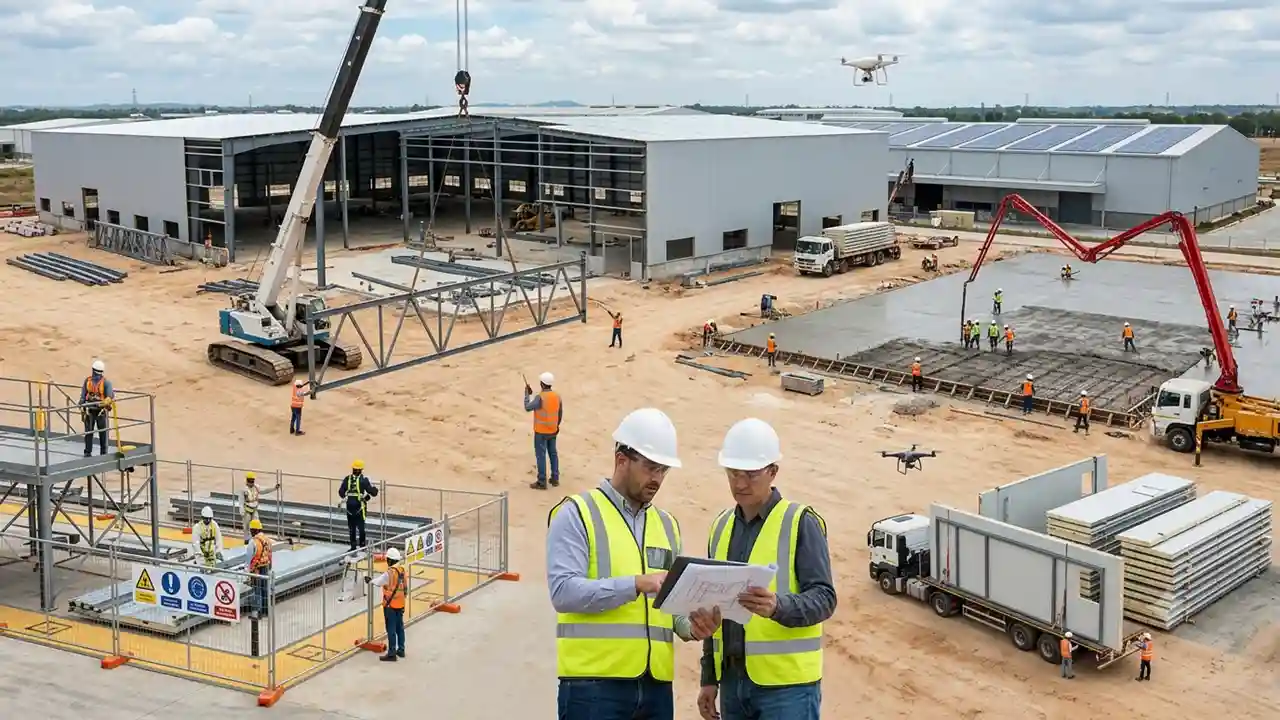
Erecting a building using a specialized crane crew minimizes the time workers spend exposed to dangerous edge-of-slab conditions.
By eliminating traditional wooden formwork construction, scaffolding, and open-flame welding operations, site managers dramatically reduce overall workers’ compensation liabilities and safety hazards.
White house construction lessons framing saves historic builds
What Sustainable ROI Factors Should Asset Owners Consider?
Sustainability is no longer an optional design choice; it is an economic directive.
A forward-thinking industrial building construction company designs enclosures that drastically reduce long-term energy consumption.
industrial building construction company precast concrete wall panels feature a continuous layer of polyisocyanurate foam insulation sandwiched between two thick layers of concrete.
This configuration completely eliminates thermal bridging, keeping industrial HVAC systems operating efficiently through harsh midwestern winters and summers.
Because concrete inherently exhibits high thermal mass, these structures absorb, store, and slowly release heat over extended time windows.
This industrial building construction company internal temperature swings and flattens daily peak electrical demand curves.
When you look at total life-cycle costs, the combination of energy savings, minimal structural maintenance, and reduced commercial insurance premiums makes precast concrete the most financially sound choice for modern industrial infrastructure.