
What is M10 Concrete?
In the world of construction, the letter “M” stands for Mix, and the number “10” represents the characteristic compressive strength of the concrete after 28 days of curing, measured in $N/mm^2$ (Newtons per square millimeter).
M10 is classified as a “Nominal Mix” concrete. Unlike higher grades that require complex laboratory designs, the m10 concrete ratio follows a standardized formula that has been used for decades to provide a reliable base for non-structural works.
M15 Concrete Ratio: The Ultimate Guide to Mix Design and Strength
The Standard M10 Concrete Ratio
To achieve the desired strength, you must follow a specific volumetric proportion of cement, sand (fine aggregate), and stone chips (coarse aggregate).
The standard m10 concrete ratio is 1:3:6.
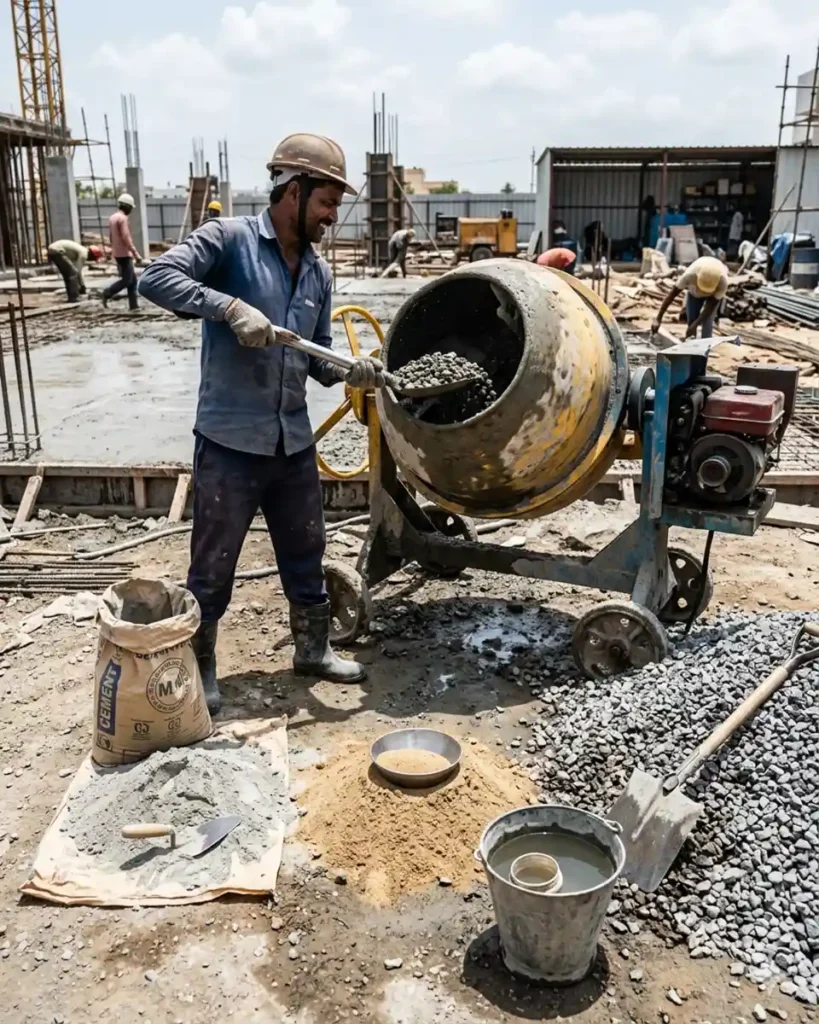
Breaking Down the 1:3:6 Ratio:
- 1 Part Cement: Usually Ordinary Portland Cement (OPC) or Portland Pozzolana Cement (PPC).
- 3 Parts Sand: Clean, well-graded river sand or manufactured sand (M-Sand).
- 6 Parts Coarse Aggregate: Crushed stones, typically 20mm in size.
To put this into perspective, if you use one bucket of cement, you will need three buckets of sand and six buckets of stone. According to standards set by the American Concrete Institute, maintaining these precise proportions is vital to prevent “honeycombing” or premature cracking in the finished slab.
Grade of Concrete: A Comprehensive Guide to Strength and Durability
M10 Concrete Ratio: The Complete Guide to Mix Proportions and Usagehttps://t.co/ikhoikKcBg
— Considering Apple (@consider_apple) May 1, 2026
Technical Specifications of M10 Grade
While the m10 concrete ratio tells us how to mix it, the technical specs tell us how it performs.
| Feature | Specification |
| Mix Type | Nominal Mix |
| Proportion (C:S:A) | 1 : 3 : 6 |
| Compressive Strength (7 Days) | Approx. $7 N/mm^2$ |
| Compressive Strength (28 Days) | $10 N/mm^2$ |
| Water-Cement Ratio | 0.50 to 0.60 |
The water-cement ratio is a “make or break” factor. Too much water makes the concrete easy to pour but incredibly weak once dry. Too little water, and the chemical reaction (hydration) won’t complete, leaving you with brittle material.
Common Applications: Where Should You Use M10?
Because M10 is a lower-strength grade, it isn’t used for heavy structural elements like beams, columns, or high-rise slabs. However, it is the “unsung hero” of foundational work.
1. Plain Cement Concrete (PCC)
Before laying a reinforced foundation, a layer of PCC is poured onto the soil. Using the m10 concrete ratio for this “blinding layer” creates a level surface and prevents the structural concrete from mixing with the dirt.
2. Pathways and Patios
For garden walkways or backyard patios where heavy vehicle traffic isn’t expected, M10 provides a cost-effective and durable solution.
3. Curbing and Retaining Wall Bases
Small-scale landscaping projects often utilize the m10 concrete ratio for bedding and haunching around curbs or drainage pipes.
4. Levelling Courses
If you have an uneven floor that needs a slight lift before tiling, a thin layer of M10 can act as a perfect leveller.
How to Calculate Material Requirements for M10
One of the biggest headaches in construction is running out of material halfway through a pour. To calculate the volume needed for the m10 concrete ratio, you must account for “shrinkage.”
When you mix dry cement, sand, and stone with water, the volume decreases by about 52% to 54% because the fine particles fill the gaps between the larger stones. Therefore, to get $1 m^3$ of wet concrete, you actually need about $1.54 m^3$ of dry ingredients.
Pro Tip: Always order 5-10% more material than your calculations suggest to account for wastage and spills on the job site.

Step-by-Step Mixing Process
To get the most out of your m10 concrete ratio, follow these steps for a consistent mix:
- Dry Mixing: Spread the sand on a clean platform, add the cement on top, and mix until the color is uniform.
- Add Aggregates: Spread the stone chips over the cement-sand mixture and flip the pile until the stones are evenly coated.
- The “Hollow” Method: Create a crater in the middle of your pile.
- Add Water: Gradually pour water into the center. Research published in the Journal of Materials in Civil Engineering suggests that gradual hydration leads to better crystalline structures within the concrete paste.
- Final Mix: Fold the dry ingredients into the water until the consistency is “plastic“—it should hold its shape but still be workable.
Garuda Construction IPO GMP: Complete Investor Guide & Performance Review
Crucial Tips for a Better M10 Mix
Use Clean Water
Never use brackish or muddy water. Impurities can react with the cement chemicals, leading to “efflorescence” (that white powdery substance) or internal corrosion.
The Importance of Curing
Concrete doesn’t “dry”; it cures. Once you have poured your m10 concrete ratio mix, keep it moist for at least 7 to 10 days. Spraying it with water or covering it with wet gunny bags ensures the chemical bond reaches its full $10 N/mm^2$ potential.
Avoid Over-Vibration
If you are using a mechanical vibrator, don’t overdo it. Over-vibration causes the heavy stones to sink to the bottom and the watery “fines” to rise to the top, resulting in a weak surface layer.
M10 vs. M15: Which One Do You Need?
A common question is whether to use the m10 concrete ratio or step up to M15 (1:2:4).
- Choose M10 (1:3:6) if you are doing non-load-bearing work, pipe bedding, or basic filling. It is more economical.
- Choose M15 (1:2:4) if you are building a driveway for a car or a small shed floor. The extra cement provides better resistance to wear and tear.
Frequently Asked Questions
What is the ratio of M10 concrete in bags?
If you are using 50kg bags of cement, the m10 concrete ratio (1:3:6) roughly translates to 1 bag of cement, 3 cubic feet of sand, and 6 cubic feet of aggregate.
Old World Builder: The Timeless Art of Traditional Construction
Can I use M10 for a house foundation?
Only for the PCC (levelling) layer. For the actual structural footings that hold the weight of the walls and roof, you should typically use at least M20 or M25 grade concrete as per modern building codes.
Is M10 waterproof?
No concrete is inherently waterproof. However, a well-mixed m10 concrete ratio with proper curing is quite dense. For water-retaining structures, you would need to add specific waterproofing admixtures.
Final Thought
The m10 concrete ratio of 1:3:6 is a foundational element of modern construction. By understanding the balance between cement, sand, and aggregate, you ensure that your project starts on a solid, reliable footing. While it may not be the strongest grade available, its cost-effectiveness and ease of mixing make it indispensable for prep work and landscaping.