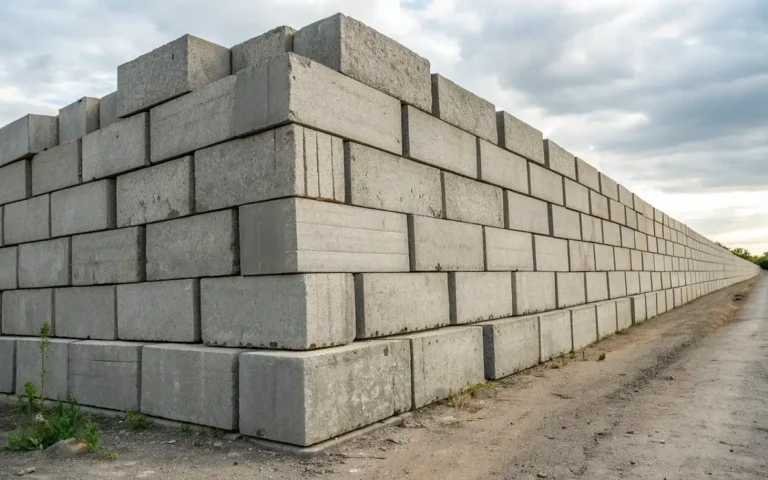

Whether you are a homeowner planning a small renovation or a budding contractor overseeing a site, understanding the m15 concrete ratio is fundamental to ensuring the structural integrity of your build. Concrete isn’t just “mud and stones”—it’s a precise chemical recipe where the right balance determines if a structure stands for decades or crumbles in years.
What Exactly is M15 Grade Concrete?
In the world of civil engineering, the “M” stands for “Mix,” and the number represents the compressive strength of the concrete after 28 days of curing. Specifically, M15 concrete is designed to withstand a pressure of $15\text{ N/mm}^2$ (Newtons per square millimeter) or roughly 2175 psi.
Grade of Concrete: A Comprehensive Guide to Strength and Durability
According to the Bureau of Indian Standards (IS 456:2000), M15 is classified as a “Nominal Mix.” This means that for standard projects, you don’t necessarily need a laboratory trial to determine the proportions; the industry-standard m15 concrete ratio is pre-defined for ease of use on-site.
The Standard M15 Concrete Ratio Proportions
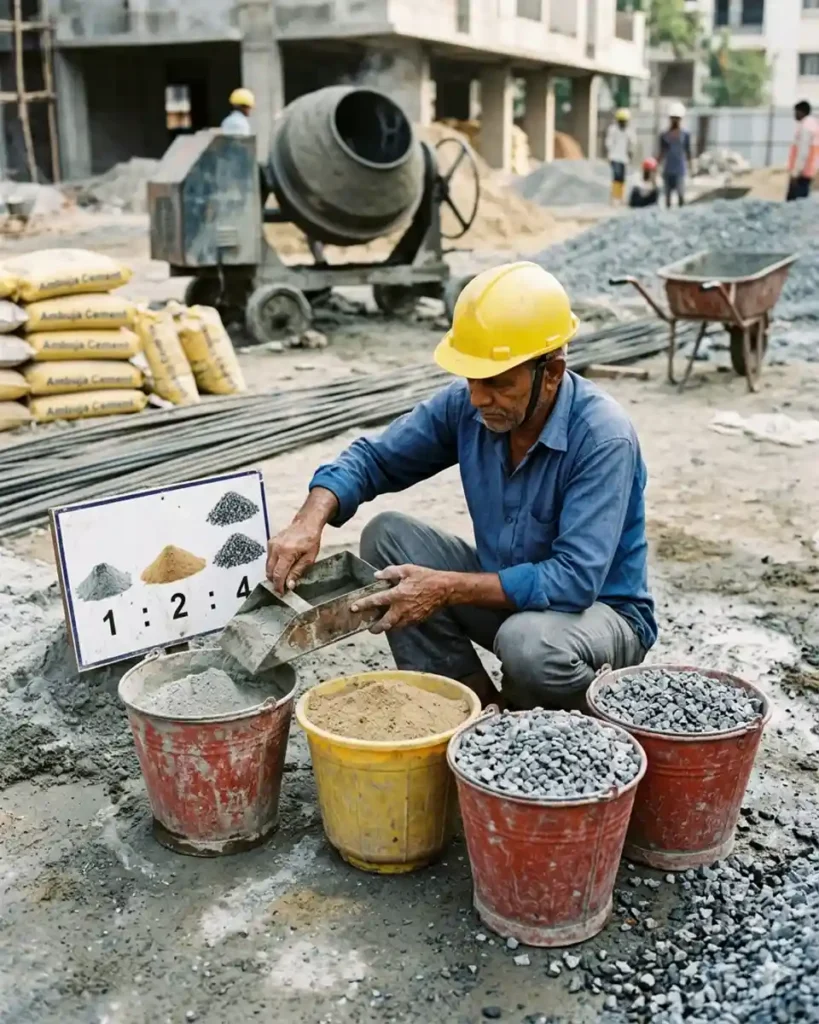
The standard volumetric m15 concrete ratio is 1:2:4. To achieve the required strength, these parts are broken down as follows:
- 1 Part Cement: Usually Ordinary Portland Cement (OPC) or Portland Pozzolana Cement (PPC).
- 2 Parts Fine Aggregate: Clean, sharp sand that is free from clay and silt.
- 4 Parts Coarse Aggregate: Crushed stone or gravel (typically 20mm down-size).
M15 Concrete Ratio: The Ultimate Guide to Mix Design and Strengthhttps://t.co/DzOCNpaj17
— Considering Apple (@consider_apple) April 30, 2026
Why the 1:2:4 Mix Works
This specific m15 concrete ratio ensures that the voids between the large stones (coarse aggregate) are filled by the sand (fine aggregate), and the microscopic gaps between the sand particles are filled by the cement paste. This creates a dense, solid mass once the water initiates the hydration process.
Step-by-Step: Calculating Materials for M15 Concrete
To help you estimate costs and order supplies, you need to know how much material goes into one cubic meter ($1\text{ m}^3$) of finished concrete. Because dry volume is roughly 54% more than wet volume (due to air gaps), we use a factor of 1.54 for our calculations.
Garuda Construction IPO GMP: Complete Investor Guide & Performance Review
1. Cement Requirement
Using the m15 concrete ratio (1+2+4 = 7 total parts):
$$\text{Cement Volume} = \left(\frac{1}{7}\right) \times 1.54 = 0.22\text{ m}^3$$
Since one bag of cement is $0.0347\text{ m}^3$, you will need approximately 6.3 to 6.5 bags per cubic meter.
2. Sand (Fine Aggregate)
$$\text{Sand Volume} = \left(\frac{2}{7}\right) \times 1.54 = 0.44\text{ m}^3$$
3. Stone (Coarse Aggregate)
$$\text{Stone Volume} = \left(\frac{4}{7}\right) \times 1.54 = 0.88\text{ m}^3$$
The Role of the Water-Cement Ratio
You can have a perfect m15 concrete ratio of dry materials, but if you add too much water, the concrete will be weak. If you add too little, it won’t be workable.
For M15 grade, the water-cement ratio typically ranges between 0.50 and 0.60. This means if you use 50kg of cement, you should use approximately 25 to 30 liters of water. Organizations like the American Concrete Institute (ACI) emphasize that maintaining a low water-to-cement ratio is the single most important factor for long-term durability.

Platina Building: The Ultimate Guide to Modern Commercial Excellence
Common Applications: When to Use M15
The m15 concrete ratio isn’t meant for skyscrapers or heavy-duty bridges, but it is the “workhorse” of residential and light commercial construction.
Ideal Use Cases:
- PCC (Plain Cement Concrete): Used as a leveling base layer under foundations to prevent the reinforced steel from touching the soil.
- Driveways and Walkways: Perfect for paths that handle foot traffic or light passenger vehicles.
- Small Compound Walls: Provides enough stability for garden walls and boundary fences.
- Flooring Sub-bases: Creating a solid “lean” layer before laying expensive tiles or marble.
For structural elements like columns, beams, or slabs in multi-story buildings, engineers usually step up to M20 or M25 grades. You can find more technical data on strength benchmarks via the Institution of Civil Engineers (ICE).
Old World Builder: The Timeless Art of Traditional Construction
Factors That Can Ruin Your M15 Mix
Even with the correct m15 concrete ratio, external factors can compromise your build. Watch out for these common pitfalls:
- Impure Water: Using salty or “hard” water can corrode any reinforcement or prevent the cement from setting correctly. Use potable (drinking) water whenever possible.
- Poor Grading of Sand: If the sand is too fine (like beach sand), it requires more cement to coat the particles, effectively weakening your m15 concrete ratio.
- Inadequate Curing: Concrete doesn’t “dry”; it cures through a chemical reaction. According to research published in the Journal of Materials in Civil Engineering, proper moist curing for at least 7 to 10 days can increase strength by up to 50% compared to uncured concrete.
FAQs About M15 Concrete Mix
Is M15 concrete considered “Lean Concrete”?
Strictly speaking, “lean” concrete usually refers to M5 or M7.5 (ratios with very little cement). However, in many residential settings, M15 is used as a high-quality lean base for foundations.
Can I use the m15 concrete ratio for a roof slab?
Generally, no. Most modern building codes require a minimum of M20 (1:1.5:3) for Reinforced Cement Concrete (RCC) slabs to ensure safety and prevent cracks.
How do I measure the 1:2:4 ratio on a busy site?
The most practical way is using a “Farina” or “Gauge Box.” These are standard-sized wooden boxes that help laborers maintain the m15 concrete ratio consistently without needing a scale for every batch.
Getting the Foundation Right
Mastering the m15 concrete ratio is a vital skill for anyone involved in construction. By sticking to the 1:2:4 proportion, using clean materials, and being disciplined with your water usage, you ensure a project that is not only cost-effective but structurally sound.