
Midwest winters punish every weak spot in a structure, and the material calls behind your precast panels get locked in long before the first freeze.
That’s why the difference between concrete and cement matters right now. Mix up the two on a spec sheet, and you risk elements that crack, scale, or fail inspection.
Key Takeaways
- Cement is an ingredient, and concrete is the finished composite that cement binds together through hydration.
- Cement selection is irreversible, because once it’s cast into a structure, you cannot swap it out.
- PCI-certified plants control mix design, curing, and testing under MNL-116 and MNL-117, which protects freeze-thaw durability in Midwest climates.
Crack in Basement Wall? Decode the 10 Types Fast
What is the real difference between concrete and cement?
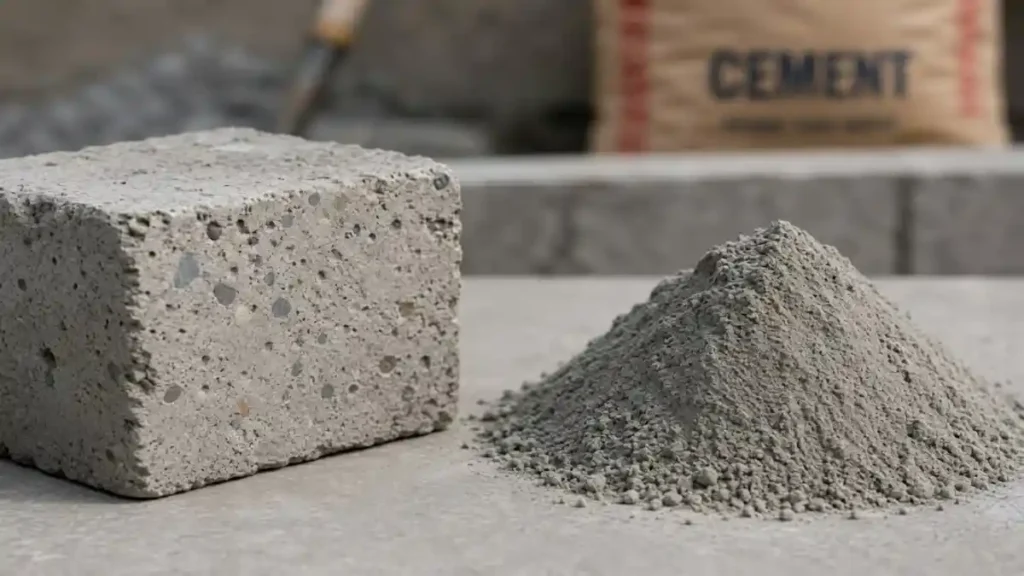
Cement is a binder, and concrete is the structure it creates.
According to UltraTech Cement’s explanation of cement and concrete, cement starts as limestone, clay or shale, silica sand, and iron ore.
Those raw materials are kiln-fired into clinker (hard nodules formed at high heat), then ground into a fine powder.
Concrete is a composite of cement, water, and aggregates such as sand and gravel.
When water meets cement, a chemical reaction called hydration forms a paste that coats the aggregates and hardens into a solid mass. Cement alone is never the finished product.
Our analysis suggests most spec confusion starts with jobsite shorthand: crews say “cement truck” when they mean ready-mix concrete.
That habit is harmless in conversation. In submittals and purchase orders, it causes real errors.
How do cement and concrete compare side by side?
This table captures the difference between concrete and cement at a glance.
| Factor | Cement | Concrete |
|---|---|---|
| Composition | Limestone, clay/shale, silica sand, iron ore | Cement + water + sand + gravel |
| Function | Binder | Load-bearing composite |
| Main types | OPC, PPC, PSC, White Cement | Lime Concrete, Cement Concrete, RCC |
| Applications | Concrete production, mortar, soil stabilization, repairs | Foundations, walls, floors, roads, bridges, precast elements |
| Form | Dry powder | Plastic mix that hardens over time |
Keep this table open when you review your next mix submittal.
Why does the difference between concrete and cement matter more in precast?
Precast magnifies every material decision. Each element, whether a wall panel, hollow-core slab, or bridge beam, is cast in a plant, cured under controlled conditions, and shipped finished.
There is no on-site fix if the cement type was wrong.
The PCI Plant Certification program requires every plant to write a plant-specific Quality Systems Manual and pass unannounced audits by third-party engineers twice a year.
Structural products are audited against MNL-116, and architectural products against MNL-117.
On the design side, the American Concrete Institute publishes ACI CODE-318-25 for structural concrete and ACI CODE-319-25 for structural precast.
If you’ve been following precast concrete trends across the Midwest, this won’t come as a surprise.
Our contractors note that more bid packages now call out PCI certification groups by name.
Foundation Waterproofing Cost: What Drives Your Bid
How does cement type affect freeze-thaw performance?
Cement type determines how concrete resists water, salts, and repeated freezing. That’s the practical side of the difference between concrete and cement: the binder you choose sets the ceiling for the finished product’s durability.
- OPC (Ordinary Portland Cement): High strength and versatility for general structural elements.
- PPC (Portland Pozzolana Cement): Better workability and durability for water-exposed applications.
- PSC (Portland Slag Cement): Strong resistance to chemical attack, suited to foundations and coastal structures.
- White Cement: Smooth, bright finishes for architectural precast.
Our team applies the same chemical-resistance logic to deicing-salt exposure on Midwest parking decks and bridge elements.
In U.S. specifications, blended cements appear as Type IP and Type IS, alongside Type IL portland-limestone cement.
How do you select the right cement for a precast project?
Selecting cement is a sequence, not a guess. Follow these steps before production begins.
- Define the exposure. Identify freeze-thaw cycles, deicing salts, soil conditions, and water contact for each element.
- Classify the product. Match each element to its PCI group: A (architectural), B (bridge), C (commercial structural), or G (GFRC).
- Set strength and finish targets. Choose OPC for strength, blended cements for durability, or White Cement for exposed architectural faces.
- Check code requirements. Confirm the design meets ACI CODE-318-25 and ACI CODE-319-25 provisions.
- Verify the plant. Request the producer’s current PCI certification and approved categories.
- Review the mix submittal. Confirm cement type, water-cement ratio, aggregate source, and air content.
- Lock it in. Treat the approved cement type as final, because it cannot be reversed once the structure is built.
How to Source Interior Doors from China: A Buyer’s Guide
Difference Between Concrete and Cement for Precast Builds That’s why the difference between concrete and cement matters right now. Mix up the two on a spec sheet, and you risk… @companyconcrete @hd_materialsUK @lafargeholcim https://t.co/q58PIV37vV
— US News (@Us_news_ways) October 30, 2026
What does this mean for Midwest contractors and owners?
The difference between concrete and cement is a specification issue, not a vocabulary quiz.
UltraTech names cement choice as one of three non-negotiable decisions, along with location and contractor.
For precast work, we add a fourth: the certified plant that turns that cement into finished product.
Our contractors trace the costliest precast problems back to early material calls that nobody questioned.
Clear terminology prevents most of them.
Pull your current project specs today, flag every place “cement” appears, and confirm it means exactly what your engineer intended.