
- A properly engineered concrete worktop mix targets a minimum of 5,000 PSI compressive strength, a water-to-cement ratio below 0.35, and fiber reinforcement for crack resistance.
- GFRC (Glass Fiber Reinforced Concrete) premix kits can be cast as thin as 18mm, making them lighter and faster to install than traditional wet-cast slabs.
- Midwest freeze-thaw cycles demand air-entrained, low w/c mixes with pozzolan replacements to prevent surface spalling and structural degradation.
A weak slab is not a cosmetic issue; it is a structural liability. The concrete worktop mix you select controls everything from load performance to long-term surface integrity. For project managers, developers, and property owners across Wisconsin and the wider Midwest, getting this specification right from day one is the difference between a 30-year surface and a 3-year problem. At Midwest Precast Contractor, our crews have poured, tested, and refined worktop mixes across hundreds of residential and commercial installations since 1975.
What Is a Concrete Worktop Mix?
A concrete worktop mix is a precisely engineered blend of Portland cement, fine aggregate, water, and chemical admixtures formulated specifically for countertop and surface applications. Unlike standard structural pours, worktop mixes prioritize:
- High compressive strength (5,000 to 10,500+ PSI)
- Low water-to-cement ratios (0.30 to 0.38)
- Tight aggregate grading to minimize bug holes and voids
- Shrinkage control through fiber reinforcement and admixtures
Concrete mix design is a calculated process of selecting and proportioning ingredients to achieve specific performance goals. Unlike standard residential mixes, commercial and specialty designs prioritize compressive strength often 4,000 to 7,000+ PSI, durability under load, and environmental resistance.
Our hands-on engineering experience shows that worktop mixes fail most often when contractors treat them like standard slab concrete. They are not the same material.
What Are The Common Causes Of Accidents On Construction Sites
Core Ingredients Breakdown
GFRC is a combination of fine aggregate, cement, water, polymer, chemical admixtures, and glass fiber. For a traditional wet-cast concrete worktop mix, the ingredient lineup is slightly different. Here is how both systems compare at the ingredient level.
| Ingredient | Wet-Cast Mix | GFRC Mix |
|---|---|---|
| Portland Cement | 25-35% of mix | 40-50% of mix |
| Fine Sand (washed) | 55-65% | 40-50% (1:1 with cement) |
| Water | w/c 0.33-0.45 | w/c 0.30-0.35 |
| Superplasticizer | Optional | Required |
| AR Glass Fiber | None | 2.5-3% by total weight |
| Acrylic Polymer | Optional | 5% solids by cement weight |
| Pozzolan (fly ash, VCAS) | Optional | 10-25% cement replacement |
| Pigment/Integral Color | Optional | Optional |
A well-balanced mix includes Portland cement and fine sand, often at a 1:1 ratio, to ensure a smooth texture.
Measure water precisely, maintaining a low w/c ratio of 0.30 to 0.35.
Wet-Cast vs. GFRC: Choosing the Right System
At Midwest Precast Contractor, we evaluate project scope before recommending a system. Both approaches produce a premium concrete worktop mix result, but they serve different structural and logistical needs.
| Feature | Wet-Cast Concrete | GFRC Premix |
|---|---|---|
| Minimum Thickness | 1.5 inches (38mm) | 18-20mm |
| Compressive Strength | 5,000-8,000+ PSI | 5,000-7,000 PSI |
| Weight per sq ft | 18-20 lbs | 9-12 lbs |
| Fiber Reinforcement | Steel or synthetic | AR glass fiber |
| Polishability | Excellent | Excellent |
| Casting Method | Upside-down mold or CIP | Precast mold only |
| Midwest Freeze-Thaw Rating | High (air entrained) | High (low w/c) |
| Ideal Application | Heavy commercial slabs | Residential, light commercial |
GFRC premix is designed to be cast as thin as 18mm, cast upside down into a smooth mould, and is suitable for indoor and outdoor use including precast concrete worktops, countertops, tables, bars, or sink projects.
Pre-blended, all-in-one, high-strength, self-leveling concrete mixes designed for countertops offer the best-graded blend of aggregates, Portland cement, and proprietary admixtures to ensure no curl, shrink, or deformation.
Industry contractors are noting a strong shift toward GFRC for residential kitchen and bath applications due to its reduced dead-load impact on cabinetry.
Water-to-Cement Ratio: The Single Most Critical Variable
If you have been tracking precast concrete standards, this specification will not come as a surprise. The w/c ratio is the dominant factor controlling strength, durability, and freeze-thaw resistance in any concrete worktop mix.
| W/C Ratio | Compressive Strength | Durability Rating | Workability |
|---|---|---|---|
| 0.28-0.32 | 8,000-10,500+ PSI | Excellent | Low (needs SP) |
| 0.33-0.38 | 6,000-8,000 PSI | Very Good | Moderate |
| 0.40-0.45 | 4,000-5,500 PSI | Good | High |
| Above 0.45 | Below 4,000 PSI | Poor | Very High |
The water-to-cement ratio is carefully controlled between 0.35 and 0.45; lower ratios improve strength and durability but reduce workability, while higher ratios facilitate fiber dispersion but compromise mechanical performance.
For premium GFRC worktop applications, a water cement ratio of w/c = 0.30 is the target benchmark.
Superplasticizers bridge the gap between low w/c ratios and adequate workability. Without them, a 0.30 w/c mix is too stiff to flow into molds cleanly.
PSI Targets and Strength Benchmarks
Our crews at Midwest Precast Contractor spec every worktop to a minimum 5,000 PSI at 28 days. Here is the full benchmark table we use internally for project classification.
| Application Type | Minimum PSI Target | W/C Max | Fiber Required |
|---|---|---|---|
| Residential kitchen worktop | 5,000 PSI | 0.40 | Recommended |
| Commercial bar top / hospitality | 6,500 PSI | 0.38 | Yes |
| Outdoor worktop (Midwest climate) | 6,000 PSI | 0.35 | Yes |
| Industrial surface | 8,000-10,500+ PSI | 0.30 | Yes (AR glass or steel) |
| Cantilevered countertop | 7,000+ PSI | 0.33 | Yes (high flex strength) |
Look for a mix with a compressive strength of at least 4,000 PSI for basic durability. Higher strengths around 5,000 to 7,000 PSI are necessary for high-use surfaces.
High-performance pre-blended mixes using white limestone rock, well-graded aggregates, cement, and performance-enhancing admixtures can achieve strengths topping 8,000 PSI after 28 days.
Some specialty countertop systems achieve super-high compressive strengths exceeding 10,500 PSI with flexural strengths greater than 1,400 PSI.
Commercial Remodeling Contractors: Repair or Replace HVAC?
Admixtures: What to Use and Why
Admixtures modify properties of your concrete. For a concrete worktop mix, the admixture selection is not optional. It is foundational engineering.
| Admixture Type | Function | Recommended Dosage |
|---|---|---|
| Superplasticizer (HRWR) | Increases flow at low w/c | Per manufacturer spec |
| Acrylic Polymer Emulsion | Improves adhesion, flexural strength | 5% solids by cement weight |
| Pozzolan (fly ash, silica fume, VCAS) | Reduces CH, densifies paste | 10-25% cement replacement |
| Shrinkage Reducing Admixture (SRA) | Controls drying shrinkage | 0.5-2% by cement weight |
| Accelerator (CSA) | Speeds set time | Per manufacturer spec |
| Integral Pigment | Color throughout slab | 0.05-6% by cement weight |
| Defoamer | Reduces surface bug holes | 5-10 mL per batch |
Mineral admixture blends specially designed for countertops can reduce water content, increase strength, and reduce shrinkage cracks to produce a smoother finish by adding one measured scoop per 80-lb bag of concrete.
In 2026, mix design is increasingly focused on reducing the environmental footprint without sacrificing performance, utilizing Supplementary Cementitious Materials (SCMs) like ground granulated blast-furnace slag (GGBFS) to achieve this balance.
Our engineering crews observe that silica fume at 8-10% cement replacement is especially effective for Midwest outdoor worktops exposed to road salt and freeze-thaw cycles.
GFRC Mix Design: Technical Specification
The traditional GFRC process consists of a very high-strength, low-shrink mix design utilizing a polymer modifier and alkali-resistant glass fiber strands.
Most GFRC formulations start with equal ratios of Portland cement to finely graded crushed quartz. CSA cement is added to speed set and overall curing time. The water-to-cement ratio is regulated and kept to a minimum with the use of a very high range superplasticizer.
Standard GFRC Worktop Batch Formula (per 22 kg dry premix)
| Ingredient | Weight / Volume |
|---|---|
| Dry premix base | 22 kg |
| Water | 3.12 litres (14-15% of dry weight) |
| AR Glass Fibers | 0.66 kg (3% of dry weight) |
| Superplasticizer | Per manufacturer spec |
| Pigment pouch | As specified |
The approximate ratio of water is 14-15% to the GFRC worktop premix. The ratio of fibres is approximately 3% of the weight of dry powder.
Glass fibers are added to the mix at about 2% to 3% for premixed GFRC or 4% to 6% by weight for spray-up mixes.
GFRC Face Coat vs. Backer Coat: Key Differences
| Property | Face Coat | Backer Coat |
|---|---|---|
| Glass Fiber | None (PVA fiber optional) | 2.5-3% AR glass |
| Thickness Applied | 3-6mm | Full backing depth |
| Surface Finish | Smooth, polished | Structural backing |
| Polymer Emulsion | Yes | Yes |
| Application Method | Hand-packed or sprayed | Hand-packed or sprayed over face coat |
GFRC typically uses a fiber-free mist or face coat applied to the visible surface of the forms, followed by a fibrous backer coat.
Keeping the water-cement ratio and polymer content about the same in the face-coat mix and the backing layer is important so that the shrinkage characteristics of both layers are similar and you do not get curling.
Difference Between Concrete and Cement for Precast Builds
Master the Concrete Worktop Mix for Lasting Precast Results A properly engineered concrete worktop mix targets a minimum of 5,000 PSI compressive strength… @concretestudio @precastconcrete @companyconcrete https://t.co/ZMNJfaW1G7
— US News (@Us_news_ways) November 2, 2026
Midwest Weather Resistance: Engineering for Freeze-Thaw
This is where Midwest Precast Contractor separates from generic precast suppliers. A concrete worktop mix that performs in Arizona does not automatically perform in Milwaukee winters. Our specifications are built for USDA Hardiness Zones 4b-6a across the Midwest.
| Threat | Engineering Response | Specification |
|---|---|---|
| Freeze-thaw cycling | Air entrainment + low w/c | 4-6% air, w/c max 0.40 |
| Road salt / chloride exposure | Low permeability mix | Silica fume + w/c 0.35 |
| Thermal expansion/contraction | Expansion joints + SRA | Joint spacing per ACI 302 |
| Surface spalling | Hard-trowel finish + sealer | 2-coat penetrating sealer |
| UV degradation (outdoor) | UV-resistant sealer | Reapply every 2-3 years |
In accordance with ACI 318, for concrete members exposed to cycles of freezing and thawing, Class F2 requires a minimum 4,500 PSI compressive strength and a maximum w/cm of 0.45.
According to the American Concrete Institute, high-strength concrete mixes outperform traditional mixes in both durability and frost resistance, making them appropriate for demanding climate conditions.
Air entrainment is non-negotiable for any outdoor concrete worktop mix installation in the Midwest. Our standard outdoor spec calls for 5-6% entrained air measured at point of placement.
Aggregate Selection and Grading
Aggregate selection directly controls surface texture, bug-hole frequency, and polishability. At Midwest Precast Contractor, we match aggregate grading to the casting method.
| Aggregate Type | Max Size | Best Application | Surface Result |
|---|---|---|---|
| Washed sand (#30 sieve) | Fine | GFRC face coat | Ultra-smooth |
| Crushed quartz | Fine | GFRC backer | Dense, strong |
| River sand | 3/8 inch | Wet-cast worktop | Polishable surface |
| White marble chips | Coarse exposed | Decorative wet-cast | Exposed aggregate finish |
| Lightweight aggregate | Medium | Reduced weight slabs | Weight savings 20-30% |
Standard aggregate grading for worktop-quality fine aggregate passes 100% through a 3/8-inch sieve, 95-100% through a #4, 80-100% through a #8, and 50-85% through a #16.
Avoid rounded river gravel larger than 3/8 inch in worktop mixes. Oversized aggregate increases bug holes, reduces surface quality, and limits cast thickness.

Precast vs. Cast-in-Place: Which Method Fits Your Project?
| Criteria | Precast (Off-Site) | Cast-in-Place (CIP) |
|---|---|---|
| Quality control | Controlled plant environment | Site-dependent |
| Curing conditions | Optimal (moist room / covers) | Variable |
| Complexity of shapes | High (mold flexibility) | Moderate |
| Installation speed | Fast (arrive ready to set) | Slow (cure on site) |
| Weight (transport) | Requires planning | Not applicable |
| Cost efficiency | High volume = lower unit cost | Lower volume = competitive |
| Midwest weather impact | Zero (cured before delivery) | High (cold weather delays) |
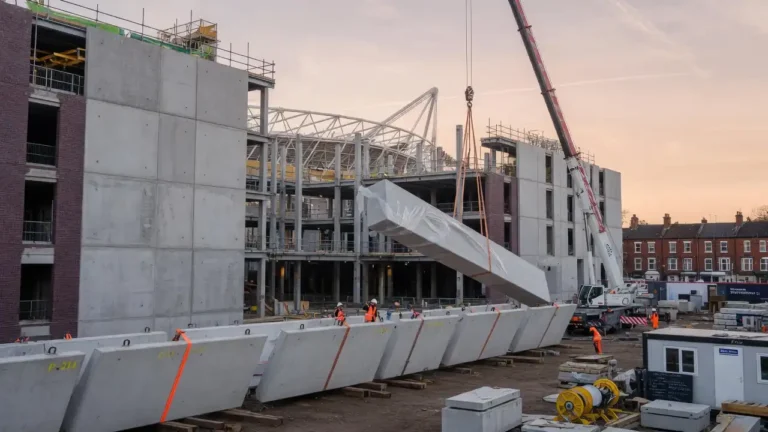
Precast concrete components can reduce on-site structural assembly time by up to 40% compared to cast-in-place methods.
At Midwest Precast Contractor, our precast concrete worktop mix elements arrive fully cured, tested, and ready to set, eliminating cold-weather pour delays that cost Midwest contractors weeks every winter.
Step-by-Step: How We Mix and Cast a Concrete Worktop
Our standard precast production process follows ACI 301 Section 4.2 proportioning guidelines. Here is the sequence our plant crews follow on every pour.
Step 1: Mold Preparation
- Build or source a melamine-coated or foam mold.
- Apply mold release agent evenly.
- Set all knockout forms for sinks, faucet holes, and edge profiles.
Step 2: Face Coat Application (GFRC)
- Apply a 3 to 6mm thick face mix layer of cement, sand, polymer, and water to the mold to achieve a smooth, dense surface finish.
- Allow the face mix to stiffen for 0 to 10 minutes to prevent fiber washout.
Step 3: Backer Mix Batching
- Add all of the sand, some of the water, and one-fourth of the cement and mix. Gradually add the rest of the cement and water.
- Add glass fibers last. Glass fiber is generally not added until after the cementitious portion is mixed thoroughly.
Step 4: Consolidation
- Apply backer mix by hand-pack or spray method.
- Once the backer mix is in place, it is consolidated utilizing a small handheld roller designed for this task.
Step 5: Curing
- With its high cement content and low water-cement ratio of 0.33 to 0.38, GFRC can dry out quickly and not gain full strength. Traditionally, GFRC panels were cured in a moist room for 7 days.
- Acrylic polymer gives the concrete rapid strength gain; GFRC panels and countertops are generally ready for use within 3 days.
Step 6: Grinding, Polishing, and Sealing
- Begin grinding at 50-grit wet diamond pads.
- Progress through 100, 200, 400, 800, and 1500-grit.
- Apply a penetrating silane-siloxane sealer for outdoor applications.
- Apply a topical polyurethane or epoxy sealer for indoor food-contact surfaces.
Sealer and Finishing Specifications
| Sealer Type | Application | Indoor/Outdoor | Reapplication |
|---|---|---|---|
| Penetrating silane-siloxane | Brush or spray | Both | Every 2-3 years |
| Polyurethane (water-based) | Roller or brush | Indoor | Every 3-5 years |
| Epoxy topcoat | Roller | Indoor (commercial) | Every 5-7 years |
| Beeswax/carnauba wax | Buff | Indoor residential | 2-4 times per year |
| UV-resistant polyurea | Spray | Outdoor | Every 3-4 years |
Sealer selection matters as much as the mix itself. An unsealed concrete worktop, regardless of PSI rating, will absorb stains, harbor bacteria, and degrade faster in Midwest humidity swings.
Common Mix Defects and How We Prevent Them
| Defect | Cause | Prevention |
|---|---|---|
| Bug holes / pinholes | Trapped air, high w/c | Vibrate mold, use defoamer |
| Surface cracking | High shrinkage, rapid drying | SRA admixture, moist curing |
| Color variation | Inconsistent water addition | Weigh water, not volume |
| Curling / warping | Unequal shrinkage layers | Match w/c across face and backer |
| Low strength at 28 days | High w/c, inadequate curing | Enforce w/c limits, moist cure 7 days |
| Delamination (GFRC) | Face and backer set too dry | Time backer application correctly |
The best-graded blend of aggregates, Portland cement, and proprietary admixtures ensures no curl, shrink, or deformation in finished precast worktop elements.
Our crews at Midwest Precast Contractor document every batch weight, w/c ratio, and slump reading. No pour leaves our facility without a documented mix record.
Sustainability in 2026: SCMs and Low-Carbon Mix Design
In 2026, commercial mix design is increasingly focused on reducing the environmental footprint without sacrificing performance, utilizing Supplementary Cementitious Materials such as ground granulated blast-furnace slag.
| SCM Type | Portland Cement Replacement | Benefit |
|---|---|---|
| Fly ash (Class C or F) | 15-30% | Reduces heat of hydration, cost |
| GGBFS (slag) | 20-50% | Dense paste, high sulfate resistance |
| Silica fume | 5-10% | High strength, low permeability |
| VCAS (glass pozzolan) | 10-25% | White color, compatible with GFRC |
| Metakaolin | 10-20% | Bright white, reactivity similar to silica fume |
Midwest Precast Contractor is committed to specifying low-embodied-carbon mixes on every project where structural targets allow. We track our SCM usage across all worktop production batches.
Strength Gain Timeline: What to Expect
| Cure Age | Expected Compressive Strength (5,000 PSI target mix) |
|---|---|
| 1 day | 1,500-2,500 PSI |
| 3 days | 3,000-4,000 PSI |
| 7 days | 4,000-4,500 PSI |
| 14 days | 4,500-5,000 PSI |
| 28 days | 5,000+ PSI (design strength) |
| 90 days | 110-120% of 28-day strength |
High-performance admixture-enhanced mixes can achieve 4,000 PSI in 1 day, 6,200 PSI in 3 days, and 8,200 PSI at later ages.
Quick cure time allows for grinding and polishing 24 hours after casting with high-performance pre-blended countertop mixes.
Pros and Cons: Concrete Worktop Mix vs. Alternative Surface Materials
Pros of Concrete Worktop Mix
- Fully custom shapes, edge profiles, and integral sinks
- Compressive strength 5,000-10,500+ PSI outperforms most natural stones
- Integral color options throughout the slab thickness
- Compatible with radiant heat systems
- Repairable and refinishable in the field
- Excellent freeze-thaw resistance when properly specified
Cons of Concrete Worktop Mix
- Requires professional mix design for structural reliability
- Longer lead time than prefabricated stone slabs
- Requires sealing and periodic maintenance
- Heavy (wet-cast) sections require cabinet reinforcement planning
- Mix consistency errors can cause color variation
High-strength concrete at 4,000 PSI or more is suitable for heavy-duty applications, ensuring worktops withstand daily wear and tear.
Frequently Asked Questions
What PSI should a concrete worktop mix reach?
A minimum of 5,000 PSI at 28 days for residential applications. Commercial and outdoor Midwest installations should target 6,000-7,000 PSI.
Can I use standard bagged concrete for a worktop?
No. Standard bagged concrete typically achieves 3,000-3,500 PSI with coarse aggregate that prevents smooth, polishable finishes. Always use a dedicated countertop or worktop mix formulation.
How thick does a concrete worktop need to be?
- Wet-cast traditional: minimum 1.5 inches (38mm)
- GFRC precast: 18-25mm (with proper fiber backing)
Does a concrete worktop need rebar?
- Traditional wet-cast slabs benefit from 1/4-inch or 3/8-inch rebar or welded wire mesh.
- GFRC replaces rebar with AR glass fiber distributed throughout the backer coat.
How does Midwest weather affect a concrete worktop mix?
Outdoor Midwest worktops face freeze-thaw cycling, road salt splash, and wide temperature swings. Our specs mandate w/c below 0.40, 5-6% air entrainment, and penetrating sealer reapplication every 2-3 years.
Can Midwest Precast Contractor produce custom worktop profiles?
Yes. We provide a comprehensive range of construction services including precast concrete solutions, custom deck construction, structural framing, formwork and concrete systems, outdoor living spaces, and full renovation and remodeling services. Custom worktop profiles, edge treatments, and integral sink cutouts are standard capability.
How Prefabricated Construction Materials Help Reduce Building Costs
Why Midwest Precast Contractor for Your Worktop Project?
At Midwest Precast Contractor, our mission is to deliver high-quality precast concrete solutions that combine strength, precision, and innovation.
At Midwest Precast Contractor, we have been delivering top-tier precast concrete solutions since 1975, meeting or exceeding industry standards.
Every concrete worktop mix we produce is backed by:
- Documented mix design records per ACI 301 requirements
- 28-day compressive strength testing on every production batch
- Midwest-specific freeze-thaw specifications built into every exterior pour
- On-time delivery with fully cured, installation-ready elements
- Factory-controlled curing conditions eliminating weather-dependent delays
- Full support from mix design through installation and sealing
Midwest Precast Contractor provides professional precast concrete and construction services for residential and commercial projects, including precast concrete solutions, formwork and concrete systems, structural framing, custom deck construction, outdoor living spaces, and renovation and remodeling.
When your project requires a concrete worktop mix that performs through a Milwaukee February and still looks polished five years later, that is the standard we engineer to every single time.